


In the complex landscape of Enterprise Architecture, the ability to communicate design intent clearly is just as critical as the design itself. As an Architect Lead, you are tasked with bridging the gap between business strategy and technical implementation. One of the most effective tools in your arsenal for achieving this alignment is the strategic use of ArchiMate Viewpoints. These specialized perspectives allow you to slice through the complexity of the enterprise model, presenting relevant information to specific stakeholders without overwhelming them with unnecessary detail.
This guide explores the nuances of comparing ArchiMate Viewpoints. It provides a deep dive into how to select, define, and utilize these viewpoints to enhance architectural governance. Whether you are refining an existing model or establishing a new framework, understanding the distinctions between different viewpoint types is essential for maintaining coherence and clarity across the enterprise.
Defining the Architecture Viewpoint 📐
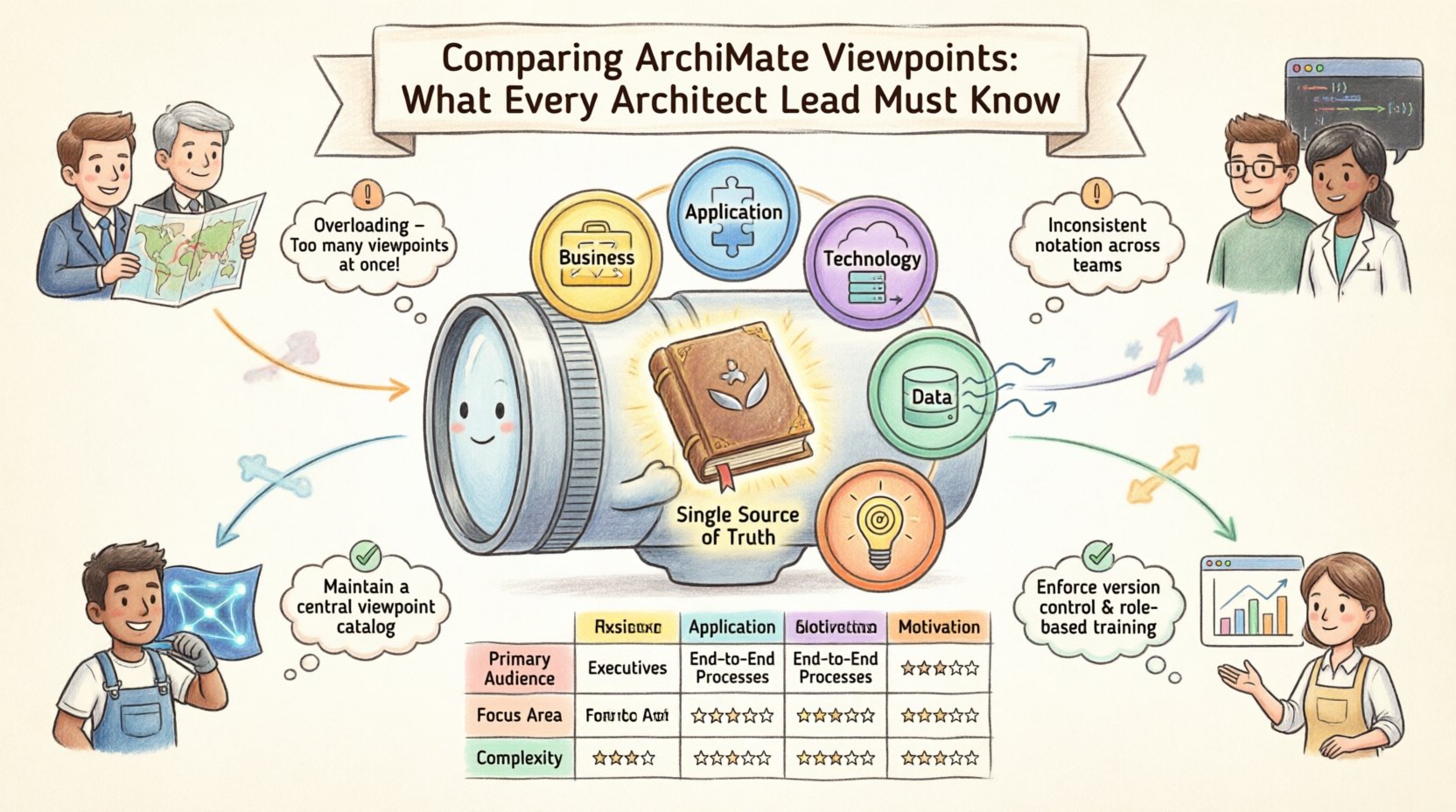
An ArchiMate Viewpoint is defined as a specification of a model or view from a particular perspective. It dictates which parts of the architecture model are visible and how they are presented. Think of it as a camera lens; the camera (the architecture model) captures the entire scene, but the lens (the viewpoint) determines what comes into focus for the viewer.
Without distinct viewpoints, an architecture model becomes a monolithic artifact that is difficult to navigate. A developer needs to see application interfaces, while a CIO needs to see business capabilities and strategic drivers. Both require the same underlying data but require different representations to be effective. Viewpoints formalize this distinction.
Key Characteristics of a Viewpoint
- Stakeholder Orientation: Each viewpoint is tailored to a specific group of stakeholders with shared concerns.
- Language Specification: It defines which ArchiMate concepts (Business, Application, Technology, etc.) are relevant.
- Notation Rules: It sets the rules for how elements are connected and displayed to ensure clarity.
- Model Scope: It determines the depth and breadth of the information included in the view.
The Strategic Value for Architect Leads 💼
Why should an Architect Lead invest time in rigorously comparing and selecting viewpoints? The answer lies in efficiency and governance. A well-defined set of viewpoints reduces ambiguity and accelerates decision-making processes.
1. Enhanced Communication
When stakeholders receive information that is relevant to their specific role, they are more likely to engage with the architecture. This leads to faster feedback loops and fewer misunderstandings regarding technical constraints or business requirements.
2. Improved Governance
By standardizing viewpoints, you create a consistent language across the organization. This consistency allows for better comparison of projects and initiatives, ensuring that all architectural decisions align with the overarching enterprise strategy.
3. Reduced Cognitive Load
Architecture models can become incredibly dense. Viewpoints act as filters, removing noise and highlighting signal. This reduces the cognitive load on stakeholders, allowing them to focus on the decisions they need to make without getting lost in the minutiae of unrelated components.
Core Viewpoint Categories Explained 📊
The ArchiMate standard provides a foundation for various viewpoint categories. Understanding the specific purpose of each category is the first step in effective comparison. Below, we break down the primary domains used in most enterprise architectures.
Business Viewpoints
These focus on the organization’s capabilities, processes, and roles. They are essential for linking strategic goals to operational execution. Key elements often include:
- Business Services
- Business Processes
- Business Roles
- Business Objects
Application Viewpoints
These describe the software systems and their interactions. They are critical for IT teams responsible for maintenance, integration, and development. Key elements often include:
- Application Services
- Application Components
- Application Interfaces
- Application Function
Technology Viewpoints
These cover the infrastructure and hardware that support the applications. They are used by infrastructure teams and cloud architects. Key elements often include:
- Node
- Device
- Network
- System Software
Data Viewpoints
These focus on the information structures and data objects. They are vital for data governance and analytics teams. Key elements often include:
- Data Object
- Data Structure
- Data Store
Motivation Viewpoints
These capture the drivers, goals, and principles behind the architecture. They provide the “why” behind the “what”. Key elements often include:
- Goal
- Requirement
- Principle
- Assessment
Viewpoint Comparison Matrix 📋
To assist in selecting the appropriate viewpoint, consider the following comparison matrix. This table highlights the primary audience, focus area, and typical complexity for each category.
| Viewpoint Category | Primary Audience | Focus Area | Typical Complexity |
|---|---|---|---|
| Business | Business Executives, Process Owners | Capabilities, Processes, Value Streams | Low to Medium |
| Application | IT Managers, Developers | Systems, Services, Integration Points | Medium |
| Technology | Infrastructure Architects, Ops | Hardware, Networks, Cloud Nodes | Medium to High |
| Data | Data Stewards, Analysts | Information Flow, Storage, Entities | Medium |
| Motivation | Strategy Teams, Governance Boards | Goals, Drivers, Principles | Low |
| Cross-Domain | Enterprise Architects | End-to-End Traceability | High |
Audience Analysis in Viewpoint Selection 👥
Creating a viewpoint is not a one-size-fits-all exercise. The first step in comparison is understanding who will consume the view. An Architect Lead must map stakeholders to specific viewpoints based on their information needs.
Identifying Stakeholder Needs
- Strategic Leaders: Need high-level motivation and business capability maps. They require a macro view to assess alignment with corporate goals.
- Project Managers: Need to understand the impact of changes on specific services and processes. They require a mid-level view that links business to application.
- Technical Teams: Need detailed interface definitions and deployment specifications. They require a micro view focused on application and technology layers.
- Compliance Officers: Need to see risk controls and regulatory adherence. They require a motivation and business process view.
Matching Viewpoints to Needs
Once needs are identified, match them to the appropriate ArchiMate layers. Avoid showing technology details to business stakeholders, and do not burden technical teams with high-level strategic goals unless context is required. This alignment ensures that the viewpoint remains relevant and actionable.
Common Challenges in Viewpoint Modeling ⚠️
Even with a clear strategy, defining viewpoints can present difficulties. Recognizing these common pitfalls helps you avoid them during the design process.
1. Overloading the View
A frequent mistake is including too many layers in a single view. If a business stakeholder sees technology nodes, the diagram becomes confusing. Maintain strict separation between layers unless the specific purpose is to show cross-domain interactions.
2. Inconsistent Notation
Using different shapes or colors for the same concept across different views creates confusion. Establish a notation standard early and adhere to it rigorously. Consistency builds trust in the model.
3. Lack of Traceability
If a viewpoint shows a process but does not link it to the application supporting it, the value of the model diminishes. Ensure that critical links are maintained across viewpoints to allow for traceability from requirement to implementation.
4. Ignoring the Motivation Layer
Many models skip the motivation layer, leaving stakeholders wondering why a change is proposed. Always include the drivers behind the architecture to ensure buy-in and understanding.
Ensuring Consistency and Traceability 🔗
When comparing viewpoints, the underlying model must remain consistent. If the Business Process changes in one view, it must reflect in the Application view. This synchronization is crucial for maintaining the integrity of the architecture.
Single Source of Truth
All viewpoints should derive from a single central model repository. This ensures that updates are propagated automatically. Managing multiple disconnected models leads to data drift and outdated information.
Link Management
Use links to connect elements across views. When an Architect Lead reviews a specific viewpoint, they should be able to click through to the supporting details in another view. This interconnectivity allows for deep dives without cluttering the primary view.
Best Practices for Viewpoint Governance 🛡️
To maintain quality, implement governance practices around how viewpoints are created and managed. This ensures long-term sustainability of the architecture framework.
1. Establish a Viewpoint Catalog
Document every approved viewpoint in a central catalog. Include details such as the intended audience, the scope, and the version history. This catalog acts as a reference for anyone creating new views.
2. Regular Reviews
Schedule periodic reviews of existing viewpoints. As the enterprise evolves, some viewpoints may become obsolete while others gain importance. Prune the catalog to keep it lean and relevant.
3. Version Control
Apply version control to your viewpoint definitions. If a notation changes, record the change. This history helps in auditing decisions and understanding the evolution of the architecture.
4. Training and Adoption
Ensure that the teams using the architecture understand how to read the viewpoints. Provide training on the notation and the specific conventions used in your organization. Adoption is key to value realization.
Integrating Viewpoints into Delivery Workflows 🔄
Viewpoints should not exist in isolation. They must be integrated into the daily workflows of the enterprise. This integration ensures that the architecture is used actively rather than sitting on a shelf.
1. Design Reviews
Use specific viewpoints during design review sessions. Present the relevant view to the reviewers to gather feedback. This keeps the discussion focused on the architecture rather than general project management.
2. Change Management
When a change request comes in, use the viewpoints to assess impact. Trace the change through the business, application, and technology layers to identify risks.
3. Reporting
Generate standard reports from your viewpoints. Dashboards for executives can be built from business viewpoint data, while technical dashboards can be built from application data.
Summary of Architectural Discipline 📝
Comparing ArchiMate Viewpoints is not merely an exercise in diagramming; it is a strategic discipline that enhances the value of Enterprise Architecture. By selecting the right perspective for the right audience, Architect Leads can drive clarity, reduce complexity, and improve decision-making across the organization.
Key takeaways for implementation include:
- Understand the Audience: Tailor every viewpoint to the specific concerns of the stakeholders.
- Maintain Consistency: Ensure that underlying data remains synchronized across all views.
- Focus on Traceability: Link motivation to execution to provide context for all architectural decisions.
- Govern the Catalog: Manage viewpoints as assets that evolve with the enterprise.
- Integrate into Workflow: Embed viewpoints into daily processes to ensure active usage.
By adhering to these principles, you ensure that your architecture remains a living, breathing asset that supports the enterprise in achieving its goals. The effort invested in defining robust viewpoints pays dividends in communication efficiency and architectural integrity.

 English
 Arabic
 Chinese (Simplified)
 Dutch
Dutch French
 German
 Italian
 Japanese
 Korean
 Portuguese
 Russian
 Spanish