The Daily Scrum is one of the most important events for monitoring the heartbeat of a Scrum project, and also a key “habit” for the team. The Daily Stand-up is one of the most valuable practices a Scrum Team can adopt. The purpose of the Daily Scrum is to increase team communication and focus by answering three key questions:
- What did I accomplish since the last meeting?
- What will I work on before the next meeting?
- What obstacles are blocking my progress?
When a team does not hold the Daily Scrum, communication, focus, and team motivation can diminish, making it harder to deliver the right product on time and with the right quality. Often, teams come up with various excuses to avoid the Daily Stand-up. However, the Daily Scrum helps teams succeed because it is the smallest feedback loop embedded in the Sprint, much like exercising for 5 minutes a day. In the long run, it’s a powerful daily habit that pays off.
What is the Daily Scrum?
The Daily Stand-up (also known as “Stand-up,” “Morning Huddle,” or “Daily Scrum”) is typically time-boxed to 5–15 minutes and happens with participants standing — a reminder to keep the meeting short. The meeting should occur at the same time every working day. All team members are encouraged to attend, but the meeting should not be delayed if someone is absent. A key feature is that it’s a communication opportunity among team members, not a status update for the Product Owner or stakeholders.
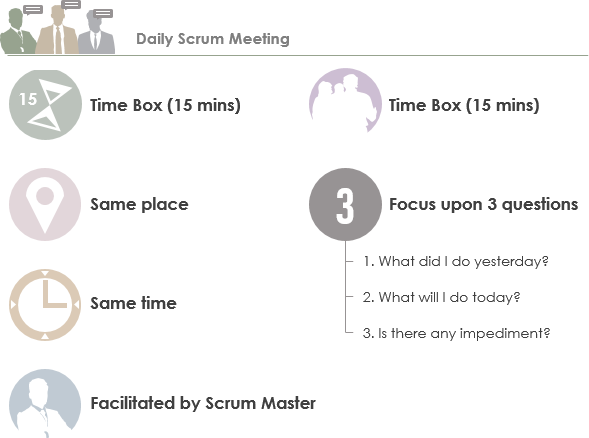
Daily Scrum Meeting Template
As a Scrum Master, this template is very useful for running the meeting. Below is a simple, effective template.
Objective
- Everyone knows what’s happening, blockers are clear, documented, and new backlog items are created.
Format
- Participants:
- Scrum Master
- Team Members
- Optional: Product Owner, other stakeholders
- Scrum task board must be visible to everyone
- Stand-up means everyone stands up!
- Duration: 15 minutes max
Agenda
- Stay focused on the 3 questions within 15 minutes:
- What did I do since the last Scrum meeting (yesterday)?
- What will I do before the next Scrum meeting (tomorrow)?
- What obstacles are blocking my progress?
- Do not resolve issues during the Daily Scrum — discuss them after the meeting.
- If someone is absent, another team member can represent them.
- Add identified blockers to the backlog for follow-up.
Additional Tips
- Stay within timebox — if a discussion runs long, schedule it for after the Daily Scrum or hold a separate meeting.
- Team does not report to the Scrum Master — it’s a discussion, not a report.
- Team members talk to each other, not to the Product Owner or Scrum Master.
- What if someone is late? Tip: Place a coin in a donation jar — proceeds go toward team refreshments.
- Team members don’t update tasks, burn-down charts, or anything else — the Scrum Master doesn’t track this.

 English
 Arabic
 Chinese (Simplified)
 Dutch
Dutch French
 German
 Italian
 Japanese
 Korean
 Portuguese
 Russian
 Spanish