


The Internet of Things (IoT) landscape is shifting rapidly. From simple sensor networks to complex, autonomous edge ecosystems, the underlying architecture demands precision. At the heart of this precision lies the Unified Modeling Language (UML), specifically State Machine Diagrams. These diagrams have traditionally served as static blueprints for software logic. However, as IoT systems grow in scale and heterogeneity, the role of state modeling is expanding. This guide explores the technical evolution of state machine diagrams within modern IoT frameworks, focusing on scalability, distributed logic, and real-time responsiveness.
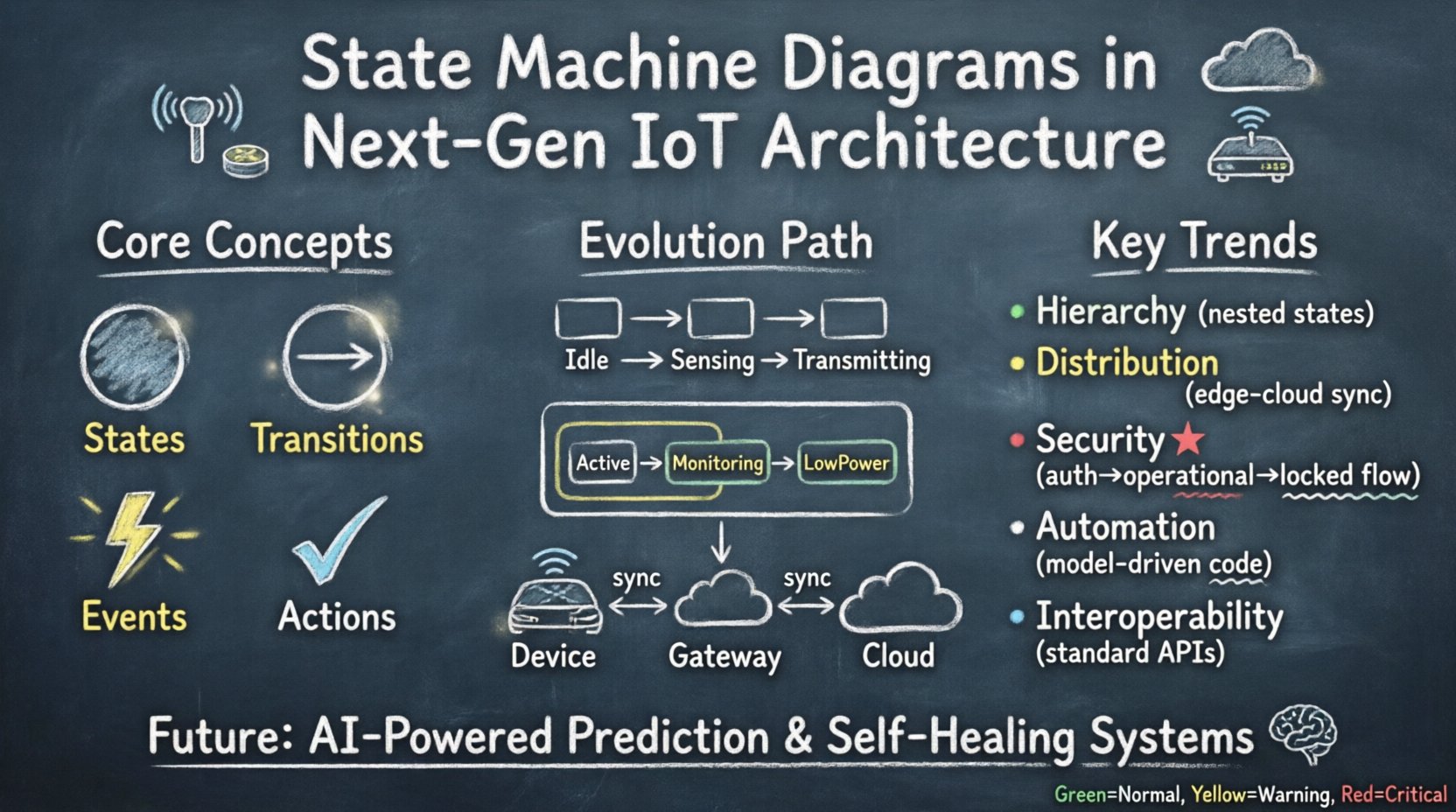
1. The Foundation: State Machines in Constrained Environments ⚙️
State Machine Diagrams provide a visual representation of the behavior of a system. They define distinct states, the transitions between them, and the events that trigger those transitions. In the context of IoT, this is not merely about software logic; it is about hardware interaction, network availability, and power consumption.
- States: Represent a condition during which a system satisfies some condition, performs some activity, or waits for some event.
- Transitions: The mechanism by which a system moves from one state to another.
- Events: Signals that trigger a transition.
- Actions: Activities performed upon entering or exiting a state.
In early IoT implementations, these models were often flat. A device might have a few states: Idle, Sensing, Transmitting, and Error. While sufficient for basic telemetry, modern architectures require far more granular control. The evolution involves moving from flat models to hierarchical structures that can handle nested logic without exploding in complexity.
2. Challenges in Traditional Modeling 🛑
As IoT architectures mature, traditional UML state diagrams face several hurdles. The rigid nature of early modeling standards often clashes with the dynamic nature of edge computing.
2.1 Scalability Issues
When a single device model expands to thousands of connected nodes, a flat state diagram becomes unwieldy. Managing transitions for every possible combination of sensor inputs and network conditions manually leads to spaghetti logic. The diagram becomes difficult to read, maintain, and debug.
2.2 Latency and Real-Time Demands
IoT often requires sub-second response times. Traditional state modeling tools often assume a synchronous execution model. In distributed IoT, events occur asynchronously. A state transition triggered by a local sensor might conflict with a command received from the cloud milliseconds later. The diagram must account for race conditions and priority queues.
2.3 Resource Constraints
Embedded devices operate with limited memory and processing power. The state machine logic itself must be lightweight. A complex diagram might require a heavy runtime interpreter. The evolution here involves optimizing the state representation to minimize overhead while maintaining clarity.
3. The Shift to Hierarchical State Machines (HSM) 🏗️
To address scalability, the industry is moving towards Hierarchical State Machines. This approach allows states to contain other states. This nesting capability is crucial for managing complex behaviors without cluttering the main diagram.
3.1 Deep Nesting for Modularity
Consider a smart agricultural sensor. It has a top-level state of Active. Within Active, it can be in Monitoring or Calibrating. Within Monitoring, it can be LowPower or HighFrequency. HSM allows these sub-states to share common transition logic.
- Shared Transitions: If the device needs to enter Calibrating from any sub-state of Monitoring, HSM handles this cleanly without repeating transition definitions.
- State Inheritance: Sub-states can inherit entry and exit behaviors from parent states, reducing code duplication.
- Scope Management: Events can be scoped to specific levels of the hierarchy, ensuring that a local event doesn’t trigger a global state change unless intended.
3.2 Visual Clarity
By grouping related behaviors, HSM keeps the high-level architecture visible. Engineers can view the system at a macro level or drill down into specific device behaviors. This modularity supports collaborative development where different teams manage different layers of the hierarchy.
4. Distributed State Synchronization 🔗
Next-generation IoT is rarely isolated. Devices communicate with gateways, clouds, and peer devices. This introduces the challenge of distributed state. A local state machine might think it is Online, while the central registry knows it is Offline.
4.1 State Consistency Models
Maintaining consistency across distributed nodes requires specific modeling strategies. State machine diagrams in this context must explicitly model the synchronization process.
- Eventual Consistency: The diagram acknowledges that state updates may lag. Transitions to critical states are deferred until confirmation is received.
- Conflict Resolution: If two nodes propose conflicting state changes, the diagram defines the priority logic (e.g., local override vs. cloud command).
- Heartbeat States: A dedicated state for maintaining connectivity status, triggering reconnection logic if the heartbeat interval is exceeded.
4.2 The Role of the Edge Gateway
The gateway often acts as a state coordinator. It aggregates state from multiple end devices and presents a unified view to the cloud. State diagrams for gateways must handle the aggregation logic, buffering, and forwarding of state changes.
| Feature | Traditional IoT State Model | Next-Gen Distributed Model |
|---|---|---|
| Scope | Single Device | Device + Gateway + Cloud |
| Consistency | Local Only | Eventual or Strong Consistency |
| Transitions | Trigger-Driven | Trigger + Time + Network |
| Complexity | Flat | Hierarchical + Nested |
| Failure Mode | Reset | Fallback + Retry + Sync |
5. Integration with Event-Driven Architecture (EDA) 📡
Modern IoT systems rely heavily on Event-Driven Architecture. State machines are the perfect complement to EDA. While EDA handles the flow of messages, state machines manage the context of those messages.
5.1 Decoupling Logic
In an EDA system, components communicate via events. A state machine listens for these events and transitions accordingly. This decoupling allows the system to evolve. New event types can be added without rewriting the core logic, provided the state machine handles them.
5.2 Asynchronous Processing
State transitions do not always happen immediately. A transition might be scheduled for later based on a timer event. This is vital for IoT devices that need to conserve battery. The state machine can enter a Sleep state and only wake up on a specific timer event, rather than polling the network.
- Timer Events: Crucial for periodic data transmission and battery management.
- Message Events: Triggered by incoming payloads from MQTT brokers or HTTP requests.
- Internal Events: Logic changes that occur within the device without external communication.
6. Security Implications of State Modeling 🔒
Security is not an afterthought; it is a state. A compromised device can pose a risk to the entire network. State diagrams must explicitly model security states to ensure safe operation.
6.1 Authentication States
Before a device enters an Operational state, it must pass through an Authenticating state. If authentication fails, the state machine transitions to a Locked state. This prevents unauthorized access even if the network is open.
6.2 Secure Boot and Firmware Updates
State diagrams govern the firmware update process. A device cannot simply overwrite its own code. It must transition through a series of verified states:
- Download: The new firmware image is received and stored.
- Verify: Cryptographic signatures are checked.
- Commit: The state is flipped to the new version.
- Rollback: If the new version fails a health check, the state reverts to the previous version.
6.3 Anomaly Detection
State machines can monitor for anomalous behavior. If a device exhibits behavior outside its defined state transitions (e.g., sending data from an Idle state unexpectedly), it can trigger an Anomaly state. This state can isolate the device or alert administrators.
7. Visualizing Complexity for Teams 🎨
As models grow more complex, visualization becomes a critical tool for engineering teams. The goal is to reduce cognitive load while preserving technical accuracy.
7.1 Color Coding and Annotations
Different types of states can be color-coded. For example:
- Green: Normal operational states.
- Yellow: Warning or degraded performance states.
- Red: Critical failure or security lockout states.
7.2 Version Control for Models
Just as code is version controlled, state diagrams should be treated as versioned artifacts. Changes to the state logic should be tracked, allowing teams to revert to previous configurations if a deployment causes instability.
7.3 Model-Driven Development (MDD)
The evolution points towards Model-Driven Development. Instead of writing code to implement the state machine, the diagram is the source of truth. Tools generate the code from the model. This ensures that the implementation matches the design, reducing bugs caused by manual coding errors.
8. Predictive Maintenance and State Prediction 🔮
One of the most exciting frontiers is using state machine logic to predict future states. By analyzing the sequence of states a device has traversed, the system can anticipate failures.
- Pattern Recognition: If a device frequently transitions from Heating to Overheat to Shutdown, the model can flag this sequence as a precursor to hardware failure.
- Pre-emptive Action: The state machine can transition to a Maintenance state before the failure occurs, scheduling a repair or alerting the user.
- Optimization: The system can learn which state paths consume the least power and optimize future transitions accordingly.
9. Standardization and Interoperability 🌍
For state machines to be truly effective in next-gen IoT, they must be interoperable. Different vendors and platforms need to understand the same state definitions.
9.1 Common Schema Definitions
Industry bodies are working towards common schemas for state definitions. This allows a device from Vendor A to be managed by a platform from Vendor B without custom adapters.
9.2 API Standards
State transitions should be exposed via standardized APIs. When a state changes, the system publishes the new state in a standard format (e.g., JSON). This allows monitoring tools to aggregate data across heterogeneous systems.
10. The Human Factor: Usability for Developers 👨💻
Technical evolution is useless if developers cannot use it. The tools supporting these diagrams must be intuitive.
- Drag-and-Drop Interfaces: Allowing engineers to build models visually.
- Simulation: The ability to run the state diagram in a sandbox environment to test logic before deployment.
- Debugging: Real-time visualization of the current state as the device runs, highlighting where the logic is actually executing.
Summary of Key Evolutionary Trends 📊
The trajectory of State Machine Diagrams in IoT is clear. We are moving away from isolated, static models towards dynamic, distributed, and hierarchical systems.
- Hierarchy: Nested states for modularity and scalability.
- Distribution: Synchronization across edge, gateway, and cloud.
- Security: Built-in state verification and authentication flows.
- Automation: Model-driven code generation and predictive analysis.
- Interoperability: Standardized definitions for cross-platform compatibility.
As IoT devices become more intelligent and interconnected, the state machine remains the backbone of logical consistency. It provides the structure needed to manage complexity without sacrificing performance. By adopting these evolved modeling practices, architects can build systems that are robust, secure, and ready for the demands of the future.
Looking Ahead: The Next Decade 🔭
What lies ahead for state modeling? We anticipate deeper integration with AI. State machines might not just react to events but predict the optimal next state based on historical data. They might become self-healing, automatically reconfiguring their transition logic when anomalies are detected.
The evolution is not just about the diagram itself, but how it interacts with the broader ecosystem. As the boundary between physical and digital worlds blurs, the state machine will serve as the translator, ensuring that the logic of the software aligns perfectly with the reality of the hardware.
For engineers and architects, staying current with these trends is essential. The tools of today are the standards of tomorrow. By prioritizing hierarchical design, distributed synchronization, and security-first modeling, the industry can continue to push the boundaries of what connected systems can achieve.

 English
 Arabic
 Chinese (Simplified)
 Dutch
Dutch French
 German
 Italian
 Japanese
 Korean
 Portuguese
 Russian
 Spanish