


Embedded systems in the Internet of Things operate under strict limitations. Every byte of memory and milliwatt of power counts. Designing reliable logic for these devices requires more than just writing functional code. It demands a structured approach to behavior modeling. The Unified Modeling Language (UML) state machine diagram provides a rigorous framework for this. However, translating a theoretical diagram into an efficient runtime implementation is a complex challenge. This guide explores how to optimize state machine logic specifically for environments where resources are scarce.
When working with microcontrollers, memory is finite. Flash storage holds the code, while RAM holds the current state. If your state machine consumes too much memory or executes transitions inefficiently, the device may crash or drain its battery prematurely. We will examine the architectural decisions that impact performance, focusing on memory footprint, execution speed, and power management without relying on specific tooling or commercial products.
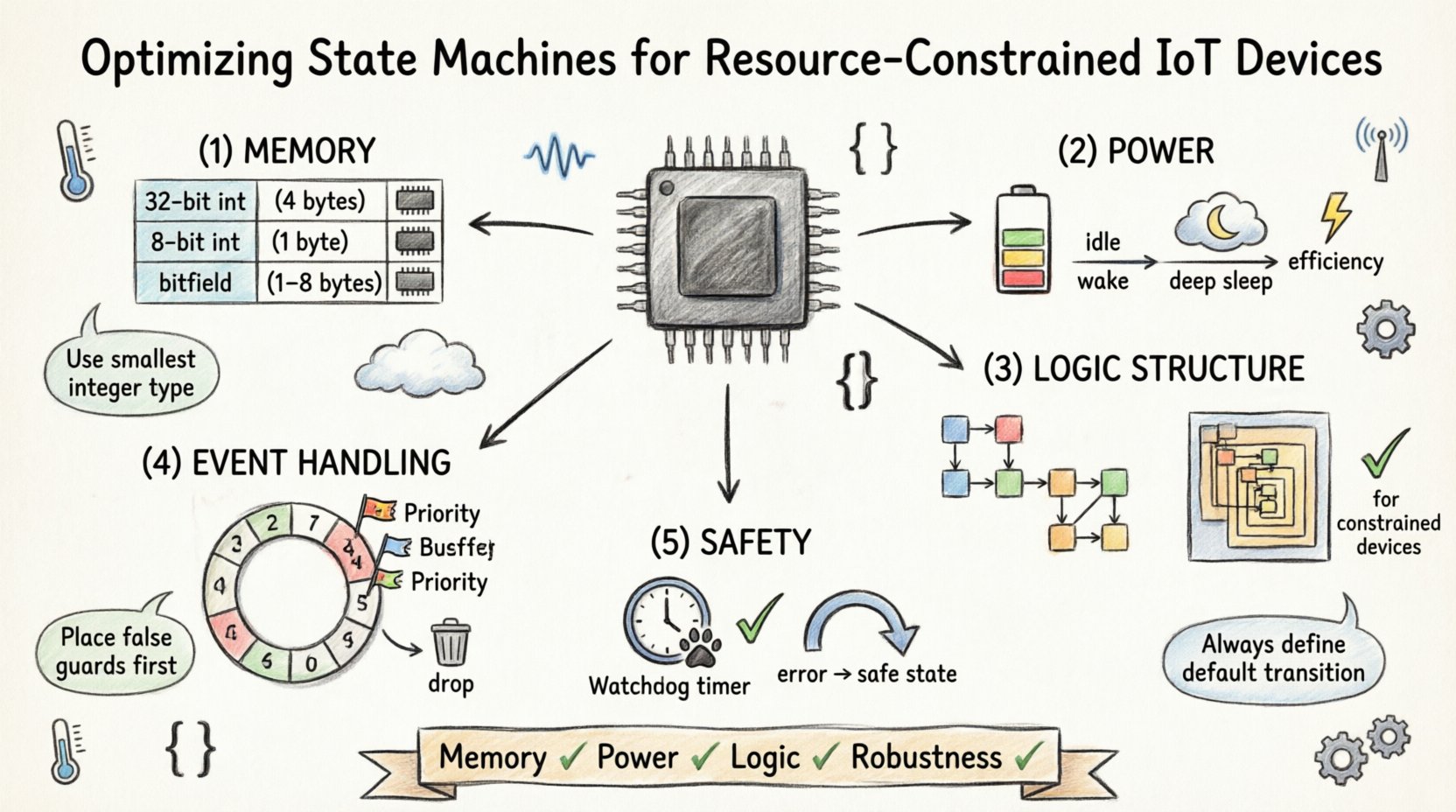
📊 Understanding State Machines in IoT Contexts
A state machine is a model of behavior consisting of a finite number of states, transitions between those states, and actions. In the context of embedded devices, this model maps directly to the operational flow of the hardware. Instead of a monolithic script that checks conditions repeatedly, a state machine isolates logic into discrete blocks. Each block runs only when the device is in that specific state.
Why this matters for constrained devices:
- Reduced Complexity: Isolating logic makes debugging easier. If a sensor fails, you know which state handles sensor reading.
- Predictable Memory Usage: Variables can be scoped to specific states, allowing for better memory management.
- Event-Driven Efficiency: The device can sleep between events rather than polling continuously.
However, the theoretical model often expands during implementation. A simple diagram can become a massive switch-case statement if not planned correctly. The goal is to maintain the clarity of the diagram while minimizing the code size required to execute it.
💾 Memory Constraints & State Storage
Memory is the most critical resource in embedded IoT. You often have kilobytes of RAM and megabytes of flash. How you store the current state determines how much space you consume. The implementation of the state machine variable itself is the first optimization point.
Enum vs. Integer vs. Bitfield
Developers often default to using an integer to represent states. While flexible, this wastes space. If you have 8 states, a standard 32-bit integer uses 4 bytes. An enumeration might map to a smaller type, but compilers still allocate based on architecture defaults.
The most space-efficient method is the bitfield. If you have fewer than 64 states, you can store the entire state machine state in a single 64-bit integer. If you have fewer than 32, a 32-bit integer suffices. Even better, if you only need 8 states, a single byte (8 bits) is enough.
| Storage Type | Typical Size (Bytes) | Max States | Best Use Case |
|---|---|---|---|
| 32-bit Integer | 4 | 4,294,967,295 | Complex systems, many states |
| 8-bit Integer | 1 | 256 | Simple sensors, basic logic |
| Bitfield | 1 to 8 | Depends on bits | Flag-based states, multiple conditions |
| Pointer/Reference | 2 to 8 | N/A | Dynamic state tables (High Risk) |
When optimizing for memory, avoid using pointers to state objects unless absolutely necessary. Pointers add overhead to the stack and heap. Static allocation is preferred. Define your state variable at the global or file scope to reserve the exact bytes needed, avoiding dynamic allocation during runtime.
State Variable Persistence
Many IoT devices reboot frequently. You must decide if the state should persist across reboots. Storing the state in non-volatile memory (EEPROM or Flash) consumes write cycles. If you write the state to flash on every transition, you will wear out the memory quickly.
Optimization Strategy:
- Only write to non-volatile memory on specific events, such as a complete cycle or critical failure.
- Use a “dirty flag” to track if the state has changed since the last write.
- Consider storing only the root state, not deep hierarchy levels, if the hierarchy is shallow.
⚡ Power Consumption & Transition Logic
Battery life is a primary concern for IoT. A state machine that keeps the CPU awake unnecessarily will drain the battery. The logic within the transitions dictates how often the processor wakes up and how long it stays active.
Idle States and Sleep Modes
Every state machine should have an idle or low-power state. When no events are pending, the device should enter a deep sleep mode. The state machine handles the wake-up event. This means the transition logic must be minimal when waking up.
Avoid complex calculations in the entry action of a state that is frequently entered. Perform heavy computations in a separate process or defer them until the device is in an active state with sufficient power margin.
Transition Guards and Efficiency
Guards are conditions evaluated during a transition. If a guard is false, the transition does not occur. Evaluating guards consumes CPU cycles. In a tight loop, excessive guards can become a bottleneck.
Best Practices:
- Place the most likely false conditions first. If the guard fails, the CPU can skip the rest of the logic immediately.
- Combine related guards. Instead of checking five variables in five different states, check them in a single pre-processing step.
- Use hardware flags where possible. Let an interrupt set a flag, and have the state machine check that flag instead of reading the hardware register directly.
🛠 UML Specifics for Optimization
UML statecharts offer advanced features like hierarchical states and history. These features are powerful but come with a cost. Implementing a hierarchical state machine requires a stack or recursion to manage parent and child contexts. This adds complexity and memory usage.
Flat vs. Hierarchical
For resource-constrained devices, a flat state machine is often preferable. If you have 10 distinct states, implement them as 10 distinct blocks. Do not group them into a superstate unless the logic is identical across all sub-states.
When to use Hierarchy:
- Only if multiple states share the exact same entry/exit actions.
- Only if the hierarchy reduces the number of transitions significantly.
History States
History states allow the machine to return to a previous state without explicit tracking. While convenient in design, implementing them requires saving the previous state ID. This adds a variable to your state storage. If you are tight on memory, calculate the previous state dynamically or skip history features entirely.
🔄 Concurrency and Event Handling
IoT devices often handle multiple inputs simultaneously. A temperature sensor, a network connection, and a user button might trigger events at the same time. How the state machine processes these events determines system stability.
Event Queues
A simple state machine processes events one by one. If events arrive faster than they can be processed, they are lost or the CPU stalls. A queue buffer solves this. However, a queue consumes RAM.
Optimization:
- Use a fixed-size circular buffer for the event queue.
- Drop low-priority events if the queue is full. Do not block the interrupt handler waiting for space.
- Keep the queue size small. If you need to handle 100 events, consider if all of them are necessary in the same cycle.
🐛 Common Pitfalls & Debugging
Even with optimization, errors occur. Debugging a state machine in an embedded environment is difficult because you cannot easily attach a debugger to every microsecond of execution.
Deadlocks and Invalid States
A deadlock occurs when the machine is in a state with no valid transitions. This freezes the device. To prevent this:
- Always define a default transition for every state. This acts as a catch-all.
- Implement a watchdog timer. If the state machine does not update the watchdog within a set time, reset the system.
State Corruption
RAM corruption can change the state variable to an invalid value. If your state variable becomes 999 (when max is 10), the switch-case statement might jump to an undefined behavior.
Defense:
- Add a validation check at the start of every event loop.
- If the state is invalid, force a transition to a known “Safe” or “Error” state.
- Use static analysis tools to verify all possible state paths.
📝 Summary of Key Points
Optimizing state machine diagrams for IoT requires a shift in mindset from design to implementation efficiency. The goal is not just to model the logic correctly, but to ensure the model fits within the hardware limits.
- Memory: Use the smallest integer type possible for state storage. Avoid dynamic allocation.
- Power: Utilize idle states to trigger deep sleep. Minimize CPU wake-up time.
- Logic: Simplify hierarchical structures. Prefer flat states for small systems.
- Robustness: Always have a default transition and a watchdog mechanism.
By carefully managing these factors, you can build IoT devices that are reliable, efficient, and long-lasting. The state machine is the brain of the embedded system. Treat it with the same care as the hardware itself.
🔍 Advanced Optimization Techniques
For systems with extremely tight constraints, standard optimization is not enough. You must look into code-level optimizations that affect the state machine directly.
Lookup Tables
Instead of using a switch-case statement or a series of if-else statements to determine the next state, use a lookup table. A lookup table is an array where the index is the current state and the input event, and the value is the next state.
Pros:
- Constant time complexity O(1).
- Very small code size (no branching logic).
Cons:
- Requires more memory for the table if there are many states.
- Harder to maintain if logic changes frequently.
Bitmasking
If your states are independent flags rather than mutually exclusive states, use a bitmask. This allows multiple “states” to exist simultaneously. For example, a device could be in “Connected” and “Updating” states at the same time.
This approach reduces the number of variables needed but requires careful bitwise logic to ensure flags do not conflict.
🔗 Final Thoughts on Implementation
The transition from a UML diagram to production code is where most failures happen. A beautiful diagram does not guarantee a working system. The implementation must respect the physical limitations of the silicon.
Focus on the lifecycle of the state. Define clearly what happens when entering, exiting, and transitioning. These three actions are the core of the state machine. Keep them lightweight. Do not perform network calls or heavy file I/O during an entry action unless the state is specifically designed for that task.
Remember that optimization is an iterative process. Measure your memory usage and power consumption early. If the state machine is too large, refactor the hierarchy. If the power draw is high, review the transitions. Continuous profiling ensures the logic remains efficient as the product evolves.
By adhering to these principles, you ensure that your IoT devices remain responsive and reliable, even in the most demanding environments.

 English
 Arabic
 Chinese (Simplified)
 Dutch
Dutch French
 German
 Italian
 Japanese
 Korean
 Portuguese
 Russian
 Spanish