


The Scrum framework includes the Scrum Team, its associated Roles, Events, Artifacts, and Rules. Each component in the framework serves a specific purpose and is crucial to the success and adoption of Scrum. Scrum rules bind roles, events, and artifacts together, governing their relationships and interactions, as shown in the diagram below:
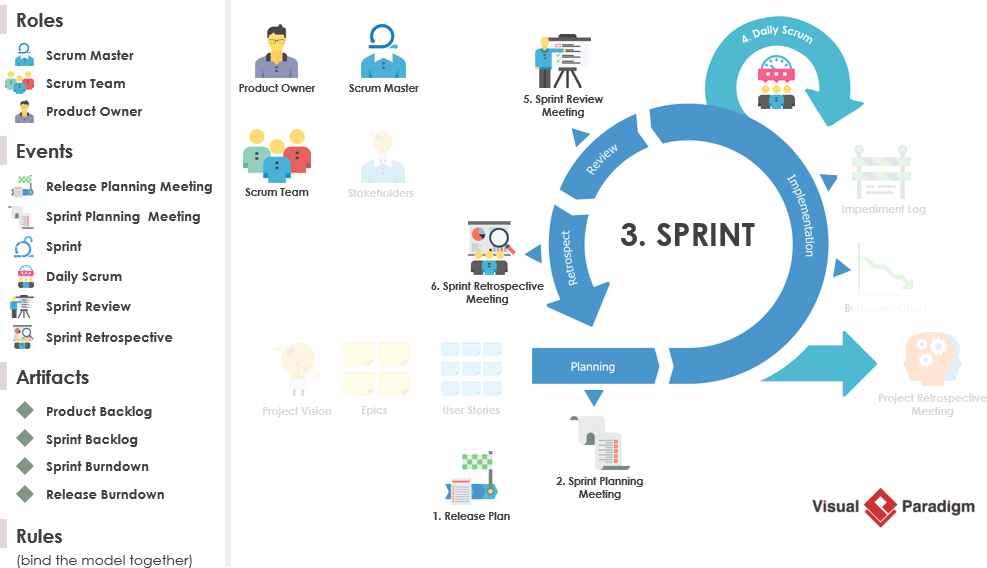
Scrum Terms Framework
Basic Scrum Rules
The primary goal of Scrum rules is to optimize the development process and minimize wasted time. Here is the list of basic Scrum rules:
- Each Sprint lasts four weeks or less
- There are no breaks between Sprints
- All Sprints are of the same length
- The goal of each Sprint is to deliver a “potentially shippable” product increment
- Each Sprint includes Sprint Planning
- The timebox for Sprint Planning is 2 hours per week of Sprint length
- Daily Scrum occurs at the same time every day
- The Daily Scrum is timeboxed to 15 minutes
- Each Sprint includes a Sprint Review to gather feedback from stakeholders on the product
- Each Sprint includes a Sprint Retrospective for the team to inspect and adapt
- The total time for Review and Retrospective meetings is 2 hours per week of Sprint length
- There are no breaks between the Sprint Review and Retrospective meetings
The Scrum Master is responsible for ensuring that everyone follows the Scrum rules related to the project. These rules tie the Scrum process together, so everyone knows how to play.


 English
 Arabic
 Chinese (Simplified)
 Dutch
Dutch French
 German
 Italian
 Japanese
 Korean
 Portuguese
 Russian
 Spanish