


Scrum (derived from “scrummage”) is a method of restarting play in rugby, where players bind closely together, heads down, in an attempt to gain possession of the ball. The scrum is used after a minor infringement or loss of the ball, depending on whether it’s rugby union or rugby league. Scrums occur more frequently and are now more critical in rugby league than in rugby union. The practice of starting play from a scrum in rugby evolved from the chaos of the game.
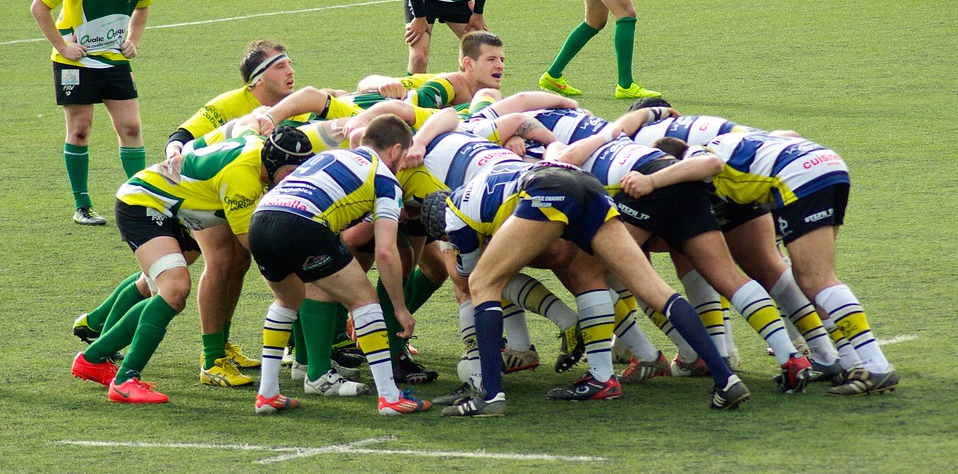
Scrummage in Rugby
Building on the rugby scrum concept, the Agile software development methodology uses the Scrum framework to effectively manage product development, with the product development team functioning as a cohesive unit to achieve shared goals. For success, a self-organizing Scrum team with defined roles works together to achieve common objectives—just like a rugby team.
Like rugby scrums, Agile Scrum heavily relies on strong communication among team members, with each player doing their part to fulfill their specific role. If one player fails to perform due to any reason, teammates must step in to fill the gap. Similarly, Scrum team members in Agile must support and empower one another. This involves frequent communication, realistic goal setting, and full commitment to the team.
Origin of the Scrum Framework in Software Development
Agile thinking was deeply influenced by Japanese industrial best practices—particularly the Lean principles introduced by Toyota and Honda—and the knowledge management strategies developed by Hirotaka Takeuchi and Nonaka. Influenced by these ideas and global research on software projects, Jeff Sutherland first defined and implemented the Scrum process for software development at Easel in 1993.
- 1986 – Takeuchi & Nonaka introduced “The New Product Development Game” in the Harvard Business Review, coining the term “Scrum” for product development.
- 1993 – Jeff Sutherland first applied Scrum in software development.
- 1995 – Jeff Sutherland and Ken Schwaber formalized the Scrum framework and presented it at OOPSLA ’95.
- 2001 – The Agile Manifesto and principles were published, forming the Agile Alliance. Scrum became recognized as an Agile methodology.
- 2001 – Ken Schwaber and Mike Beedle published the first book on Scrum, Agile Software Development.
- 2002 – Ken Schwaber and Mike Cohn co-founded the Scrum.org, later known as the Scrum Alliance.
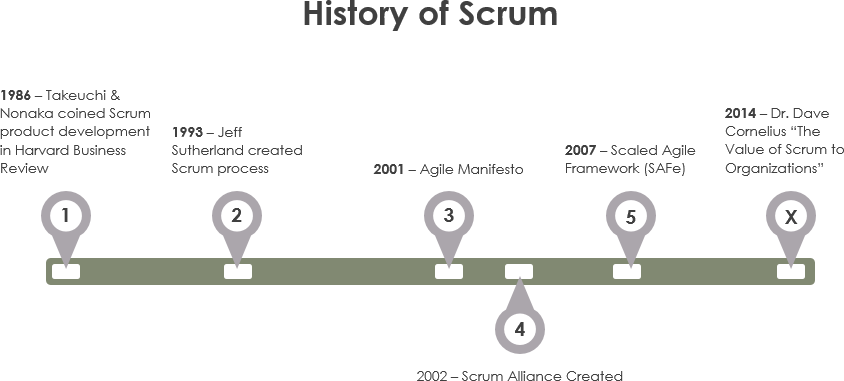
History of Scrum
The Agile Methodology Umbrella
Since the birth of the Agile Manifesto in 2001, Agile has generated significant buzz. In reality, Agile is not a rigid process but a mindset that enables teams and organizations to innovate, respond quickly to changing requirements, and reduce risks. Organizations can flexibly adopt various available frameworks—such as Scrum, Kanban, Lean, XP, and others—depending on their needs.
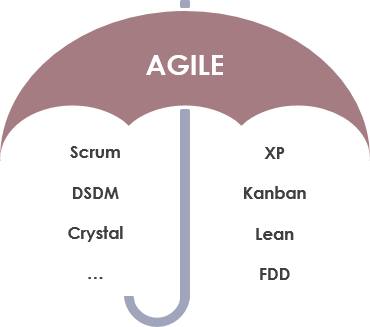
Agile Umbrella
Agile vs. Scrum
Agile doesn’t prescribe a fixed set of steps. Scrum provides a structured way to apply Agile to projects. Think of Scrum as a framework that enables Agile development. You can adopt other Agile frameworks—such as Kanban, Extreme Programming (XP), or Feature-Driven Development (FDD)—but Scrum’s simplicity makes it the most popular choice among Agile methodologies. Scrum can also serve as an entry point into other Agile practices. Moreover, Scrum is not limited to software development—it can benefit many non-IT projects as well.


 English
 Arabic
 Chinese (Simplified)
 Dutch
Dutch French
 German
 Italian
 Japanese
 Korean
 Portuguese
 Russian
 Spanish