


Enterprise architecture is often compared to a labyrinth. As systems grow, the connections between business processes, software applications, and infrastructure become increasingly tangled. Stakeholders struggle to see the big picture, leading to misalignment and inefficiency. The challenge is not just building systems but communicating how they fit together. This is where the structured approach of ArchiMate Viewpoints becomes essential. By defining specific lenses for different audiences, we can cut through the noise and present clarity where there was once confusion.
Complexity is the enemy of execution. When a digital transformation initiative stalls, it is rarely due to a lack of technical skill. It is usually due to a communication gap. Executives need to see strategic alignment. Developers need to see interface definitions. Auditors need to see compliance controls. A single diagram cannot satisfy all these needs. ArchiMate provides a standardized language to model these layers, but the real power lies in how we present that information through dedicated viewpoints.
In this guide, we explore how to leverage ArchiMate Viewpoints to manage system complexity effectively. We will look at the core layers of the architecture, how to map them to stakeholder concerns, and the best practices for constructing views that drive understanding. No jargon without definition, no fluff, just the mechanics of clear architecture.
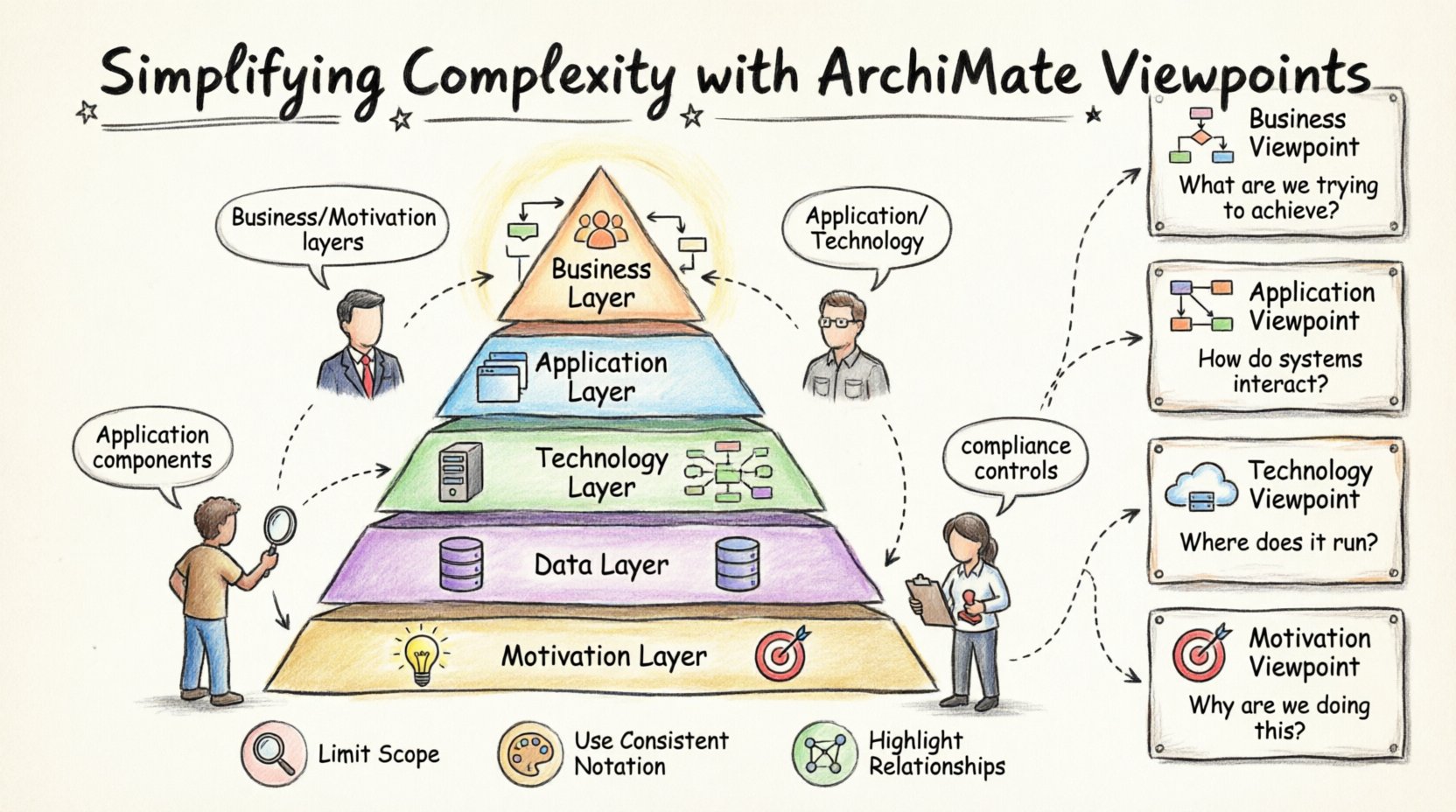
Understanding the Architecture of Complexity 🧩
Before diving into viewpoints, it is necessary to understand what is being viewed. Enterprise architecture is typically modeled using a layered approach. This separation of concerns allows architects to focus on specific aspects of the system without getting overwhelmed by the entirety of the infrastructure.
The standard model divides the enterprise into several distinct layers, each with its own set of building blocks and relationships:
- Business Layer: This covers the strategy, governance, organization, and processes. It answers the question: “What does the organization do?”
- Application Layer: This includes the software applications that support business processes. It focuses on how information is processed and managed by technology.
- Technology Layer: This describes the physical and logical infrastructure. It includes hardware, networks, and operating systems that host the applications.
- Data Layer: Often integrated with the Business or Application layers, this represents the information objects that flow through the system.
- Motivation Layer: This captures the drivers behind the architecture, such as goals, principles, and requirements.
Each of these layers contains specific elements. For example, a “Business Process” exists in the Business Layer, while an “Application Function” exists in the Application Layer. Connecting these elements requires understanding the relationships between them, such as “serves,” “uses,” or “realizes.” However, showing all these connections at once creates a spaghetti diagram that is impossible to read.
This is where the concept of a Viewpoint comes into play. A viewpoint defines the conventions for a specific view. It specifies which layers are relevant, which elements to include, and the notation style to use. It acts as a filter, allowing the architect to present only the information necessary for a specific audience.
What is an ArchiMate Viewpoint? 🎯
An ArchiMate Viewpoint is a specification that defines the purpose, audience, and scope of a view. It is not the diagram itself, but the rulebook for creating that diagram. Think of it as the template for a report. The report (the View) changes based on the topic, but the template (the Viewpoint) ensures consistency and readability.
The Open Group standard defines viewpoints to ensure that different stakeholders can interpret the architecture in a consistent manner. Without viewpoints, every architect might create their own style of diagram, leading to confusion when teams collaborate.
Key characteristics of a Viewpoint include:
- Stakeholders: Who is the primary audience for this view? (e.g., CIO, Project Manager, Auditor).
- Concerns: What specific questions must this view answer? (e.g., “Does this app support the new regulation?”).
- Layers: Which architectural layers are visible in this view? (e.g., Business and Application only).
- Notation: How are the relationships and elements drawn? (e.g., specific colors, line styles).
By adhering to a defined viewpoint, the architecture becomes a language that can be spoken across the organization. It reduces the cognitive load required to understand the system. If a stakeholder knows that the “Security Viewpoint” always highlights compliance boundaries, they can quickly scan that diagram without needing to decode new symbols every time.
Mapping Stakeholders to Layers 📊
One of the most common mistakes in enterprise architecture is assuming one size fits all. A technical architect needs different information than a business strategist. To simplify complex systems, we must align the complexity of the view with the complexity of the stakeholder’s needs.
Here is a breakdown of typical stakeholder groups and the architectural concerns they prioritize:
- C-Suite & Business Leaders: They care about value, cost, and strategy. They need to see the Business Layer and potentially the Motivation Layer. They do not need to see server configurations or database schemas.
- IT Managers: They manage resources and delivery. They need to see the Application and Technology layers to understand capacity, licensing, and infrastructure dependencies.
- Developers & Engineers: They need granular detail. They focus on the Application Layer, specifically interfaces, components, and data structures.
- Auditors & Compliance Officers: They require evidence of control. They look for the Motivation Layer (principles) and specific nodes in the Business and Technology layers that touch regulated data.
When designing a viewpoint, start by asking: “Who is looking at this, and what do they need to decide?” If the answer is “to decide on budget,” the view should focus on business capabilities and the applications that support them, mapped to cost drivers. If the answer is “to decide on migration path,” the view should focus on technology dependencies and application interfaces.
Core ArchiMate Viewpoints Explained 🔍
While specific tools may define their own variations, the standard ArchiMate methodology provides a set of core viewpoints that cover the vast majority of enterprise architecture needs. Understanding these standard types allows for consistent communication across projects.
1. Business Viewpoint
This viewpoint focuses on the external face of the enterprise. It illustrates how business processes, roles, and organizational units interact. It is crucial for process improvement and organizational design.
- Primary Elements: Business Actor, Business Role, Business Process, Business Function, Business Object.
- Key Relationships: Aggregation, Association, Specialization.
- Use Case: Mapping a new product launch to the departments responsible for it.
2. Application Viewpoint
This view zooms in on the software systems. It shows how applications interact with each other and with business processes. It is vital for integration planning and application rationalization.
- Primary Elements: Application Component, Application Service, Application Interface, Application Function.
- Key Relationships: Access, Use, Realization.
- Use Case: Identifying redundant applications that perform the same function.
3. Technology Viewpoint
This view describes the infrastructure. It is the foundation upon which the application layer sits. It is essential for infrastructure planning and migration.
- Primary Elements: Node, Device, System Software, Communication Network.
- Key Relationships: Deployment, Access, Flow.
- Use Case: Planning a migration from on-premise servers to cloud infrastructure.
4. Motivation Viewpoint
This is often overlooked but critical for alignment. It connects the “why” to the “what.” It captures goals, drivers, and requirements.
- Primary Elements: Goal, Driver, Principle, Requirement, Assessment.
- Key Relationships: Satisfies, Influences, Realizes.
- Use Case: Tracing a business requirement back to a specific architectural decision.
The following table summarizes how these viewpoints differ in scope and focus:
| Viewpoint Type | Primary Audience | Focus Area | Key Question |
|---|---|---|---|
| Business | Management, Process Owners | Strategy & Operations | What are we trying to achieve? |
| Application | IT Architects, Developers | Software & Services | How do the systems interact? |
| Technology | Infrastructure Team, Ops | Hardware & Network | Where does it run? |
| Motivation | Strategists, Governance | Goals & Drivers | Why are we doing this? |
| Implementation & Migration | Project Managers | Projects & Deliverables | How do we get from A to B? |
Designing Effective Views for Stakeholders 🛠️
Once the viewpoint is selected, the next step is constructing the view. A view is the actual diagram generated based on the viewpoint’s rules. A well-designed view simplifies complexity by omitting irrelevant details. This is the art of abstraction.
Here are the principles for constructing effective views:
- Limit Scope: Do not try to show the entire enterprise in one diagram. A single view should focus on a specific domain or project.
- Use Consistent Notation: If “Application Component” is represented by a cylinder icon in one view, it must be the same in all related views. Consistency reduces learning time.
- Label Clearly: Every element should have a clear, descriptive label. Avoid abbreviations that might not be understood by the audience.
- Highlight Relationships: The value of architecture lies in the connections. Use line weights or colors to emphasize critical dependencies.
- Iterate: A view is rarely perfect on the first try. Share drafts with stakeholders to ensure it answers their questions.
Consider the scenario of a digital transformation. The leadership team needs to understand the impact of moving to a cloud model. A single view of the infrastructure is insufficient. A combination of views is needed:
- View 1 (Business): Show how business processes will change. Which roles will be affected?
- View 2 (Application): Show which applications are being replaced and which are being integrated.
- View 3 (Technology): Show the new cloud nodes and network topology.
- View 4 (Motivation): Show the cost savings and performance goals driving the change.
By separating these concerns, the complexity of the transformation is broken down into manageable chunks. Each stakeholder can focus on the view that matters to them without being distracted by technical details they do not control.
Common Pitfalls in Architecture Modeling ⚠️
Even with a solid methodology, pitfalls exist. Recognizing them early prevents wasted effort. Below are common mistakes to avoid when working with ArchiMate Viewpoints.
1. Over-Modeling
There is a temptation to model everything. This leads to massive diagrams that no one reads. Remember the goal is simplification. If an element does not answer a stakeholder’s concern, exclude it. It is better to have a sparse diagram that is understood than a dense diagram that is ignored.
2. Ignoring the Stakeholder
Creating a technical diagram for a business audience is a recipe for failure. If the language is too technical, the business value is lost. Always tailor the vocabulary to the audience. Use business terms in the Business Viewpoint and technical terms in the Technology Viewpoint.
3. Lack of Context
A diagram without context is just a picture. Always include a legend or an introduction that explains the scope. What is the boundary of this view? What is the time frame? Without context, the model can be misinterpreted.
4. Static Modeling
Architecture is not static. Systems change. If the view is not maintained, it becomes a relic. Establish a process for reviewing and updating the models. The cost of a stale model is higher than the cost of maintaining it.
Best Practices for Long-Term Success 🚀
To ensure the architecture practice delivers value over time, certain habits should be cultivated. These practices help maintain the integrity of the viewpoints and the relevance of the views.
- Define a Meta-Model: Agree on the standard definitions for terms like “Application” or “Process.” Ensure everyone in the organization uses the same definitions.
- Automate Where Possible: While we avoid specific software products, the principle of automation is key. If data can be extracted from systems to populate the model automatically, do so. It reduces manual error.
- Integrate with Delivery: Architecture should not sit in a silo. It should be part of the project lifecycle. When a new project starts, the relevant views should be updated to reflect the new components.
- Review Regularly: Schedule architecture review boards. Have stakeholders review the views to ensure they still match reality and business needs.
- Focus on Traceability: Ensure that every element in the model can be traced back to a business requirement. This traceability is the ultimate proof of alignment.
By following these practices, the architecture function evolves from a documentation exercise to a strategic asset. It becomes a tool that guides decision-making rather than a record of past decisions.
Integrating Viewpoints into Strategy 🤝
One of the most powerful uses of ArchiMate Viewpoints is in strategic planning. Strategy is often abstract and high-level. Architecture is concrete and detailed. Viewpoints bridge this gap.
When a new strategic initiative is proposed, the Architecture team can use the Motivation Viewpoint to map the initiative to specific goals. Then, the Business Viewpoint can show which processes need to change to support that goal. Finally, the Application and Technology viewpoints can estimate the investment required.
This creates a clear line of sight from the boardroom to the data center. It allows leadership to see the implications of their decisions before they are implemented. It transforms architecture from a support function into a strategic partner.
For example, a strategy to “Improve Customer Experience” can be modeled. The Business Viewpoint identifies the customer touchpoints. The Application Viewpoint identifies the systems that manage customer data. The Technology Viewpoint identifies the latency requirements. By viewing the strategy through these different lenses, the organization ensures that the technical implementation actually supports the strategic intent.
Conclusion: Clarity Through Structure 🌟
Simplifying complex systems is not about removing complexity; it is about managing it. ArchiMate Viewpoints provide the structure needed to organize that complexity into digestible pieces. By defining clear roles for different stakeholders and using standardized layers, we can ensure that everyone sees the same truth.
The journey toward effective architecture is iterative. It requires discipline to stick to the viewpoints, humility to update the models, and clarity to communicate the results. When done correctly, the result is an organization that moves with purpose, where technology serves business, and where decisions are made with full visibility.
Start by selecting one viewpoint that addresses a current pain point. Build the view. Share it. Refine it. This is how complexity is tamed, one diagram at a time.

 English
 Arabic
 Chinese (Simplified)
 Dutch
Dutch French
 German
 Italian
 Japanese
 Korean
 Portuguese
 Russian
 Spanish