


Enterprise Architecture (EA) is often viewed as a complex web of models, standards, and documentation. Without a clear structure, these artifacts can become overwhelming for stakeholders at all levels. The ArchiMate modeling language provides a robust framework, but its true power lies in how it is presented. This is where ArchiMate Viewpoints come into play. They act as the bridge between technical complexity and business clarity.
This guide explores how to leverage these viewpoints to streamline architecture processes. We will examine the core concepts, design principles, and practical applications that ensure your architecture remains relevant and actionable. By focusing on specific lenses, organizations can reduce noise and highlight what truly matters for decision-making. 🚀
Understanding the Core Concept 🧠
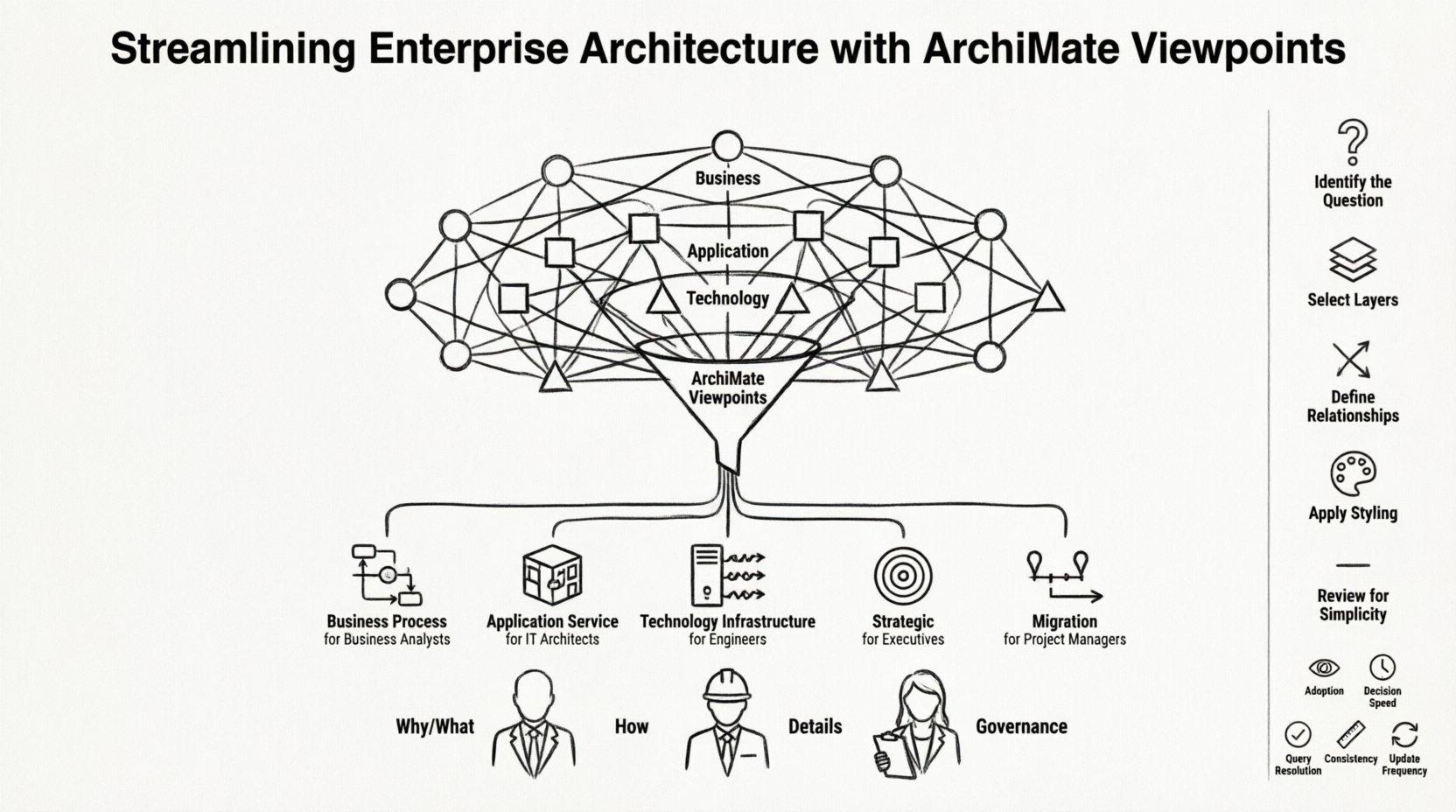
Before diving into implementation, it is essential to understand the fundamental distinction between a Model and a View. An ArchiMate model contains the entire landscape of an enterprise. It includes business processes, application services, technology infrastructure, and their relationships. However, showing this entire model to a single stakeholder is rarely effective.
A Viewpoint defines the specific aspects of the architecture that are relevant to a particular audience or concern. It dictates:
- Which layers of the architecture are visible (Business, Application, Technology, etc.)
- Which viewpoints are applicable (e.g., Strategic, Operational)
- How the information should be structured and presented
- Which stakeholders require this specific information
Think of a Viewpoint as a filter. It allows you to slice the complex model into digestible pieces. This ensures that a C-level executive sees strategic alignment, while a developer sees application interfaces. 🎯
The Architecture Landscape Context 🌍
Enterprise Architecture operates within a dynamic environment. Regulatory changes, market shifts, and technological advancements occur constantly. Without a streamlined approach, the architecture documentation can become stale or misaligned with reality. The use of standardized Viewpoints helps maintain consistency across the organization.
Key challenges in the current landscape include:
- Information Overload: Stakeholders are bombarded with data that is not relevant to their specific roles.
- Communication Gaps: Technical teams and business units often speak different languages.
- Fragmentation: Different departments may build their own models without a unified standard.
- Maintenance Burden: Keeping a massive model updated requires significant effort.
ArchiMate Viewpoints address these issues by enforcing a structured approach to communication. They ensure that every artifact produced serves a specific purpose for a specific audience. This reduces the cognitive load on stakeholders and increases the likelihood of adoption. 📉
Key ArchiMate Viewpoint Types 📊
There are numerous Viewpoints defined within the ArchiMate specification. While you do not need to use all of them, understanding the categories helps in selecting the right one for your needs. Below is a breakdown of common types and their primary uses.
| Viewpoint Category | Primary Focus | Typical Audience | Key Benefit |
|---|---|---|---|
| Business Process Viewpoint 🏃♂️ | Workflows and activities | Business Analysts, Process Owners | Identifies bottlenecks and inefficiencies |
| Application Service Viewpoint 💻 | Software capabilities | IT Architects, Developers | Clarifies system dependencies and interfaces |
| Technology Infrastructure Viewpoint 🖥️ | Hardware and networks | Infrastructure Engineers, Ops | Maps physical deployment and connectivity |
| Strategic Viewpoint 🎯 | Goals and drivers | Executives, Strategy Teams | Aligns IT initiatives with business goals |
| Migration Viewpoint 🚚 | Transition planning | Project Managers, Change Leads | Visualizes the path from current to target state |
Using a standardized table of Viewpoints allows an organization to create a catalog of reusable templates. This consistency speeds up the creation of new architecture artifacts. It also makes it easier for new team members to understand how information is organized. 📚
Designing Effective Views 👁️
Creating a Viewpoint is more than just selecting a template. It requires careful consideration of the message you want to convey. A well-designed Viewpoint focuses on clarity and relevance. Here are the steps to design an effective architecture view.
- Identify the Question: What decision needs to be made? If the goal is to approve a budget, the view should focus on cost and value, not technical specs.
- Select the Layers: Decide which ArchiMate layers are necessary. Do you need the Technology layer, or is the Business layer sufficient?
- Define Relationships: Specify which relationships (flows, usage, association) are visible. Too many lines can clutter the diagram.
- Apply Styling Rules: Use consistent colors and shapes. For example, always represent a “Business Process” with the same icon across all views.
- Review for Simplicity: Remove any element that does not directly support the primary question. Less is often more.
Consider the concept of abstraction levels. A high-level view might show only major systems and their connections. A detailed view might show specific data flows or API endpoints. Both are valid, provided they serve their intended audience. 🛠️
Stakeholder Alignment 👥
The success of an Enterprise Architecture practice depends on engagement. Stakeholders must trust the architecture documentation. If they cannot understand it, they will not use it. Viewpoints are the primary tool for building this trust.
Different roles require different perspectives:
- Executives: Need to see strategic alignment, risk exposure, and investment portfolios. They care about the “Why” and “What”.
- Managers: Need to see process flows, resource allocation, and performance metrics. They care about the “How”.
- Engineers: Need to see interfaces, protocols, and data structures. They care about the “Details”.
- Compliance Officers: Need to see data flows, security boundaries, and regulatory controls. They care about “Governance”.
By mapping these roles to specific Viewpoints, you ensure that the right information reaches the right people. This reduces the need for meetings to explain diagrams. The diagrams themselves become the source of truth. 🤝
Governance and Maintenance 🛡️
Once Viewpoints are established, they require governance. A model without maintenance becomes a liability. Governance ensures that the architecture remains accurate and useful over time.
Key governance activities include:
- Regular Audits: Periodically review the Viewpoints to ensure they still match stakeholder needs. The business changes, and the views must evolve.
- Version Control: Maintain a history of changes. This helps in understanding how the architecture has evolved.
- Access Control: Ensure that sensitive views are only accessible to authorized personnel. Not all architectural data is public.
- Change Management: Link architectural changes to project lifecycles. When a project completes, the view should be updated.
A governance framework should also define who is responsible for updating each Viewpoint. Clear ownership prevents gaps in documentation. It ensures accountability for the accuracy of the information presented. ✅
Common Pitfalls ⚠️
While Viewpoints are powerful, they can be misused. Understanding common mistakes helps avoid them.
- Over-Customization: Creating too many unique Viewpoints for every minor request creates fragmentation. Stick to a standard set.
- Too Much Detail: Including every relationship in a high-level view confuses the audience. Simplify aggressively.
- Ignoring the Audience: Designing a view based on technical preference rather than user need. Always start with the stakeholder.
- Static Documentation: Treating the views as static documents rather than living artifacts. They should be dynamic representations of the current state.
- Lack of Context: Providing a diagram without explaining the assumptions or the scope of the view. Context is key to interpretation.
Avoiding these pitfalls ensures that the architecture practice remains lean and effective. It keeps the focus on value delivery rather than documentation overhead. 📉
Integrating Viewpoints into Workflow 🔄
Viewpoints should not exist in isolation. They need to be integrated into the daily workflow of the architecture team and the broader organization.
Integration strategies include:
- Repository Management: Store Viewpoints in a central repository. This ensures everyone accesses the latest version.
- Automation: Where possible, automate the generation of views from the underlying model. This reduces manual effort and error.
- Reporting: Use Viewpoints to generate standard reports for steering committees. This makes the architecture visible in regular meetings.
- Training: Train stakeholders on how to read the views. If they understand the notation, they can engage more deeply.
- Feedback Loops: Create a mechanism for stakeholders to suggest improvements to the Viewpoints. This ensures continuous improvement.
By embedding these views into existing processes, the architecture becomes a natural part of decision-making. It moves from being a separate activity to an integrated capability. 🔄
Measuring Success 📈
How do you know if your use of ArchiMate Viewpoints is working? You need measurable indicators of success. These metrics should focus on utility and impact.
Potential metrics include:
- Adoption Rate: How often are the views accessed by stakeholders?
- Decision Speed: Has the time required to make architectural decisions decreased?
- Query Resolution: How often do stakeholders ask for clarification that the views could have answered?
- Consistency: Are the views consistent across different departments?
- Update Frequency: Is the architecture being kept up to date with changes in the business?
Tracking these metrics helps refine the approach. If a specific Viewpoint is rarely used, it may need to be retired or redesigned. If another is critical, it may need more resources. 📊
Conclusion 💡
Streamlining Enterprise Architecture requires discipline and focus. ArchiMate Viewpoints provide the structure needed to manage complexity without losing clarity. By defining specific lenses for different stakeholders, organizations can ensure that their architecture supports business goals effectively.
The journey involves establishing standards, maintaining governance, and continuously refining the views based on feedback. It is a practice that evolves with the organization. When done correctly, the architecture becomes a strategic asset rather than a documentation burden.
Start by auditing your current artifacts. Identify which Viewpoints are actually being used and which are generating noise. Simplify where possible. Focus on the value delivered to the stakeholder. With the right approach, Enterprise Architecture becomes a clear guide for the future. 🌟
Remember, the goal is not just to model the enterprise, but to understand it and guide it forward. Viewpoints are the tool that makes this understanding possible. Use them wisely. 🛤️
Advanced Considerations 🔬
For organizations seeking deeper integration, there are advanced considerations regarding how Viewpoints interact with other architectural standards. This includes mapping Viewpoints to TOGAF Architecture Development Method (ADM) phases.
- Phase Alignment: Ensure that specific Viewpoints are generated at specific stages of the architecture lifecycle. For example, the Baseline Viewpoint is critical in the early stages, while the Target Viewpoint is crucial in later stages.
- Cross-Domain Views: Sometimes a decision requires understanding the intersection of Business and Technology. Create specialized Viewpoints that bridge these domains explicitly.
- Contextual Annotations: Add metadata to views. This includes the date of creation, the owner, and the version. This adds traceability to the artifacts.
These advanced practices require a mature architecture organization. They are not necessary for every project, but they add significant value for large-scale transformations. 🏛️
Final Thoughts on Implementation 🎓
Implementation is a gradual process. Do not attempt to standardize every Viewpoint overnight. Begin with the most critical pain points. If stakeholders complain about confusion in budget approvals, create a Financial Viewpoint. If developers complain about unclear interfaces, create an Interface Viewpoint.
Growth should be organic. As trust is built, more complex Viewpoints can be introduced. The key is to remain responsive to the needs of the business. The architecture function exists to serve the business, not to impress it with complexity.
By adhering to these principles, organizations can achieve a state where architecture is streamlined, visible, and valuable. The ArchiMate Viewpoints are the mechanism to achieve this state. 🏆

 English
 Arabic
 Chinese (Simplified)
 Dutch
Dutch French
 German
 Italian
 Japanese
 Korean
 Portuguese
 Russian
 Spanish