


Enterprise Architecture is often viewed through a lens of technical complexity. However, the true value lies not in the diagrams themselves, but in the communication they enable. For leadership teams, understanding the strategic necessity of ArchiMate Viewpoints is critical for alignment, decision-making, and resource allocation. Without a structured approach to visualizing architecture, organizations risk building silos that hinder agility and growth.
This guide explores the core mechanics of viewpoints, their specific application for executives, and how they transform abstract technical data into actionable business intelligence. We will navigate the landscape of architecture modeling without relying on hype, focusing instead on practical implementation and clear communication strategies. 🧭
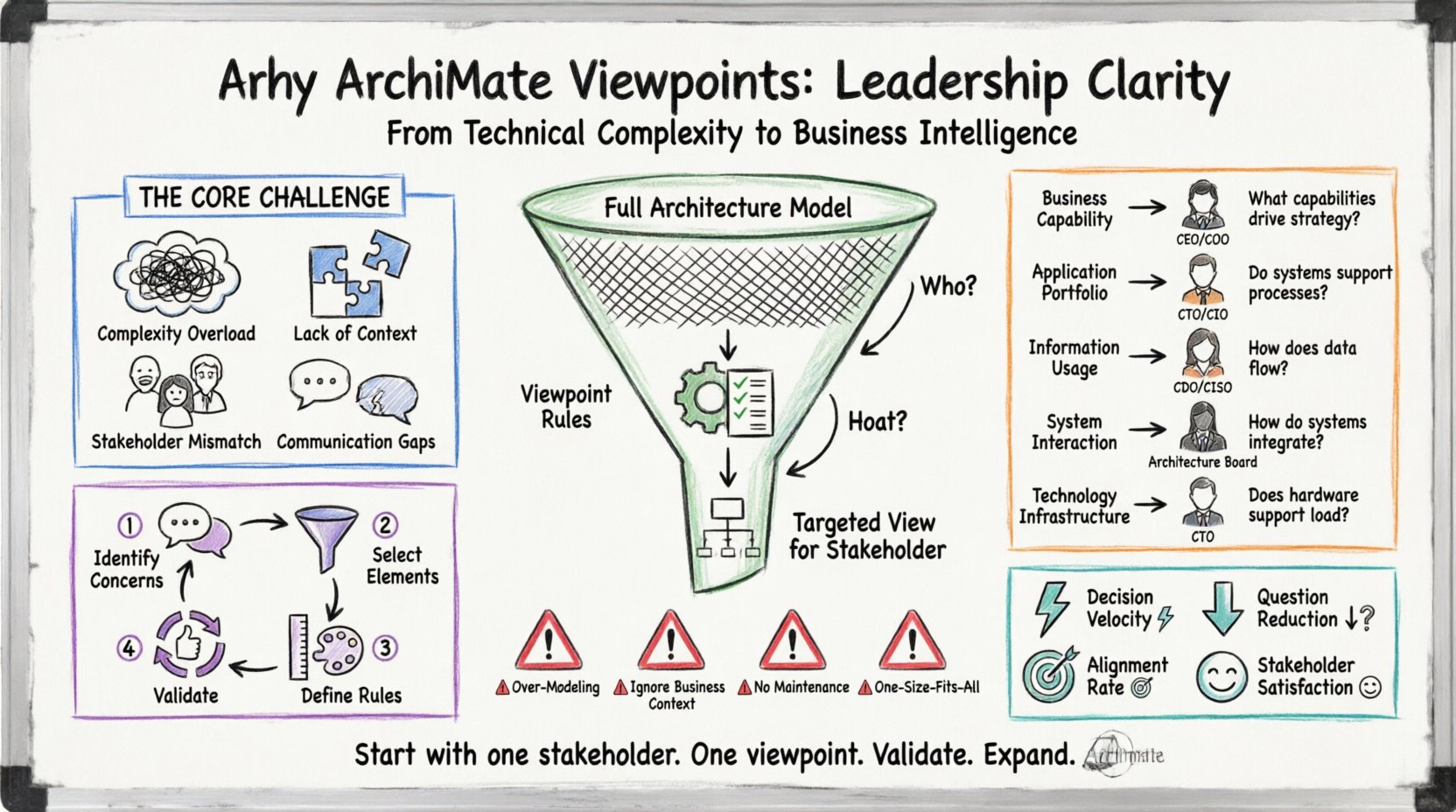
Understanding the Core Challenge 🤔
Enterprise Architecture (EA) deals with the structure of an organization. It encompasses business processes, information systems, applications, and infrastructure. When these elements are presented to a leadership team without filtering, the result is often information overload. Executives do not need to see every dependency in a software stack; they need to understand the impact of a change on revenue, risk, or operational efficiency.
Here are the primary challenges leadership faces regarding architecture:
- Complexity Overload: Too many details obscure the strategic picture.
- Lack of Context: Technical diagrams often lack business justification.
- Stakeholder Mismatch: A CIO sees things differently than a CFO or COO.
- Communication Gaps: Misinterpretation of technical debt or risk.
ArchiMate Viewpoints address these challenges directly. They are not just drawing templates; they are defined perspectives that select specific information from the architecture model to answer specific questions. By using viewpoints, you create a controlled environment for information delivery.
What is an ArchiMate Viewpoint? 🔍
A viewpoint defines the conventions for creating a view. In simpler terms, it determines who sees what and how it is presented. Think of it as a filter that focuses on a specific set of concerns relevant to a particular group of stakeholders.
The distinction between a Viewpoint and a View is vital:
- Viewpoint: The plan or specification. It defines the rules, notations, and modeling languages used. It is the blueprint for the communication.
- View: The actual instance. It is the specific diagram or document produced for a specific meeting or decision.
Without a defined viewpoint, views become inconsistent. One team might use one set of symbols, while another uses a different notation. This inconsistency leads to confusion. A standardized viewpoint ensures that a “Business Process” looks the same to the CIO as it does to the CEO, even if the underlying data depth differs.
The Strategic Value for Leadership 👔
For leadership teams, the adoption of ArchiMate Viewpoints shifts the conversation from technical implementation to business outcome. It bridges the gap between strategy and execution.
1. Alignment of Strategy and Operations
Leadership often struggles to trace how a high-level strategic goal translates into daily operations. Viewpoints allow for the construction of Strategy Maps that link objectives to capabilities, processes, and supporting technology. This traceability ensures that every dollar spent on IT contributes directly to a business goal.
2. Risk Management and Governance
Architecture is a primary driver of risk. Viewpoints can isolate specific risk domains. For example, a security viewpoint might highlight all data flows crossing organizational boundaries, while a compliance viewpoint focuses on regulatory touchpoints. This targeted visibility allows governance committees to address risks without getting lost in general system architecture.
3. Resource Optimization
When resources are scarce, leadership must prioritize. Viewpoints help visualize redundancy. If multiple applications serve the same business function, a Capability Viewpoint can highlight this overlap immediately. This insight supports decisions on consolidation, migration, or decommissioning.
Key Viewpoint Types for Executives 📊
Different leaders require different lenses. Below is a breakdown of the most critical viewpoints for a leadership team, categorized by their primary focus.
| Viewpoint Name | Primary Audience | Key Question Answered |
|---|---|---|
| Business Capability | CEO, COO, CDO | What capabilities do we need to deliver our strategy? |
| Application Portfolio | CTO, CIO | How well do our systems support our business processes? |
| Information Usage | CDO, CISO | How is data moving between business units? |
| System Interaction | CTO, Architecture Board | How do external systems integrate with our core platform? |
| Technology Infrastructure | CTO, CIO | Is our hardware and network supporting our load? |
Notice how the audience changes with the viewpoint. A single diagram cannot satisfy all these needs. The ability to switch perspectives is what makes the framework powerful.
Designing Effective Viewpoints for Stakeholders 🛠️
Creating a viewpoint requires discipline. It is not enough to simply draw a diagram. You must define the scope, the audience, and the intent. Here is a step-by-step approach to designing effective viewpoints.
Step 1: Identify the Stakeholder Concerns
Before drawing anything, interview the stakeholders. What keeps them awake at night? Is it cost? Is it speed to market? Is it security? The viewpoint must address these specific concerns. If a CFO is concerned with cost, a technical network topology diagram is irrelevant. A cost-centric viewpoint is required.
Step 2: Select the Relevant Model Elements
ArchiMate contains many elements. Do not show them all. Select only those that matter for the specific concern. For a Business Capability view, you might include Capabilities and Business Objects, but exclude Application Services unless they directly impact the capability.
Step 3: Define the Presentation Rules
How should the information look? Use standard notation. Avoid custom shapes that require a legend. Ensure that the scale is appropriate. A high-level strategy view should not have the same granularity as a deployment view.
Step 4: Validate with the Audience
Once a view is created based on the viewpoint, present it to the stakeholder. Ask them: “Does this answer your question?” If the answer is no, adjust the viewpoint or the view. This iterative process ensures the architecture remains relevant.
Common Pitfalls to Avoid ⚠️
Even with the best intentions, architecture teams often stumble when implementing viewpoints. Being aware of these common traps can save significant time and effort.
- Over-Modeling: Trying to model everything leads to a “big ball of mud.” Focus on the elements that change frequently or carry the most risk.
- Ignoring the Business Context: Technical views often fail because they do not explain why a technology exists. Always link the technology to the business process it supports.
- Lack of Maintenance: An outdated architecture model is worse than no model. Viewpoints must be updated as the business evolves. Stale data erodes trust.
- One Size Fits All: Assuming one diagram works for everyone is a mistake. Tailor the output to the specific role.
Implementing a Viewpoint Strategy 🚀
Transitioning to a viewpoint-driven architecture requires a change in process. It is not just about tools; it is about culture. Here is how to introduce this strategy within an organization.
1. Establish an Architecture Repository
You need a central place where the model lives. This repository should store the source data, not just the diagrams. This ensures that if you change a process in the model, all views that reference it update automatically. This consistency is key for leadership trust.
2. Define Governance Standards
Set rules for how viewpoints are created. Who approves a new viewpoint? Who is responsible for updating the data? Governance ensures quality and prevents the proliferation of inconsistent models.
3. Train the Leadership Team
Leadership may not be familiar with ArchiMate notation. Provide training sessions that explain the symbols and the meaning behind the diagrams. When leaders understand the language, they can ask better questions and make faster decisions.
4. Integrate with Planning Cycles
Do not let architecture exist in a vacuum. Integrate the viewpoints into your budget planning, project intake, and risk assessment cycles. When a project proposal is reviewed, the architecture team should provide a view showing how the project impacts existing capabilities.
Measuring the Success of Your Viewpoints 📈
How do you know if your viewpoint strategy is working? You need to measure the impact on decision-making and communication.
- Decision Velocity: Are decisions being made faster because the information is clear?
- Question Reduction: Are leadership teams asking fewer clarification questions during reviews?
- Alignment Rate: Do project initiatives align more closely with strategic goals?
- Stakeholder Satisfaction: Survey the leadership team on the clarity of the architecture documentation.
If the architecture is seen as a bottleneck, the viewpoints are likely too complex. If they are seen as a guide, the strategy is succeeding.
The Role of Data in Viewpoints 📁
Data is the backbone of modern enterprise architecture. A viewpoint that ignores data is incomplete. Information views are particularly important for leadership because they highlight data ownership and flow.
When examining data, leadership needs to know:
- Where does the data come from? Understanding source systems is crucial for data quality.
- Who owns the data? Clear ownership prevents data silos and governance issues.
- How is the data protected? Security viewpoints must highlight sensitive data flows.
By incorporating data elements into your viewpoints, you ensure that data governance is not an afterthought but a central part of the architectural strategy.
Conclusion: A Path to Clarity 🌟
ArchiMate Viewpoints are not merely a technical requirement; they are a management tool. They bring order to chaos and clarity to complexity. For leadership teams, the ability to see the enterprise through specific, relevant lenses is the difference between reactive firefighting and proactive strategy.
By adopting a disciplined approach to viewpoint design, organizations can ensure that their architecture serves their business, rather than the other way around. The goal is not to create perfect models, but to facilitate perfect communication. When stakeholders speak the same architectural language, the organization moves with greater speed and confidence.
Start by identifying your most critical stakeholder. Define a single viewpoint for them. Validate it. Expand from there. The journey to architectural clarity begins with a single, well-defined perspective.

 English
 Arabic
 Chinese (Simplified)
 Dutch
Dutch French
 German
 Italian
 Japanese
 Korean
 Portuguese
 Russian
 Spanish