Scrum advocates for fixed-length Sprints. The sprint length can be adjusted to balance the need for rapid releases and enough time to complete meaningful work in each sprint. Once an appropriate length is found, it typically remains unchanged, as shown in the figure below:
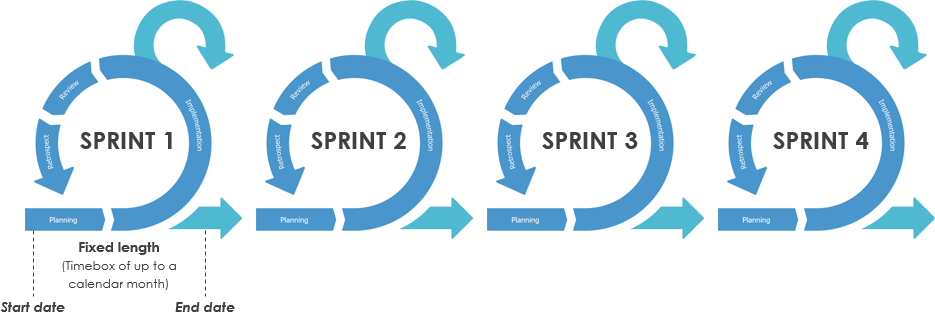
Sprints in Scrum
Note:
A Sprint is the fundamental unit of work when using Scrum. Therefore, any product development work using Scrum is broken down into Sprints.
Why Fixed-Length Sprints?
The fixed length of a Sprint allows the team to have predictable timeboxes for work, which helps with both short- and long-term planning. Fixed-length Sprints provide clarity for development, customers, and the Product Owner: when some working software is available for demonstration, and define the feedback loop duration—equal to the Sprint length.
On the other hand, if Sprint lengths vary, the rhythm of Scrum is disrupted, and the team must relearn their capacity, which typically takes at least a few Sprints. If Sprints are irregular in length, the Scrum team will struggle to make reliable plans. Most teams adopt fixed-length Sprints for several reasons:
- Teams benefit from a consistent rhythm
- Sprint Planning becomes easier
- Tracking velocity is simpler
- Time-based process improvements are more effective
- Maximizes responsiveness to customers
Summary
Scrum is about delivering software regularly to provide fast feedback on increments (or working software). With fixed-length Sprints, everyone—Product Owner, management, customers, users, and other stakeholders—knows exactly when to expect the next upgrade. It also helps the team manage expectations and self-organize around this predictable rhythm.

 English
 Arabic
 Chinese (Simplified)
 Dutch
Dutch French
 German
 Italian
 Japanese
 Korean
 Portuguese
 Russian
 Spanish