


1. Introduction to the Case Study
This case study examines the employee leave application process at ABC Company, a mid-sized organization committed to operational transparency and process efficiency. The workflow is modeled using Business Process Model and Notation (BPMN)—the globally recognized standard for visualizing business processes.
By applying BPMN, ABC Company gains a clear, standardized, and executable representation of its HR workflow. This enables better communication across departments, faster decision-making, and opportunities for automation and continuous improvement.
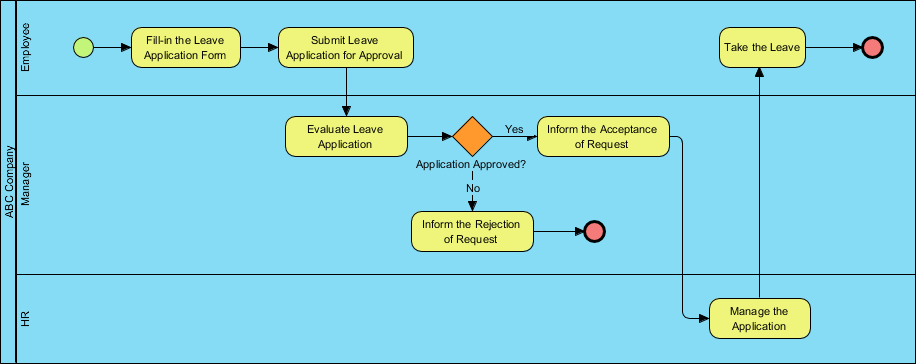
The analysis focuses on the cross-functional nature of the process, involving three key stakeholders: the Employee, the Manager, and the Human Resources (HR) Department. The goal is to demonstrate how BPMN enhances clarity, accountability, and traceability in everyday administrative operations.
2. Process Overview: Employee Leave Application Workflow
The leave application process at ABC Company follows a structured, sequential flow designed to ensure fairness, compliance, and timely approvals.
Step-by-Step Process Flow
| Step | Description |
|---|---|
| 1. Initiation | An employee begins the process by filling out a leave application form and submitting it via the company’s internal portal or HR system. |
| 2. Evaluation | The employee’s Manager receives the request and reviews it for validity, workload impact, and alignment with company policies. |
| 3. Decision Point | A critical decision gateway determines the outcome: – If Rejected: The manager notifies the employee, and the process ends. – If Approved: The manager confirms approval, and the request is forwarded to HR. |
| 4. Administrative Action | The HR Department performs the task of “Manage the Application”, which includes updating attendance records, adjusting payroll, and logging the leave in the HR database. |
| 5. Execution & Closure | Upon successful processing by HR, the employee is notified and proceeds to take the leave, marking the formal conclusion of the process. |
✅ Key Insight: This process exemplifies a private, internal workflow with clear ownership and defined handoffs—ideal for BPMN modeling.
3. Key BPMN Notations & Symbols Used
BPMN uses a standardized set of symbols to represent the dynamic and structural aspects of a business process. The ABC Company case study leverages the following core notations:
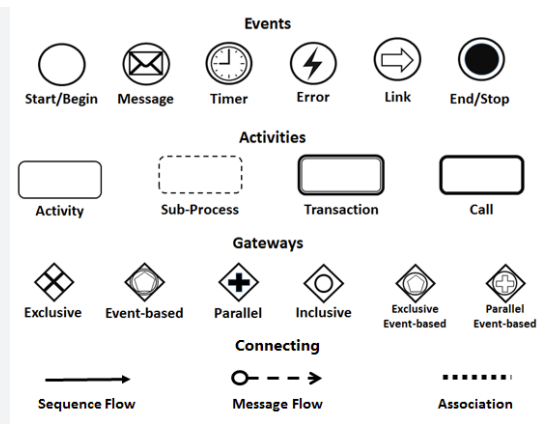
🔹 Events (Circles)
Represent significant occurrences that trigger or conclude a process.
-
Start Event (Green Circle)
Symbolizes the initiation of the process: “Fill in the Leave Application Form”.
→ Represents the trigger: employee submission. -
End Event (Red Circle)
Marks the final stage: “Take the Leave”.
→ Represents process completion. -
Intermediate Events (Optional)
Though not explicitly shown, timers (e.g., “Wait 24 hours for approval”) or error events could be added for enhanced control.
🔹 Activities (Rounded Rectangles)
Denote work units performed by individuals or systems.
-
Task: “Evaluate Leave Application”
Performed by the Manager—a single, atomic unit of work. -
Task: “Manage the Application”
Executed by HR, involving data updates and record-keeping. -
Sub-Process (Optional)
Could be used to encapsulate complex tasks like “Verify Leave Balance” or “Check Team Coverage.”
🔹 Gateways (Diamonds)
Control the branching logic of the process flow.
-
Exclusive Gateway (XOR)
Represented by the “Application Approved?” decision diamond.
→ Only one path is taken: Approved or Rejected.
→ Ensures deterministic flow and clear accountability.
🔹 Connecting Objects (Arrows & Lines)
| Object | Function | Example in Diagram |
|---|---|---|
| Sequence Flow (Solid Arrow) | Shows the order of execution within a pool. | From “Fill in Form” → “Evaluate Application” |
| Message Flow (Dashed Arrow) | Represents inter-pool communication. | From Manager to HR (approval notification) |
| Association (Dotted Line) | Links data, artifacts, or notes to flow elements. | Connecting “Leave Type” data object to the application task |
📌 BPMN ensures that every element is semantically meaningful and visually unambiguous—critical for cross-functional collaboration.
4. Structural Concepts in BPMN: Pools and Lanes
To maintain clarity and organizational alignment, BPMN employs swimlanes—visual partitions that group activities by role or department.
🏗️ Pool: ABC Company
-
Represents the entire organization involved in the process.
-
Contains all participants and internal workflows.
🛥️ Lanes: Role-Based Responsibilities
Each lane defines a specific role and its associated tasks:
| Lane | Responsibilities |
|---|---|
| Employee | Initiates the process by submitting the form. |
| Manager | Evaluates the request and makes the approval/rejection decision. |
| HR | Processes the approved application and updates records. |
✅ Best Practice: Lanes reflect real-world organizational structure, minimizing confusion and ensuring clear ownership.
5. Summary Table of BPMN Elements in the ABC Company Process
| BPMN Element | Example from ABC Company Process | Purpose & Insight |
|---|---|---|
| Start Event | Green circle before “Fill in the Leave Application Form” | Triggers the process; indicates the beginning. |
| Activity (Task) | “Evaluate Leave Application” (performed by Manager) | Represents a single, actionable task. |
| Exclusive Gateway (XOR) | “Application Approved?” decision diamond | Ensures only one outcome (approved/rejected) is selected. |
| End Event | Red circle after “Take the Leave” | Marks the successful completion of the process. |
| Sequence Flow | Solid arrows between tasks | Defines the logical order of execution. |
| Message Flow | Dashed line from Manager to HR | Shows inter-departmental communication. |
| Data Object | “Leave Application Form” (implied) | Tracks information used in the process. |
📊 This structured breakdown enables stakeholders to quickly interpret the process, identify bottlenecks, and support future automation.
6. Benefits of BPMN for HR Process Management
The use of BPMN in HR workflows like leave management delivers measurable value:
| Benefit | Impact on ABC Company |
|---|---|
| Clarity & Transparency | All parties understand their roles and responsibilities. |
| Standardization | Consistent process across departments and locations. |
| Improved Compliance | Clear audit trail for leave policies and approvals. |
| Faster Onboarding & Training | New employees and managers can quickly learn the process. |
| Foundation for Automation | Diagrams can be exported to workflow engines (e.g., Camunda, Flowable). |
| Performance Analysis | Simulate process duration, identify delays (e.g., slow manager approvals). |
🚀 With BPMN, HR transitions from a reactive function to a proactive, data-driven partner in organizational success.
7. Recommendations for Process Optimization
Based on the BPMN model, the following enhancements can further improve efficiency:
-
Add a Timer Event
→ If no decision is made within 48 hours, automatically escalate to the manager’s supervisor. -
Introduce a “Rejection Reason” Field
→ Improve feedback quality and reduce repeat submissions. -
Enable Self-Service via Portal
→ Employees can submit, track, and view status of leave requests in real time. -
Automate HR Tasks
→ Use BPMN to generate executable workflows that auto-update calendars and payroll. -
Implement Process Simulation
→ Analyze average approval times, resource utilization, and potential bottlenecks.
💡 These improvements transform a manual, paper-based process into a smart, scalable digital workflow.
8. Next Steps: Applying BPMN to Other Business Processes
The success of the leave application model demonstrates the power of BPMN. ABC Company can extend this approach to other critical processes:
| Process | BPMN Application |
|---|---|
| Customer Support Ticketing | Model ticket creation, assignment, resolution, and escalation. |
| Procurement Request | Visualize purchase requisition, approval hierarchy, vendor selection, and PO generation. |
| Onboarding New Hires | Map HR, IT, and departmental tasks with clear handoffs. |
| Expense Reimbursement | Track submission, review, approval, and payment stages. |
✅ Tip: Start with one high-impact process, validate with stakeholders, then scale across departments.
9. Conclusion
The ABC Company leave application process serves as a compelling example of how BPMN can transform routine administrative tasks into transparent, efficient, and automatable workflows.
By leveraging:
-
Standardized BPMN notations,
-
Clear swimlane structures,
-
Executable process models,
ABC Company achieves:
-
Greater accountability,
-
Reduced processing time,
-
Enhanced employee experience,
-
Foundation for digital transformation.
This case study underscores a fundamental truth: A well-modeled process is the first step toward operational excellence.
📌 Final Takeaway:
“Don’t just manage processes—visualize, analyze, and optimize them.”
With BPMN and tools like Visual Paradigm, every organization can turn complexity into clarity.
BPMN Articles
- What is BPMN? – Visual Paradigm Guide: An introductory guide explaining the purpose, structure, and benefits of BPMN in business process design.
- BPMN Notation Overview – Visual Paradigm Guide: A comprehensive overview of BPMN notation elements, including events, activities, gateways, and artifacts used in process modeling.
- How to Draw a BPMN Diagram – Visual Paradigm Tutorial: A step-by-step tutorial on creating professional BPMN diagrams using an intuitive interface and industry best practices.
- Understanding Pools and Lanes in BPMN – Visual Paradigm User Guide: A detailed explanation of how to use pools and lanes to represent different departments, organizations, or roles within a process.
- As-Is to To-Be Business Process Modeling Tutorial: A guide on analyzing current business processes (As-Is) and designing improved future processes (To-Be) using BPMN tools.
- How to Create a BPMN Conversation Diagram in Visual Paradigm: A comprehensive guide for modeling interactions between business partners using specialized conversation diagrams.
- How to Generate a RACI Chart from BPMN Models: Instructions on how to automatically generate a RACI matrix from existing BPMN diagrams to clarify roles and responsibilities.
- How to Animate Business Processes with Visual Paradigm: A tutorial on creating dynamic, animated business process diagrams to enhance visualization and team communication.
- Unlocking Efficiency: Performing Gap Analysis with BPMN: An article explaining how BPMN can be leveraged to visualize and analyze shortfalls in business processes for optimization.
- AI Business Process Improvement Tool – Visual Paradigm Product Updates: An announcement regarding a tool that uses AI to transition from a problem statement directly to diagrams, KPIs, and analysis.




 English
 Arabic
 Chinese (Simplified)
 Dutch
Dutch French
 German
 Italian
 Japanese
 Korean
 Portuguese
 Russian
 Spanish