


Introduction to Class Diagrams
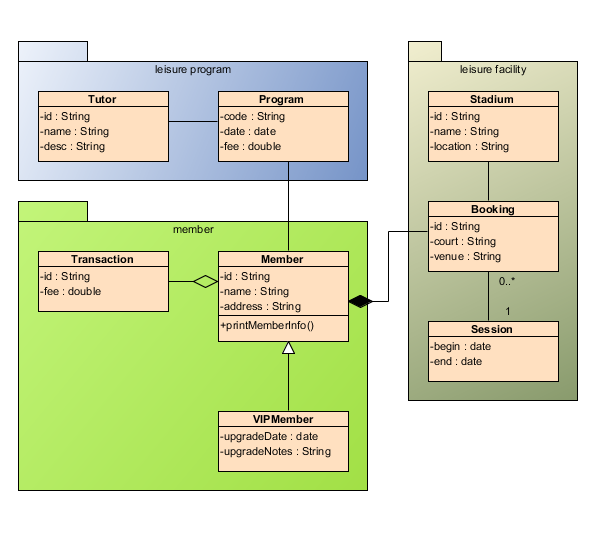
Class Diagram provides an overview of the target system by describing the objects and classes inside the system and the relationships between them. It provides a wide variety of usages; from modeling the domain-specific data structure to detailed design of the target system.
Key Benefits:
-
Domain Modeling: Capture business entities and their relationships
-
System Design: Define software architecture at the class level
-
Code Generation: Generate implementation code from model elements
-
Documentation: Create maintainable technical documentation
-
Model Reuse: Share class models across interaction diagrams for dynamic behavior modeling
-
Automated Generation: Use Form Diagram to generate diagrams automatically with user-defined scope
Core Notations and Elements
Basic Structural Elements
 Class
Class
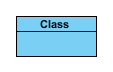
Definition: A class describes a set of objects that share the same specifications of features, constraints, and semantics. Class is a kind of classifier whose features are attributes and operations.
Key Properties:
| Property | Description |
|---|---|
| Name | The name of the class |
| Parent | The model element that owns the class |
| Visibility | Determines namespace appearance and accessibility |
| Abstract | If true, class cannot be instantiated directly |
| Leaf | If true, class cannot be further specialized |
| Root | Indicates whether the class has no ancestors |
| Active | Determines if objects are active (concurrent) or passive |
| Attributes | Direct properties owned by the class |
| Operations | Behavioral features specifying invocation parameters |
| Template Parameters | Formal parameters for template binding |
 Class <>
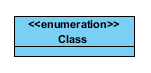
Definition: A form of class that acts as a container of enumeration literals. For instance, an enumeration Color holds enumeration literals red, green, and blue.
 Class <>
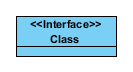
Definition: An interface is a kind of classifier that represents a declaration of a set of coherent public features and obligations. An interface specifies a contract; any instance of a classifier that realizes the interface must fulfill that contract.
Key Characteristics:
-
Interfaces are declarations and not instantiable
-
Implemented by instances of instantiable classifiers
-
A classifier may implement multiple interfaces
-
May include constraints and protocol specifications
 Class <>
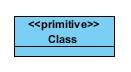
Definition: A form of class that represents a predefined data type. For instance, a boolean class (type).
 Note
Note
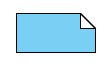
Definition: A note (comment) gives the ability to attach various remarks to elements. A comment carries no semantic force, but may contain information that is useful to a modeler.
 Constraint
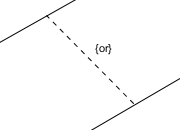
Definition: A condition or restriction expressed in natural language text or in a machine readable language for the purpose of declaring some of the semantics of an element.
Properties:
| Property | Description |
|---|---|
| Name | Optional name of the constraint |
| Expression | The condition that must be true for satisfaction |
| Documentation | Description of the constraint |
 Collaboration
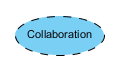
Definition: A collaboration is represented as a kind of classifier and defines a set of cooperating entities to be played by instances (its roles), as well as a set of connectors that define communication paths between the participating instances.
 Model
Model
Definition: A top-level package that contains the entire model or a significant part of it.
 NARY
NARY
Definition: Represents an n-ary association connecting multiple classifiers simultaneously.
Relationship Types
Association Relationships
 Association (Without aggregation)
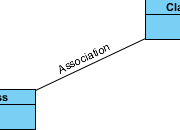
Definition: An association specifies a semantic relationship that can occur between typed instances. It has at least two ends represented by properties, each of which is connected to the type of the end.
Key Properties:
| Property | Description |
|---|---|
| Name | The name of the association |
| Visibility | Namespace appearance and accessibility |
| Association End From/To | Source and target of the association |
| Abstract | If true, association is incomplete and not instantiable |
| Leaf | If true, association cannot be further specialized |
| Derived | Specifies if derived from other model elements |
 Aggregation (Shared association)
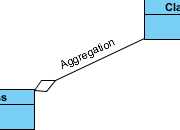
Definition: A kind of association that has one of its end marked shared as a kind of aggregation, meaning that it has a shared aggregation (whole-part relationship where parts can exist independently).
 Composition (Composite association)
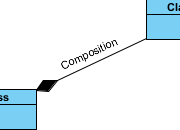
Definition: A strong form of aggregation where a part instance can be included in at most one composite at a time. If a composite is deleted, all of its parts are normally deleted with it.
Key Characteristics:
-
Parts cannot belong to multiple composites simultaneously
-
Deleting the composite typically deletes its parts
-
Parts can be removed before composite deletion
-
Compositions may form directed acyclic graphs with transitive deletion
 Association Class
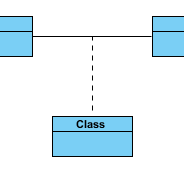
Definition: A model element that has both association and class properties. An AssociationClass can be seen as an association that also has class properties, or as a class that also has association properties.
Related Resource: Drawing association class
Dependency Relationships
 Dependency
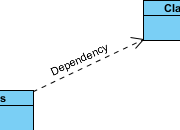
Definition: A relationship that signifies that a single or a set of model elements requires other model elements for their specification or implementation.
Properties:
| Property | Description |
|---|---|
| Supplier | Independent element(s) in the relationship |
| Client | Dependent element(s) in the relationship |
| Visibility | Namespace appearance and accessibility |
| Mapping | Optional expression stating the relationship |
 Abstraction
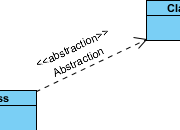
Definition: A relationship that relates two elements or sets of elements that represent the same concept at different levels of abstraction or from different viewpoints.
 Realization
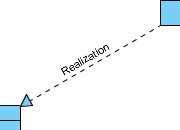
Definition: A specialized abstraction relationship between two sets of model elements, one representing a specification (the supplier) and the other represents an implementation of the latter (the client).
Use Cases: Stepwise refinement, optimizations, transformations, templates, model synthesis, framework composition
 Generalization
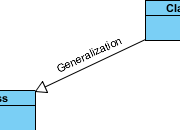
Definition: A taxonomic relationship between a more general classifier and a more specific classifier. Each instance of the specific classifier is also an indirect instance of the general classifier.
Key Property:
| Property | Description |
|---|---|
| Substitutable | If true, specific classifier can replace general classifier at runtime |
 Usage
Usage
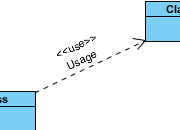
Definition: A relationship in which one element requires another element (or set of elements) for its full implementation or operation.
 Access
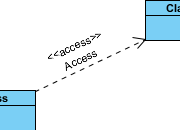
Definition: An element import defined as a directed relationship between an importing namespace and a packageable element. The name of the packageable element or its alias is added to the namespace of the importing namespace.
Notation:
-
<\<import>>keyword for public visibility -
<\<access>>keyword for private visibility
 Import
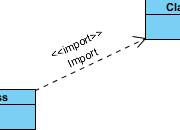
Definition: A package import is defined as a directed relationship that identifies a package whose members are to be imported by a namespace.
 Permission
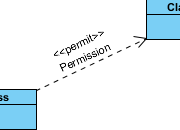
Definition: A kind of dependency that grants a model element permission to access elements in another namespace.
 Instantiation
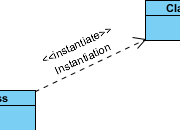
Definition: A usage dependency among classifiers indicating that operations on the client create instances of the supplier.
 Binding
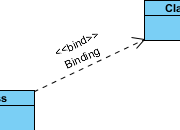
Definition: TemplateBinding is a directed relationship from a bound templateable element to the template signature of the target template. A TemplateBinding owns a set of template parameter substitutions.
 Derive
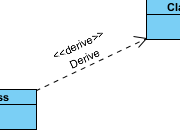
Definition: Specifies a derivation relationship among model elements that are usually, but not necessarily, of the same type. A derived dependency specifies that the client may be computed from the supplier.
 Refine
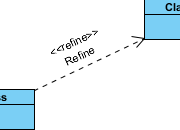
Definition: Specifies a refinement relationship between model elements at different semantic levels, such as analysis and design.
Use Cases: Transformations from analysis to design, model evolution
 Trace
Trace
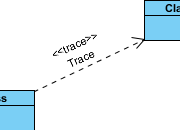
Definition: Specifies a trace relationship between model elements or sets of model elements that represent the same concept in different models.
Primary Use: Tracking requirements and changes across models; mapping is usually informal and bidirectional
 Substitution
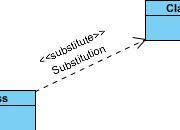
Definition: A relationship between two classifiers which signifies that the substitutingClassifier complies with the contract specified by the contract classifier.
Implication: Instances of the substituting classifier are runtime substitutable where instances of the contract classifier are expected.
 Merge
Merge
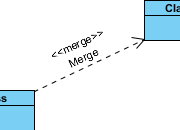
Definition: A package merge is a directed relationship between two packages that indicates that the contents of the two packages are to be combined.
Key Characteristics:
-
Similar to Generalization but for package contents
-
Used when elements in different packages represent the same concept
-
Enables incremental extension of base concepts
-
Particularly useful in meta-modeling and UML metamodel definition
Class Variants and Stereotypes
ORM-Specific Classes
 Class <>
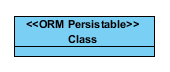
Definition: A special form of class that can be used to model an object model of a relational database. ORM code can be generated from a set of ORM Persistable classes.
Additional Properties:
| Property | Description |
|---|---|
| ORM Class Details | Settings affecting ORM code generation |
| Business Key | Used for generating equals() and hashCode() operations |
| ORM Query | Define ORM Qualifiers and named queries |
 Class <>
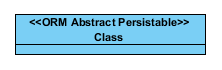
Definition: A special form of class that captures common attributes of sub-ORM-Persistable classes.
 Class <>
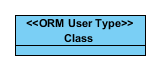
Definition: A user type class defines an object type for object model that can be accessed in generated ORM code, and persist in database as a column instead of an entity.
Related Resource: Hibernate User Type Support
 Class <>
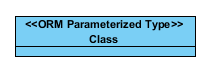
Definition: An ORM Parameterized type provides you with opportunity to enforce the correctness of data by implementing correctness checking in generated ORM code.
 Class <>
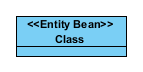
Definition: A special form of class for modeling EJB entity bean.
Additional Properties:
| Property | Description |
|---|---|
| EJB Class Code Details | EJB-related attributes for code generation |
Properties and Configuration
Common Class Properties Reference
| Property | Applies To | Description |
|---|---|---|
| Name | All elements | Identifier for the model element |
| Parent | Classes, Interfaces | Owning model element |
| Visibility | Most elements | Controls namespace appearance: public, private, protected, package |
| Abstract | Classes, Associations | If true, element is incomplete and not directly instantiable |
| Leaf | Classes, Associations | If true, element cannot be further specialized |
| Root | Classes | Indicates whether element has no ancestors |
| Active | Classes | Determines if objects are active (concurrent) or passive |
| Business Model | Classes | Flag to mark as a “business class” |
| Attributes | Classes | Direct properties owned by the class |
| Operations | Classes | Behavioral features with parameters and constraints |
| Template Parameters | Templateable elements | Formal parameters for generic/parameterized elements |
| Derived | Associations | Specifies if element is derived from other model elements |
Code Generation Settings
Java-Specific Configuration
-
Java Annotations: Metadata added to Java source code for annotation purposes
-
Round-trip Engineering: Generate and synchronize Java code
ORM-Specific Configuration
-
ORM Query: Define qualifiers and named queries for persistable classes
-
Business Key: Configure fields used for equals()/hashCode() generation
-
Column Mapping: Specify database column names and types
Related UML Diagram Types
Class diagrams integrate with other UML diagrams for comprehensive system modeling:
| Diagram Type | Purpose | Link |
|---|---|---|
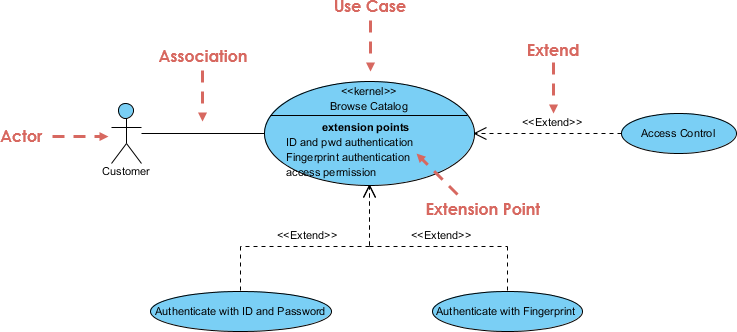
| Use Case Diagram | Capture functional requirements | Use case diagram |
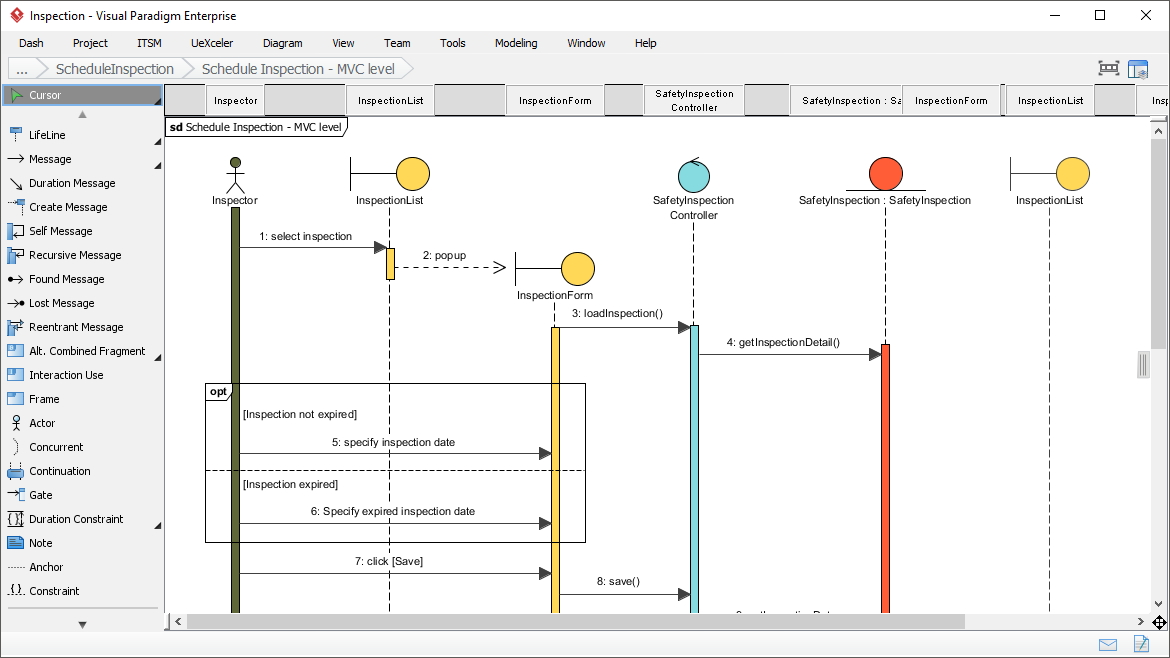
| Sequence Diagram | Model dynamic interactions over time | Sequence diagram |
| Communication Diagram | Show object interactions and links | Communication diagram |
| State Machine Diagram | Model object lifecycle and states | State machine diagram |
| Activity Diagram | Represent workflows and processes | Activity diagram |
| Component Diagram | Show physical software components | Component diagram |
| Deployment Diagram | Model hardware and software deployment | Deployment diagram |
| Package Diagram | Organize model elements into packages | Package diagram |
| Object Diagram | Show instances at a specific moment | Object diagram |
| Composite Structure Diagram | Model internal structure of classifiers | Composite structure diagram |
| Timing Diagram | Focus on timing constraints | Timing diagram |
| Interaction Overview Diagram | Combine interaction and activity diagrams | Interaction overview diagram |
Reference List
- Primary Diagram References
-
Use Case Diagram: Visual representation of system functionality from user perspective, capturing actors and their goals.
-
Sequence Diagram: Shows object interactions arranged in time sequence, emphasizing message ordering.
-
Communication Diagram: Displays object interactions with emphasis on structural relationships between objects.
-
State Machine Diagram: Models the dynamic behavior of an object through its lifecycle states and transitions.
-
Activity Diagram: Represents workflows, business processes, and operational steps with control flow.
-
Component Diagram: Illustrates physical software components, their interfaces, and dependencies.
-
Deployment Diagram: Shows hardware nodes, software artifacts, and their deployment relationships.
-
Package Diagram: Organizes model elements into hierarchical packages for modularity and namespace management.
-
Object Diagram: Displays instances of classes and their links at a specific point in time.
-
Composite Structure Diagram: Models internal structure of classifiers including parts, ports, and connectors.
-
Timing Diagram: Focuses on timing constraints and state changes over precise time intervals.
-
Interaction Overview Diagram: Combines interaction diagrams with activity diagram notation for high-level interaction flow.
- Class Diagram Notation References
-
Abstraction: Relationship relating elements representing same concept at different abstraction levels.
-
Access: Element import relationship controlling visibility of imported packageable elements.
-
Aggregation (Shared association): Whole-part relationship where parts can exist independently of the whole.
-
Association (Without aggregation): Semantic relationship between typed instances with navigable ends.
-
Association Class: Model element combining association and class properties for relationship attributes.
-
Binding: Template binding relationship with parameter substitutions for generic elements.
-
Class: Core classifier describing objects with shared features, attributes, and operations.
-
Class <>: Container class for enumeration literals representing fixed value sets.
-
Class <>: Contract specification declaring public features for implementing classifiers.
-
Class <>: Predefined data type class representing basic language types.
-
Class <>: Database-mapped class supporting ORM code generation and persistence.
-
Class <>: Abstract base class for sharing common ORM attributes across persistable subclasses.
-
Class <>: Custom type persisted as database column rather than entity table.
-
Class <>: Parameterized type enabling data correctness validation in ORM code.
-
Class <>: EJB entity bean modeling class for enterprise Java applications.
-
Collaboration: Classifier defining cooperating roles and communication paths for interacting instances.
-
Composition (Composite association): Strong whole-part relationship with exclusive ownership and cascading deletion.
-
Constraint: Condition or restriction declaring semantics of model elements.
-
Dependency: Relationship indicating one element requires another for specification or implementation.
-
Derive: Relationship specifying client element computable from supplier element.
-
Generalization: Inheritance relationship where specific classifier inherits features from general classifier.
-
Import: Package import relationship making package members available to importing namespace.
-
Instantiation: Dependency indicating client operations create instances of supplier classifier.
-
Merge: Package merge combining contents of two packages for incremental concept extension.
-
Model: Top-level container for organizing model elements and packages.
-
NARY: N-ary association connecting multiple classifiers simultaneously.
-
Note: Comment element for attaching non-semantic remarks to model elements.
-
Permission: Dependency granting access permission to elements in another namespace.
-
Realization: Specialized abstraction where client implements specification defined by supplier.
-
Refine: Relationship between model elements at different semantic levels like analysis and design.
-
Substitution: Relationship indicating substituting classifier complies with contract classifier specification.
-
Trace: Relationship tracking same concept across different models, primarily for requirements management.
-
Usage: Dependency where client element requires supplier element for full implementation or operation.
- Tutorial and Resource References
-
Drawing Association Class: Step-by-step guide for creating association classes in Visual Paradigm.
-
Generate and Synchronize Java Code: Tutorial for round-trip engineering between class diagrams and Java implementation.
-
Hibernate User Type Support: Resource for implementing custom Hibernate user types with ORM-Persistable classes.
- Standards Reference
-
Object Management Group – Unified Modeling Language: Official UML specification source from the standards body governing UML.
-
Definition of notations is quoted from Object Management Group Unified Modeling Language (OMG UML) Superstructure Version 2.2 and former versions (for notations that do not exist anymore in latest specification).
- This guide is based on Visual Paradigm’s UML Class Diagram documentation. For the most current specifications, always refer to the official OMG UML standards.


 English
 Arabic
 Chinese (Simplified)
 Dutch
Dutch French
 German
 Italian
 Japanese
 Korean
 Portuguese
 Russian
 Spanish