


Enterprise architecture is a complex discipline that demands clarity, precision, and alignment. At the heart of successful architecture management lies the ability to communicate effectively across different levels of the organization. This is where ArchiMate Viewpoints become indispensable. A viewpoint defines the perspective from which an architecture description is constructed, ensuring that stakeholders receive information relevant to their specific roles and concerns. 🎯
Applying these viewpoints correctly is not merely about drawing diagrams; it is about structuring knowledge to drive decision-making. This guide provides a deep dive into best practices for implementing ArchiMate Viewpoints within your organization. We will explore the foundational concepts, design strategies, governance frameworks, and common pitfalls to avoid. By following these guidelines, you can ensure your architecture efforts translate into tangible business value. 💡
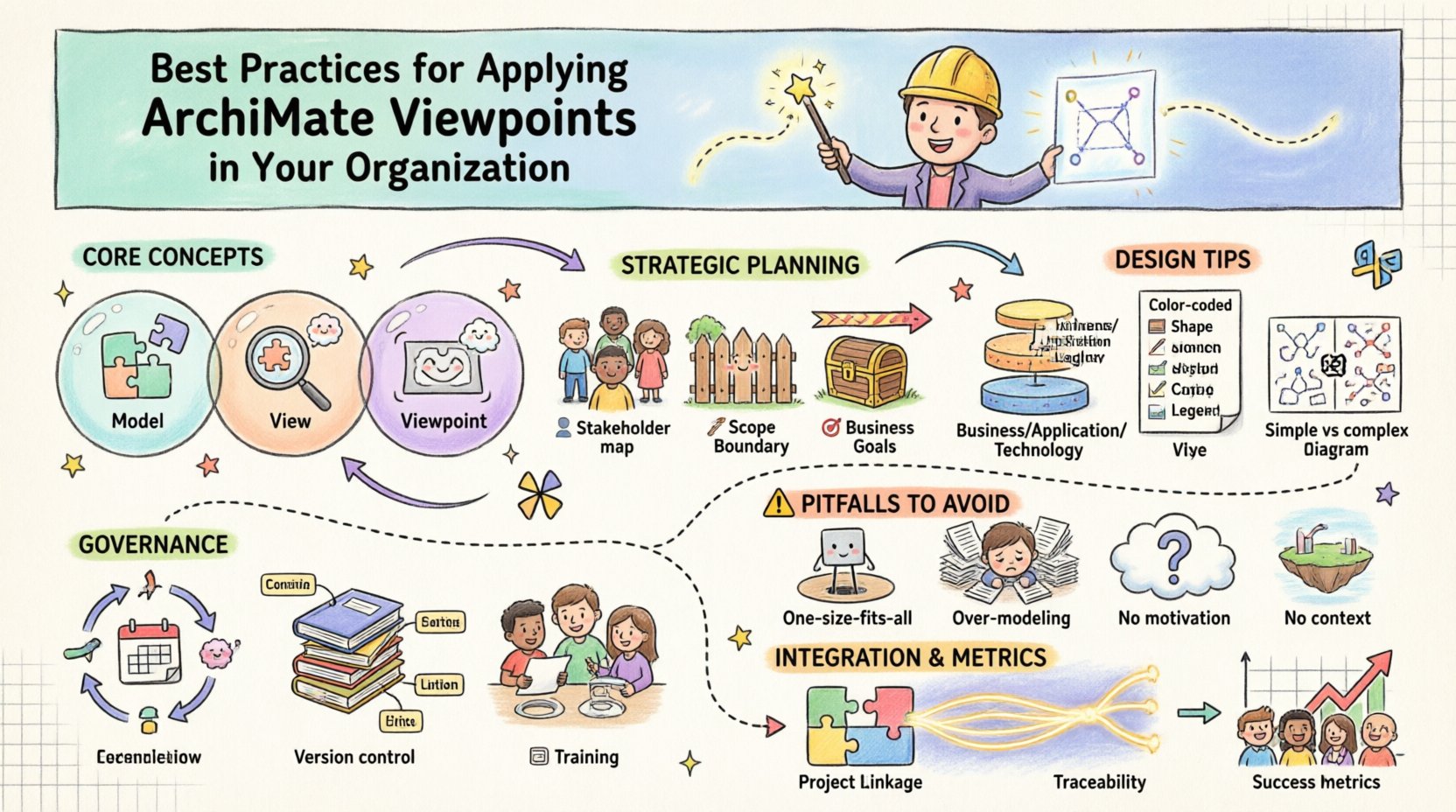
Understanding the Core Concepts 🔍
Before implementing any practice, it is crucial to understand the terminology. In the context of enterprise architecture, three terms often get confused: Model, View, and Viewpoint. Distinguishing between them is the first step toward effective application.
- Architecture Model: This is the complete description of the enterprise architecture. It contains all the elements, relationships, and rules defined within the standard.
- View: A representation of a system from the perspective of a stakeholder. It is a specific subset of the model tailored for a specific audience.
- Viewpoint: The specification of a view. It defines the conventions, language, and rules used to construct the view. It tells the architect what to show and what to hide.
Think of the Viewpoint as the template. It defines the questions the view must answer. For example, a viewpoint for a Chief Financial Officer might focus on cost structures and resource allocation, while a viewpoint for a Developer might focus on component interfaces and data flows. 📊
Strategic Planning for Viewpoint Adoption 📅
Rolling out a new architectural practice requires more than just technical knowledge; it requires strategic planning. You cannot simply define a Viewpoint and expect it to be adopted. It must fit into the existing organizational processes.
1. Identify Key Stakeholders Early 👥
Every Viewpoint serves a specific audience. The first step in planning is to map out who these audiences are. Do not assume you know their needs. Conduct interviews or workshops to understand their information gaps.
- Executive Leadership: Needs high-level strategy, business capabilities, and investment risks.
- Business Managers: Needs process flows, organizational structures, and service definitions.
- IT Managers: Needs application landscapes, infrastructure, and data models.
- Developers: Needs interface specifications, deployment nodes, and technical standards.
2. Define the Scope and Boundaries 🚧
Not every Viewpoint needs to cover the entire enterprise. Scope creep is a common failure point. Define clear boundaries for each Viewpoint. Does it cover the whole organization or just a specific department? Does it cover the current state, the target state, or both?
Clear boundaries prevent the architecture team from becoming overwhelmed and ensure the artifacts remain manageable. A Viewpoint that tries to explain everything usually explains nothing. Focus on the specific concerns of the intended audience.
3. Align with Business Goals 🎯
Architecture exists to serve the business. Every Viewpoint should have a clear link to a business goal. If a Viewpoint does not help answer a business question or support a strategic decision, it may be unnecessary. Ensure that the content of the Viewpoint aligns with the organization’s strategic objectives.
Designing Effective Viewpoints 🎨
Designing a Viewpoint is an exercise in abstraction. You must decide which elements of the ArchiMate language are relevant and how they should be presented. A well-designed Viewpoint is intuitive and reduces cognitive load.
1. Select the Right Language Layers 🧩
The ArchiMate language is divided into layers such as Business, Application, Technology, and Strategy. A Viewpoint should not mix layers arbitrarily unless there is a clear cross-layer relationship to illustrate.
For instance, a Business Process Viewpoint typically stays within the Business Layer. However, a Service-Oriented Architecture Viewpoint might bridge the Business and Application layers to show how services enable processes. Choose the layers that provide the necessary context without introducing noise.
2. Standardize Notation and Symbols ✍️
Consistency is key to readability. Establish a standard for shapes, colors, and line types within your Viewpoints. If a rectangle represents a Business Process in one Viewpoint, it must represent a Business Process in all other Viewpoints.
Use the following table to establish a standard notation guide for your organization:
| Element Type | Shape | Color | Usage |
|---|---|---|---|
| Business Actor | Person Icon | Blue | Stakeholders, Roles |
| Business Process | Rounded Rectangle | Green | Activities, Flows |
| Application Component | Cylinder | Orange | Software Systems |
| Technology Node | Device Icon | Grey | Hardware, Infrastructure |
| Relationship (Usage) | Arrow | Black | Dependency, Flow |
3. Keep Diagrams Simple 🖼️
A common mistake is overcrowding a Viewpoint with too many elements. If a diagram requires a legend that is longer than the diagram itself, it is too complex. Aim for simplicity. Use multiple Viewpoints to break down complex topics rather than forcing them onto a single page.
Focus on the relationships that matter. If two elements are loosely coupled and not central to the message, exclude them. The goal is clarity, not completeness.
Governance and Maintenance 🛡️
Once Viewpoints are created, they require governance. Architecture is not a one-time project; it is a continuous discipline. Viewpoints must evolve as the organization changes.
1. Establish a Review Cycle 🔁
Schedule regular reviews for your Viewpoints. These reviews should check for accuracy, relevance, and compliance with standards. An outdated Viewpoint is worse than no Viewpoint at all because it misleads stakeholders.
Consider a quarterly review for critical Viewpoints and an annual review for general ones. Ensure that the review process includes feedback from the stakeholders who use these Viewpoints.
2. Version Control and Change Management 📝
Just like software, architecture artifacts need version control. When a Viewpoint changes, document what changed, why it changed, and who approved the change. This creates an audit trail and helps stakeholders understand the evolution of the architecture.
- Version Numbering: Use a clear scheme (e.g., v1.0, v1.1, v2.0).
- Change Log: Maintain a log of modifications for each Viewpoint.
- Approval Workflow: Define who has the authority to approve changes to the Viewpoint definitions.
3. Training and Documentation 📚
Even the best Viewpoint is useless if no one knows how to use it. Provide training sessions for architects and stakeholders. Create documentation that explains the purpose of each Viewpoint and how to interpret the diagrams.
Develop a glossary of terms to ensure everyone uses the ArchiMate terminology consistently. This reduces ambiguity and improves communication efficiency.
Common Pitfalls and How to Avoid Them ⚠️
Many organizations struggle with architectural modeling. Understanding common pitfalls can save you from making the same mistakes. Below are the most frequent issues encountered when applying Viewpoints.
1. The “One Size Fits All” Trap 🚫
Creating a single Viewpoint for everyone is a mistake. Executives do not need to see technical deployment nodes, and developers do not need to see high-level business strategy. Tailor your Viewpoints to the specific audience.
2. Over-Modeling 🏗️
Modeling every single detail in the enterprise is impossible and unnecessary. Focus on the parts of the architecture that are changing or that are critical to the current business challenge. If a Viewpoint is too detailed, it becomes a reference manual rather than a communication tool.
3. Ignoring the Motivation Layer 🧠
Often, architects focus on the structural layers (Business, Application, Technology) and ignore the Motivation layer (Goal, Objective, Principle). Without the Motivation layer, stakeholders do not understand why a change is being proposed. Include drivers and constraints in your Viewpoints to provide context.
4. Lack of Context 🌍
A Viewpoint that shows a process in isolation is confusing. Always include context. If you show a business process, show who owns it and what business service it supports. Context bridges the gap between the diagram and the reality.
Integrating Viewpoints into the Enterprise Architecture Process 🔄
Viewpoints should not exist in a vacuum. They must be integrated into the broader Enterprise Architecture (EA) lifecycle. This ensures that the Viewpoints are used to support actual projects and initiatives.
1. Link Viewpoints to Projects 📂
When a project is initiated, identify which Viewpoints are required to support it. For example, a migration project will require a Technology Viewpoint to show the target infrastructure and a Business Viewpoint to show the affected processes.
Make the use of Viewpoints a gate in the project approval process. Projects should not proceed without the necessary architectural views to validate the design.
2. Ensure Traceability 🔗
Traceability is the ability to link elements from one Viewpoint to another. If a Business Process is mapped to an Application, that link should be visible and traceable. This ensures that changes in one layer are understood in the context of the other layers.
Use traceability to perform impact analysis. If a technology component changes, trace it up to see which business processes are affected.
3. Automate Where Possible 🤖
While manual modeling is common, automation can improve consistency. Use tools to generate Viewpoints from the underlying model. This reduces the effort required to keep diagrams up to date and ensures that the views are always consistent with the source data.
Measurement and Success Metrics 📈
How do you know if your Viewpoint strategy is working? You need to define success metrics. Without metrics, it is difficult to justify the investment in architecture governance.
1. Adoption Rate 👥
Measure how often stakeholders use the Viewpoints. Are they accessing them during meetings? Are they referencing them in decision documents? High adoption indicates that the Viewpoints are relevant and useful.
2. Decision Support ⏱️
Track the time it takes to answer architectural questions. If Viewpoints are effective, the time to find information should decrease over time. If stakeholders still need to ask the architecture team for every detail, the Viewpoints are not sufficient.
3. Consistency Score ✅
Measure the consistency of the models. Are there conflicting diagrams? Are the definitions standard across Viewpoints? A high consistency score indicates good governance and maintenance practices.
4. Stakeholder Satisfaction 🗣️
Conduct regular surveys with stakeholders. Ask them if the Viewpoints help them understand the architecture and if they find the information accurate. Qualitative feedback is often more valuable than quantitative metrics.
Final Thoughts on Architecture Communication 🤝
Applying ArchiMate Viewpoints is a journey toward better communication and alignment. It requires discipline, planning, and continuous improvement. By following the best practices outlined in this guide, your organization can create a robust architecture capability that supports strategic goals.
Remember that the goal is not to create perfect models. The goal is to create useful representations that enable stakeholders to make informed decisions. Focus on the audience, keep the design simple, and maintain a strong governance framework.
With the right approach, Viewpoints become more than just diagrams. They become the common language of your enterprise, bridging the gap between business strategy and technical execution. 🚀

 English
 Arabic
 Chinese (Simplified)
 Dutch
Dutch French
 German
 Italian
 Japanese
 Korean
 Portuguese
 Russian
 Spanish