


Enterprise Architecture (EA) serves as the blueprint for organizational change. It bridges the gap between business strategy and IT implementation. However, a complete architecture model can quickly become overwhelming. Too much detail in a single diagram obscures the message. This is where the strategic application of ArchiMate Viewpoints becomes essential. By defining specific perspectives, architects can communicate complex information effectively to different audiences. This guide explores how to leverage these viewpoints to clarify, structure, and transform your enterprise architecture practice. 📈
The complexity of modern organizations requires more than just a collection of models. It demands a structured approach to representation. Viewpoints act as lenses. They filter the vast amount of data in the architecture repository to show only what is relevant for a specific task. Whether you are presenting to a C-level executive or detailing a technical deployment for developers, the right viewpoint ensures clarity. This document outlines the methodology for designing and implementing these viewpoints without relying on specific tooling vendors. 🛠️
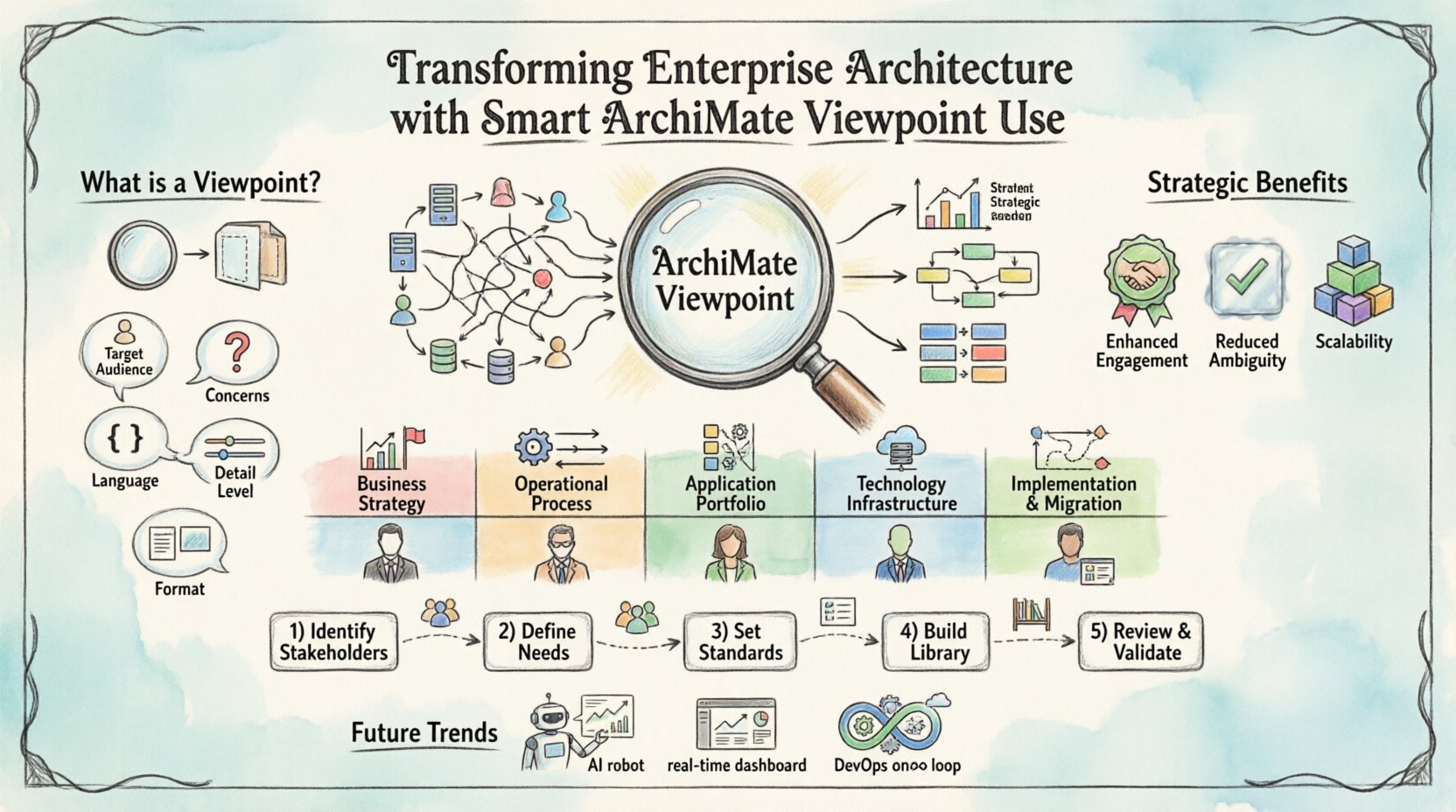
Understanding the Core Concept: What is a Viewpoint? 🧩
In the context of the ArchiMate modeling language, a viewpoint is a specification of the conventions for a particular type of architecture description. It defines the scope, purpose, and the specific elements and relationships that should be included in a view. Think of it as a template. It tells the modeler what to show and what to hide to maintain focus.
Without viewpoints, an architecture repository risks becoming a chaotic collection of unrelated diagrams. Stakeholders often complain that EA is too abstract or too technical. Viewpoints solve this by aligning the representation with the stakeholder’s concerns. For instance, a business manager cares about processes and capabilities. A software engineer cares about components and interfaces. A single diagram cannot satisfy both needs effectively.
Key Components of a Viewpoint Specification
- Target Audience: Who is consuming this information? Is it management, developers, or auditors?
- Concerns: What questions must this view answer? Examples include cost, risk, or performance.
- Language: Which ArchiMate concepts are permitted? For example, restricting the view to Business Layer elements only.
- Level of Detail: How granular should the data be? High-level summaries versus detailed implementation specs.
- Format: How will the information be presented? Diagrams, tables, or reports?
By strictly defining these components, you create consistency across the architecture repository. This consistency builds trust. Stakeholders know what to expect when they request a specific type of view. It reduces the cognitive load required to interpret the models. 🧠
Strategic Benefits of Structured Viewpoints 📊
Implementing a robust set of viewpoints is not merely an administrative task. It yields tangible strategic advantages. It transforms the EA function from a documentation exercise into a communication engine.
1. Enhanced Stakeholder Engagement 🤝
When stakeholders see information tailored to their specific role, they are more likely to engage. A finance director reviewing a cost view will find value immediately. They do not need to sift through technical deployment details to understand the financial impact of a change. This relevance drives participation in the architecture governance process.
2. Reduced Ambiguity and Misinterpretation
Generic models often lead to assumptions. A diagram might be interpreted differently by different people. Viewpoints impose constraints on the symbols and relationships used. This standardization ensures that a specific symbol means the same thing to everyone in the organization. It creates a common language that minimizes errors during implementation.
3. Scalability of the Architecture Repository
As an organization grows, so does its architecture model. A monolithic model becomes unmanageable. Viewpoints allow you to slice the model into manageable chunks. You can maintain the integrity of the whole model while presenting only the necessary slices to specific users. This approach keeps the repository clean and performant.
Designing Effective Viewpoints for Stakeholders 🎯
Designing viewpoints requires an understanding of the organizational structure and the information needs of its members. It is a deliberate process of abstraction. Below is a breakdown of common viewpoint categories and their specific applications.
| Viewpoint Category | Primary Audience | Focus Area | Key Concepts |
|---|---|---|---|
| Business Strategy | Executive Leadership | Alignment of goals | Value Stream, Capability, Goal |
| Operational Process | Process Owners | Workflow efficiency | Process, Function, Application Service |
| Application Portfolio | CTO, IT Managers | Software landscape | Application Component, Interface |
| Technology Infrastructure | Infrastructure Teams | Hardware and networks | Node, Device, Communication Path |
| Implementation & Migration | Project Managers | Transition planning | Plateau, Path, Application Deployment |
This table illustrates the diversity of views required. A successful architecture practice will maintain a library of these viewpoints. It allows architects to assemble reports quickly without recreating data from scratch. 📋
Implementation Steps for Architecture Descriptions 🛠️
Integrating viewpoints into your workflow requires a structured approach. It is not enough to simply draw diagrams. You must establish the governance and standards that support them.
Step 1: Identify Stakeholder Groups
Begin by mapping out who needs architecture information. Categorize them by their function and decision-making power. Do not treat all stakeholders the same. A developer needs different data than a procurement officer. List these groups explicitly.
Step 2: Define Information Needs
For each stakeholder group, determine what they need to know to do their job effectively. Ask questions such as: What risks do they face? What decisions do they make? What metrics do they track? This analysis forms the basis for the viewpoint definition.
Step 3: Establish Modeling Standards
Define the rules for the diagrams. Which elements are mandatory? Which relationships are allowed? Consistency is key. If one architect uses a specific notation for a business role, all must follow suit. Create a style guide for your architecture descriptions.
Step 4: Develop the View Library
Create the actual templates. These can be saved configurations within your modeling environment. Ensure they are reusable. When a new project starts, the architect should be able to select the appropriate viewpoint template and begin modeling immediately.
Step 5: Review and Validate
Before rolling out new viewpoints, test them. Show them to the intended audience. Ask if the information is clear. Is anything missing? Are there unnecessary details? Iterate based on this feedback. A viewpoint that is not understood is a failed viewpoint.
Common Challenges and How to Avoid Them ⚠️
Even with a solid plan, challenges arise. Understanding these pitfalls helps you navigate the implementation process smoothly.
- Over-Engineering: Creating too many viewpoints can be as bad as having none. It creates maintenance overhead. Focus on the high-frequency views first. Expand only when a genuine need arises.
- Inconsistent Naming: Ensure that element names are consistent across all viewpoints. If a process is called “Order Processing” in one view and “Sales Order Mgmt” in another, it causes confusion. Enforce a naming convention.
- Lack of Maintenance: Architecture models degrade over time. If the source data is not updated, the views become obsolete. Integrate viewpoint updates into the regular change management cycle.
- Ignoring the Context: A view that works for a large enterprise might not work for a division. Consider the scale of the organization. Sometimes a simplified view is necessary to avoid overwhelming the audience.
Addressing these issues early prevents technical debt in your architecture documentation. It ensures the repository remains a living asset rather than a graveyard of outdated diagrams. 🗑️
Integrating Viewpoints into Governance 📜
Viewpoints are most effective when they are part of the governance process. Governance is the mechanism that ensures architecture standards are followed. Viewpoints provide the evidence required for governance decisions.
The Role in Architecture Review Boards
During architecture review meetings, reviewers need a standard way to assess proposals. Viewpoints provide this standard. If a proposal is submitted using a specific viewpoint, reviewers know exactly what criteria to apply. This speeds up the review process and makes the criteria transparent.
Compliance and Audit Trails
In regulated industries, proof of compliance is essential. Viewpoints can be designed to highlight specific compliance elements. For example, a security viewpoint might focus exclusively on authentication and data protection mechanisms. This makes audit preparation significantly easier. You can generate the specific views needed for an auditor without digging through unrelated models.
Measuring Success and Iteration 📏
How do you know if your viewpoint strategy is working? You need metrics. Quantitative and qualitative data can guide your improvements.
Usage Metrics
- How often are specific viewpoints accessed?
- Are certain views requested frequently while others are ignored?
- What is the turnaround time for generating a view?
Feedback Loops
Regularly survey your stakeholders. Ask them if the information provided helps them make decisions. Are they confused by any terminology? Use this feedback to refine the viewpoints. The goal is continuous improvement.
Quality Assurance
Conduct periodic audits of the models. Check for consistency between the viewpoint definition and the actual diagram. Are all required elements present? Are forbidden elements excluded? This ensures the integrity of the architecture repository.
Future Trends in Architecture Modeling 🚀
The landscape of enterprise architecture is evolving. As organizations become more agile and digital, the demand for architecture information changes. Viewpoints must adapt to these shifts.
Automation and AI
Future tools may automate the generation of viewpoints based on natural language requests. Instead of manually selecting a view, an architect might ask for “the security view for the payment service.” The system would generate the relevant diagram using the defined viewpoint standards. This reduces the administrative burden significantly.
Real-Time Architecture
Current models are often snapshots in time. Future trends point towards live architecture views connected to operational data. Viewpoints will need to handle dynamic data streams. This allows stakeholders to see the current state of the architecture, not just the planned state.
Integration with DevOps
As DevOps practices mature, the gap between architecture and development narrows. Viewpoints will need to be more granular and closer to the code level. They will serve as a bridge between high-level strategy and low-level implementation details.
Conclusion on Architecture Value 🏁
The transformation of enterprise architecture relies heavily on communication. It is not enough to have a model that is technically correct. The model must be understood. ArchiMate Viewpoints provide the mechanism to translate technical complexity into business value. By defining clear perspectives, you ensure that the right information reaches the right people at the right time.
Implementing this strategy requires discipline. It demands a commitment to standards and continuous refinement. However, the payoff is a clearer understanding of the organization. It reduces risk and accelerates decision-making. As you move forward, prioritize the needs of your stakeholders. Let their requirements drive the design of your viewpoints. This approach ensures that your architecture practice remains relevant and valuable. 🌟
Remember, the goal is not just to document. It is to illuminate the path forward. With thoughtful viewpoint management, you create a foundation for sustainable change. Start with the basics. Identify your key audiences. Define their needs. Build your library. Then iterate. The journey to a mature architecture capability begins with these fundamental steps. Keep the focus on clarity and utility. That is the true measure of success. ✅

 English
 Arabic
 Chinese (Simplified)
 Dutch
Dutch French
 German
 Italian
 Japanese
 Korean
 Portuguese
 Russian
 Spanish