


Enterprise architecture is a complex discipline that requires precision, clarity, and a shared understanding across various organizational levels. At the heart of this discipline lies the ArchiMate modeling language. While the language provides the syntax, the ArchiMate Viewpoints provide the semantics necessary for effective communication. They serve as the lens through which stakeholders view the architecture, ensuring that the right information is presented to the right people at the right time.
This guide explores the architecture of viewpoints in depth. We will move beyond surface-level definitions to understand the structural components, the layer interactions, and the strategic application of these models. Whether you are designing a new framework or refining an existing one, understanding these components is essential for maintaining architectural integrity.
🔍 Understanding the Core Concept of Viewpoints
A viewpoint defines how a specific set of stakeholders sees the architecture. It is not merely a drawing; it is a representation of the structure and behavior of the enterprise that is relevant to a particular concern. Without viewpoints, an architecture model becomes a monolithic blob of information that is difficult to navigate.
- Stakeholder Alignment: Different roles require different information. A developer needs technical details, while a business executive needs process flows. Viewpoints bridge this gap.
- Abstraction Management: Viewpoints allow for the hiding of unnecessary detail, focusing attention on specific aspects of the model.
- Consistency: By defining standard viewpoints, organizations ensure that models created by different teams remain consistent and comparable.
The ArchiMate specification organizes these viewpoints into a structured matrix. This matrix is defined by the intersection of Layers and Types. Understanding this matrix is the first step in mastering the language.
📊 The Architecture Viewpoint Matrix
The matrix provides a structured approach to selecting the right view for a given situation. The following table outlines the primary layers and the specific types of concerns they address.
| Layer | Business | Application | Technology | Infrastructure | Implementation & Migration |
|---|---|---|---|---|---|
| Motivation | Business Goals | Application Requirements | Technical Drivers | Infra Constraints | Migration Strategy |
| Business | Processes & Roles | – | – | – | – |
| Application | – | Services & Data | – | – | – |
| Technology | – | – | Hardware & Software | – | – |
| Implementation | Project Mapping | App Deployment | System Deployment | – | Transition States |
🧩 The Motivation Layer: The Foundation
The Motivation Layer is often the most overlooked, yet it is critical for understanding why changes are being made. It deals with the drivers, goals, and assessment of the architecture. Without this layer, the rest of the model lacks context.
🎯 Goals, Principles, and Requirements
This layer defines the driving forces behind the architecture. It answers questions such as: What is the business trying to achieve? What constraints must be respected?
- Goal: A desired state of affairs that an actor wishes to achieve. Goals provide direction.
- Driver: Something that motivates an actor to initiate a change. This could be a market trend or a regulatory requirement.
- Principle: A rule or guideline that guides decision-making. Principles ensure consistency across the enterprise.
- Requirement: A condition or capability that must be met by the architecture. This often stems from a goal.
- Assessment: A formal evaluation of a situation. This helps in determining the value of a proposed change.
🔄 Relationship Mapping
Understanding the relationships between these elements is vital. For instance, a Driver might lead to a Goal, which in turn creates a Requirement. A Principle might constrain how a Goal is achieved. Visualizing these relationships helps stakeholders see the logical flow from intent to implementation.
🏢 The Business Layer: Processes and Roles
The Business Layer describes how the organization operates. It focuses on the people, their roles, and the processes they execute to deliver value. This layer is the closest to the day-to-day operations of the enterprise.
⚙️ Business Processes
A business process is a collection of related, structured activities or tasks that produce a specific service or product for a particular customer or customers. Key elements include:
- Business Process: The core activity unit.
- Business Function: An ability to perform a specific activity. Functions are more stable than processes.
- Business Actor: A person or organization that performs a business process. This could be an employee, a department, or an external partner.
- Business Role: A collection of responsibilities. A single actor can fulfill multiple roles.
- Business Service: A unit of functionality provided by a business actor to another actor.
🔗 Business Service and Process Flow
The connection between services and processes is crucial. A process provides a service. Actors perform processes. Roles define the responsibilities within the process. When modeling this layer, it is important to distinguish between the what (process) and the who (actor/role).
💻 The Application Layer: Software and Data
The Application Layer represents the software systems that support the business processes. It describes how data is managed and how functionality is exposed to the business or other applications.
🗄️ Data and Functionality
This layer bridges the gap between business logic and technical implementation. Key components include:
- Application Component: A modular part of an application system. It encapsulates functionality.
- Application Function: A specific capability provided by an application component.
- Application Service: A unit of functionality exposed by an application component to other components or users.
- Application Interaction: A communication between application components.
- Application Interface: A boundary where an application component interacts with the outside world.
- Data Object: Information that is managed by an application function. This is the data structure.
📡 Service Orientation
In modern architecture, services are the primary unit of interaction. The Application Layer focuses heavily on how these services are exposed and consumed. Understanding the interface between an application service and a business service is key to ensuring traceability from business need to technical capability.
🖥️ The Technology Layer: Infrastructure
The Technology Layer describes the hardware and software infrastructure required to support the applications. It is the physical or virtual environment where the application layer runs.
🌐 Nodes and Devices
This layer deals with the deployment of software onto hardware. Key elements include:
- Device: A hardware component. Examples include servers, workstations, or network routers.
- System Software: Software that manages hardware resources. Examples include operating systems or databases.
- Network: A collection of devices and communication paths. This includes LANs, WANs, and cloud networks.
- Communication Path: The physical or logical path used for data transmission.
- Artifact: A physical representation of information. This could be a file, a program, or a document.
🔌 Deployment Relationships
The relationship between the Application Layer and the Technology Layer is defined by deployment. Application components are deployed onto devices. System software is deployed onto devices. Network paths connect devices. Understanding these deployment relationships is critical for infrastructure planning and capacity management.
🏗️ Implementation & Migration Layer: Transition
Enterprise architecture is not static; it evolves. The Implementation & Migration Layer deals with the transition from the current state to the target state. It is essential for project planning and change management.
📅 Projects and Capabilities
This layer provides the structure to manage change over time. Key concepts include:
- Implementation Event: An event that marks the start or end of a project or phase.
- Project: A temporary endeavor undertaken to create a unique product or service.
- Capability: An ability to perform a specific activity within the context of a project. This is often used to measure progress.
- Deliverable: A tangible or intangible product produced by a project.
- Artifact: Physical representation of information used during the transition.
🔄 State Changes
The core of this layer is the concept of state change. Architectures move from a Current State to a Target State through a series of Transitional States. Projects are mapped to these states to ensure that the necessary capabilities are delivered at the right time. This layer ensures that the architectural vision is realized through actionable steps.
🛡️ Cross-Cutting Concerns: Security and Performance
Security and performance are not isolated layers; they are concerns that cut across all layers. They must be integrated into every viewpoint to ensure a robust architecture.
- Security: Protection of information and systems. Security mechanisms can be applied at the business level (policies), application level (authentication), and technology level (encryption).
- Performance: The ability of the system to meet performance requirements. This involves throughput, latency, and availability.
- Reliability: The probability that a system will perform its intended function under stated conditions for a specified period.
When designing viewpoints, these concerns should be explicitly modeled. For example, a security viewpoint might map authentication mechanisms in the application layer to physical security controls in the technology layer.
🛠️ Best Practices for Designing Viewpoints
Creating effective viewpoints requires discipline and adherence to established patterns. The following guidelines help ensure clarity and usability.
1️⃣ Define the Audience First
Before creating a view, identify who will consume it. A CIO needs a different view than a system administrator. Tailor the level of detail to the audience’s needs.
2️⃣ Limit Scope
Do not try to show everything in one view. A view with too much information becomes noise. Focus on the specific concern that the stakeholder is interested in.
3️⃣ Use Consistent Naming
Ensure that terms are used consistently across all viewpoints. This reduces confusion and makes the model easier to navigate. Define a glossary for key terms.
4️⃣ Maintain Traceability
Ensure that elements in one layer can be traced to elements in another. For example, a business process should trace to the application function that supports it. This traceability validates the architecture.
5️⃣ Review and Iterate
Architecture is not a one-time activity. Review viewpoints regularly to ensure they remain relevant as the enterprise evolves. Update them when requirements change.
⚠️ Common Pitfalls to Avoid
Even experienced architects can fall into traps when designing viewpoints. Being aware of these pitfalls helps in maintaining quality.
- Over-Modeling: Creating too many viewpoints that are too detailed. This leads to maintenance overhead.
- Under-Modeling: Providing too little detail for the stakeholder to make decisions. This leads to ambiguity.
- Inconsistent Layers: Mixing concepts from different layers in a single view without clear justification. This confuses the reader.
- Ignoring the Motivation Layer: Focusing only on structure and ignoring the drivers. This leads to solutions that do not meet business needs.
- Lack of Context: Presenting a view without explaining the boundaries or assumptions. This leads to misinterpretation.
🚀 Moving Forward with Architectural Clarity
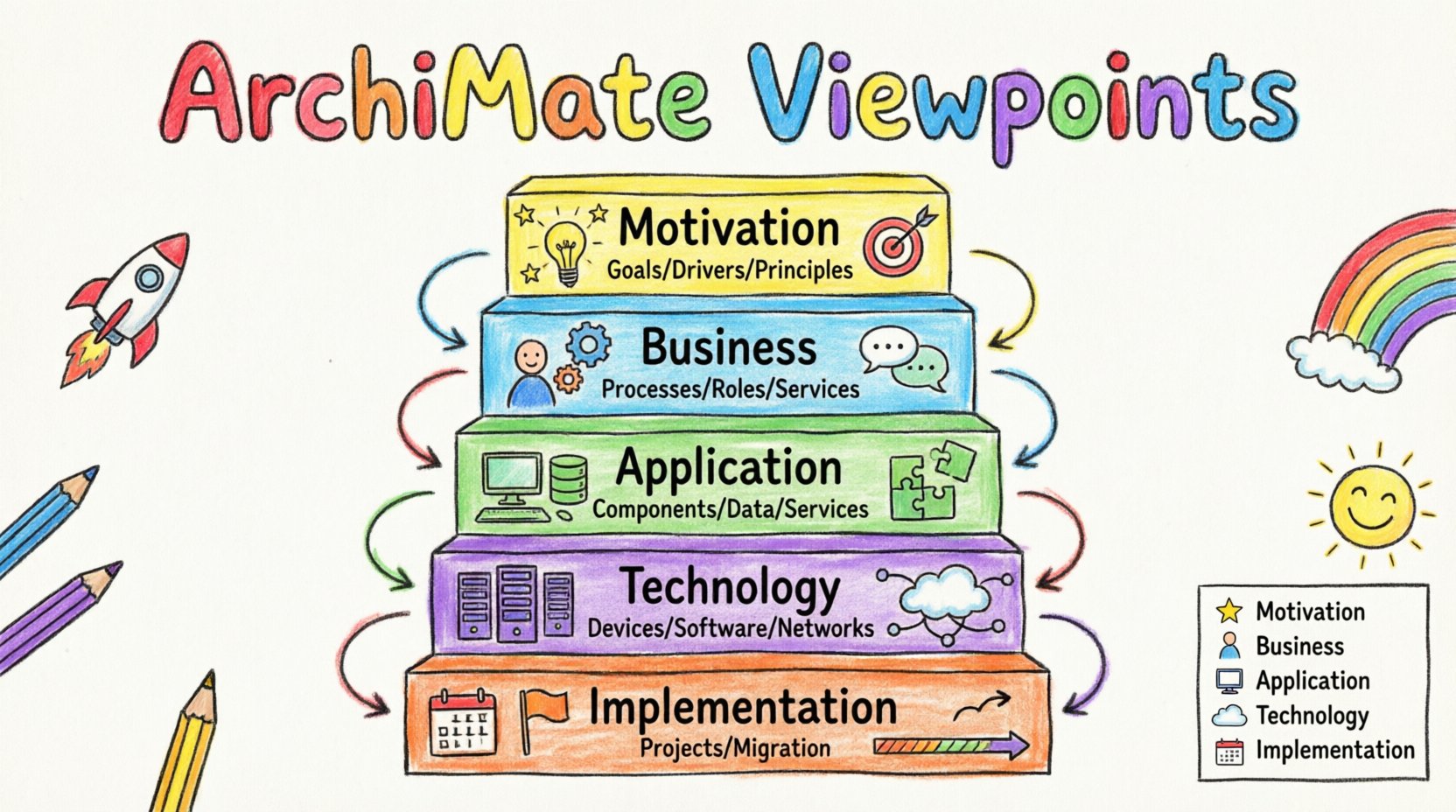
The effective use of ArchiMate Viewpoints transforms a complex architecture into a manageable and understandable asset. By breaking down the model into specific components and layers, architects can communicate value clearly to stakeholders. The Motivation, Business, Application, Technology, and Implementation layers each play a distinct role in this ecosystem.
As organizations continue to navigate digital transformation, the need for clear architectural communication will only grow. Adopting these viewpoints ensures that the architecture remains aligned with business strategy, technical reality, and operational needs. The result is a resilient enterprise capable of adapting to change while maintaining stability.
By focusing on the component-by-component breakdown, this guide has provided a foundation for understanding the depth of the language. Continued practice and application of these concepts will lead to more robust and effective enterprise architectures.

 English
 Arabic
 Chinese (Simplified)
 Dutch
Dutch French
 German
 Italian
 Japanese
 Korean
 Portuguese
 Russian
 Spanish