


Introduction
In the contemporary digital landscape, the efficiency and reliability of an online shopping platform are paramount to commercial success. Software architecture serves as the blueprint for these platforms, ensuring that business needs are translated into functional, scalable, and maintainable systems. Unified Modeling Language (UML) provides a standardized visual language for developers and stakeholders to communicate these architectural decisions.
This case study examines a fabricated online shopping system, utilizing various UML diagrams to illustrate how user interactions and system components integrate to create a seamless customer experience.
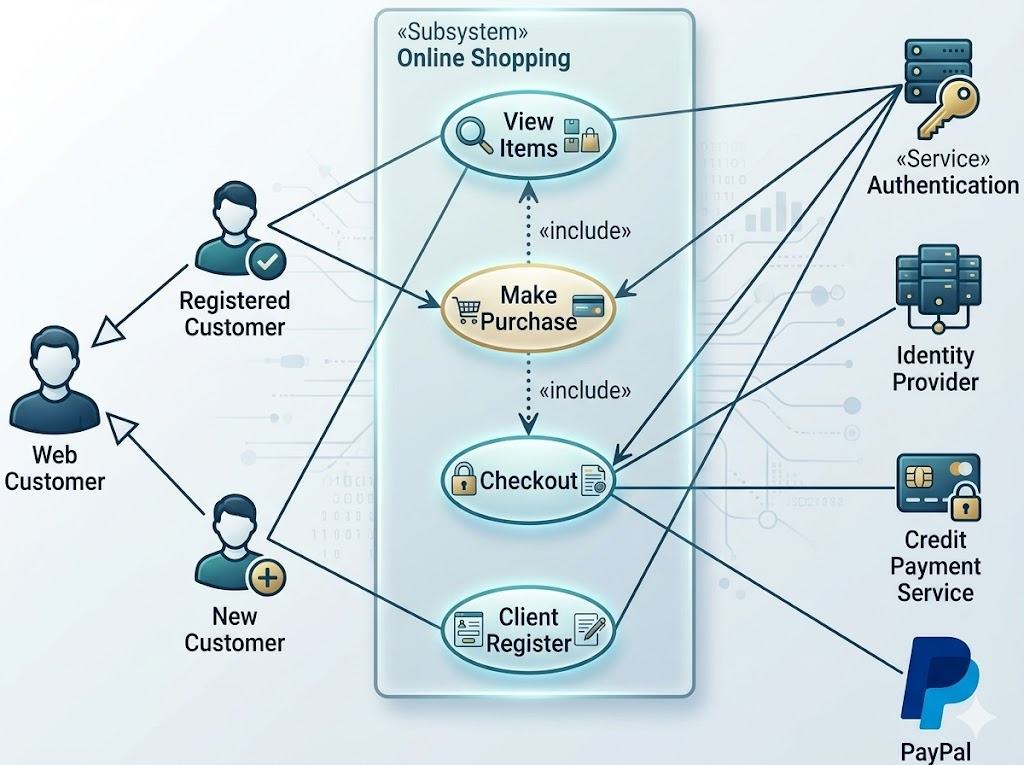
The Online Shopping Model: A Structural Overview
To understand the core functionality of an online shopping system, we look at the primary interactions between the end-user—the Web Customer—and the system itself.
Use Case Analysis
The purpose of the Use Case Diagram is to define the top-level functionality from the perspective of the Web Customer. The primary actor, the Web Customer, engages with the platform to achieve specific objectives.
Top-Level Use Cases:
-
View Items: Allows the customer to search, browse catalogs, or view recommended products.
-
Make Purchase: The complex process of converting selected items into a formal order.
-
Client Register: Enables users to create accounts for enhanced services, such as coupons or private sales.
Note: The “Checkout” process is an included use case within “Make Purchase,” representing a required sequence of events.
Architectural Components and Dynamic Behavior
Beyond simple use cases, a robust system requires an understanding of how data flows and how components behave over time.
Domain Modeling
A class diagram acts as the “dictionary” for the system, defining entities such as Customer, Account, Shopping Cart, Product, Order, and Payment. It establishes the relationships between these entities, ensuring that every order is correctly linked to a unique customer and payment transaction.
Interaction Modeling
To understand the dynamic flow, we utilize Sequence and Activity diagrams. These tools map the step-by-step actions a customer takes—from browsing the catalog to finalizing a secure payment through a credit card gateway.
Conclusion
The application of UML diagrams transforms abstract business requirements into concrete technical specifications. By modeling the interactions, domain entities, and system flows, developers can mitigate risks, improve communication among stakeholders, and ensure that the final product aligns perfectly with the initial business goals. As illustrated in this case study, a methodical approach to system design using UML is essential for building sophisticated, user-centric e-commerce solutions that stand the test of a competitive market.
Reference List
-
Online Shopping System | Use Case Diagram Template: An overview of how to visualize core functionalities and user interactions using professional diagramming tools.
-
Navigating the Software Development Journey: A Case Study of Online Shopping System Design with UML Diagrams: A comprehensive guide on the software development lifecycle, detailing how various UML diagrams support the design process from requirements gathering to deployment.

 English
 Arabic
 Chinese (Simplified)
 Dutch
Dutch French
 German
 Italian
 Japanese
 Korean
 Portuguese
 Russian
 Spanish