


Introduction
In the modern digital landscape, the gap between business strategy and technical execution is often where projects stall. Product managers draft roadmaps in one tool, architects design systems in another, and developers document code in a third. This fragmentation leads to misalignment, outdated documentation, and costly rework.
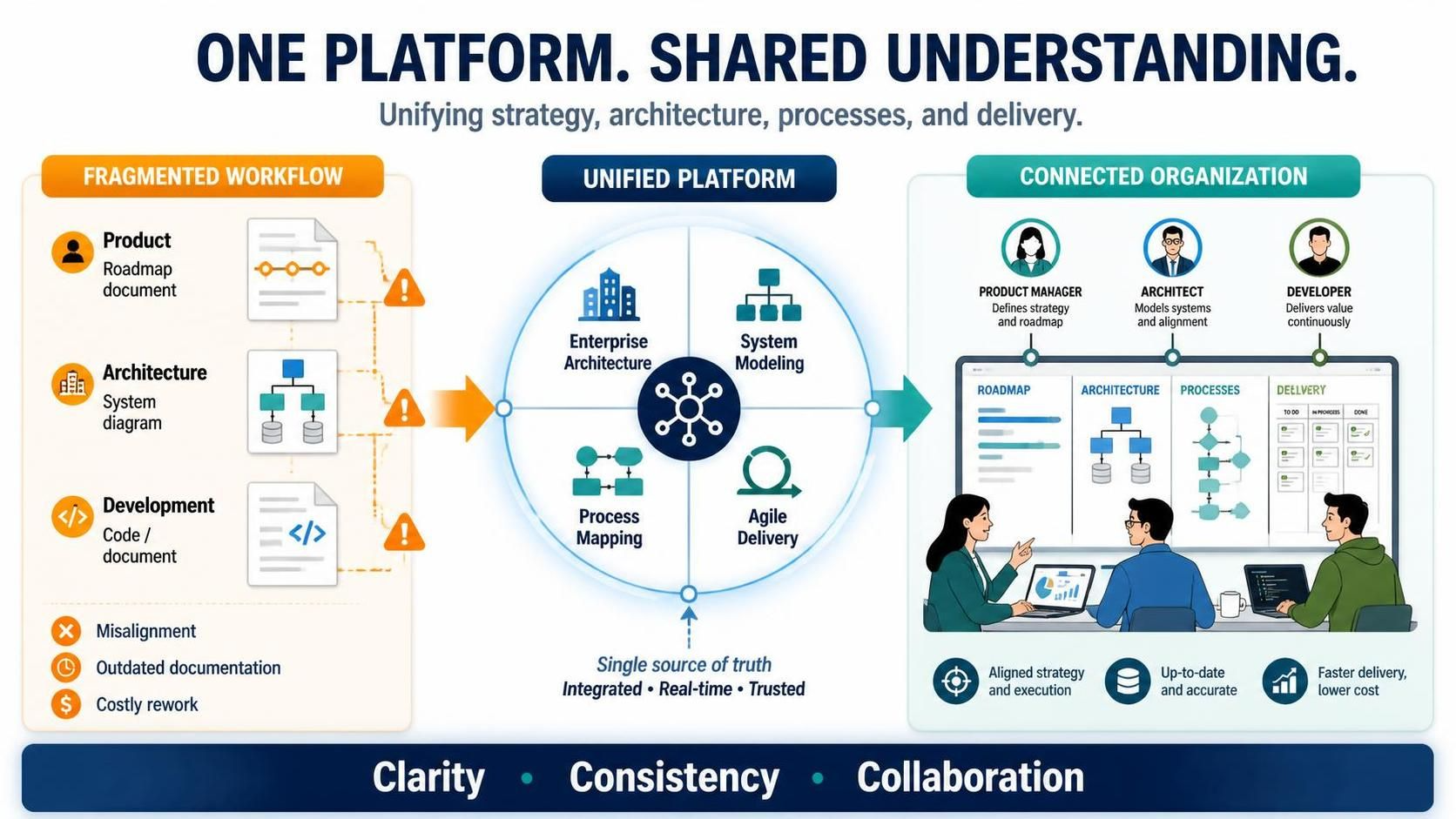
Visual Paradigm Unified Platform emerges as the solution to this disjointed workflow. It is not merely a diagramming tool; it is an all-in-one platform that unifies enterprise architecture, system modeling, process mapping, and agile delivery into a single source of truth. This guide explores how leveraging Visual Paradigm Unified Platform can transform your organization’s approach to software engineering and business process management, ensuring clarity, consistency, and collaboration across all stakeholders.
Key Concepts of Unified Modeling
To fully leverage Visual Paradigm Unified Platform, it is essential to understand the core methodologies it supports. These standards provide the common language needed for cross-functional alignment.
1. Multi-Standard Modeling Integration
Visual Paradigm Unified Platform eliminates the need for disparate tools by natively supporting industry-standard modeling languages:
-
BPMN 2.0 (Business Process Model and Notation): Used for mapping end-to-end business workflows. It helps identify bottlenecks and optimize operational efficiency.
-
UML (Unified Modeling Language) & C4 Model: Essential for software design. UML provides detailed class, sequence, and state diagrams, while the C4 model offers a hierarchical view of software architecture from context down to code.
-
ArchiMate & TOGAF ADM: Critical for enterprise architecture. These frameworks allow you to map relationships between business capabilities, application services, and technology infrastructure.
-
SysML (Systems Modeling Language): Bridges the gap between hardware and software, ideal for complex systems engineering projects.
2. AI-Powered Visual Automation
The platform leverages artificial intelligence to accelerate the modeling process:
-
Text-to-Diagram: Convert natural language descriptions into structured diagrams instantly. For example, typing “Create a login flow with OAuth2” generates a corresponding sequence diagram.
-
Diagram-as-Code: Support for PlantUML and Mermaid.js allows developers to maintain diagrams as code, ensuring version control and easy integration into CI/CD pipelines.
-
Living Documentation (OpenDocs): Automatically synchronizes technical specifications with model changes, ensuring documentation never becomes obsolete.
3. Agile-Business Alignment
Visual Paradigm Unified Platform bridges strategic vision with tactical execution:
-
User Story Mapping: Translates high-level business processes into actionable user stories with clear acceptance criteria (Given-When-Then).
-
Prioritization Frameworks: Built-in support for WSJF (Weighted Shortest Job First) and RACI matrices helps teams prioritize features based on value and effort.
Practical Examples: Using Visual Paradigm Unified Platform
Example 1: Optimizing a Customer Onboarding Process
Scenario: A fintech company wants to reduce the time it takes to onboard new customers.
Steps in Visual Paradigm Unified Platform:
-
Map the Current State: Use BPMN 2.0 to diagram the existing onboarding workflow, identifying manual steps and delays.
-
Analyze Value Streams: Apply Value Stream Mapping to visualize waste and non-value-added activities.
-
Design the Future State: Redesign the process using BPMN, integrating automated KYC (Know Your Customer) checks.
-
Align with IT: Link the new business processes to UML Sequence Diagrams showing how the mobile app interacts with backend microservices.
-
Generate User Stories: Automatically convert the new process steps into user stories for the agile backlog, complete with acceptance criteria.
Example 2: Designing a Microservices Architecture
Scenario: An e-commerce platform is migrating from a monolith to microservices.
Steps in Visual Paradigm Unified Platform:
-
High-Level View: Use the C4 Model to create a Context Diagram showing the system’s interaction with users and external payment gateways.
-
Container Diagram: Define the microservices (e.g., Order Service, Inventory Service) and their technologies.
-
Component Diagram: Drill down into each service to show internal components and data flows.
-
Enterprise Architecture: Use ArchiMate to map these applications to the underlying technology infrastructure (servers, databases) and business capabilities.
-
Living Documentation: Publish the architecture as OpenDocs, allowing developers to access up-to-date diagrams directly from their IDE or wiki.
Example 3: Managing Complex Systems Engineering Projects
Scenario: A medical device company is developing a new IoT-enabled insulin pump.
Steps in Visual Paradigm Unified Platform:
-
Requirements Modeling: Use SysML to capture functional and non-functional requirements.
-
System Structure: Create block definition diagrams to show the relationship between hardware components (sensors, pumps) and software modules.
-
Behavioral Modeling: Use state machine diagrams to model the device’s operational states (e.g., Idle, Delivering, Alarm).
-
Traceability: Link requirements to design elements and test cases, ensuring full coverage and compliance with regulatory standards.
Benefits for Modern Teams
-
Single Source of Truth: Eliminates discrepancies between business, architecture, and development views.
-
Enhanced Collaboration: Cloud synchronicity allows real-time co-authoring and review across distributed teams.
-
Automated Consistency: Changes in one model (e.g., a business process) can automatically propagate to related artifacts (e.g., user stories), reducing manual effort.
-
Faster Time-to-Market: AI-powered automation accelerates diagram creation and documentation, allowing teams to focus on value delivery.
Conclusion
Visual Paradigm Unified Platform represents a significant leap forward in enterprise modeling and architecture. By unifying diverse modeling standards, leveraging AI for automation, and bridging the gap between business and agile teams, it empowers organizations to navigate complexity with confidence.
For product managers, architects, and business analysts, adopting Visual Paradigm Unified Platform means moving away from fragmented tools and toward a cohesive, collaborative ecosystem. In doing so, teams can ensure that every line of code and every business decision is aligned with the overarching strategic vision, driving innovation and efficiency in today’s fast-paced digital world.

 English
 Arabic
 Chinese (Simplified)
 Dutch
 French
 German
 Italian
 Japanese
 Korean
 Portuguese
 Russian
 Spanish