


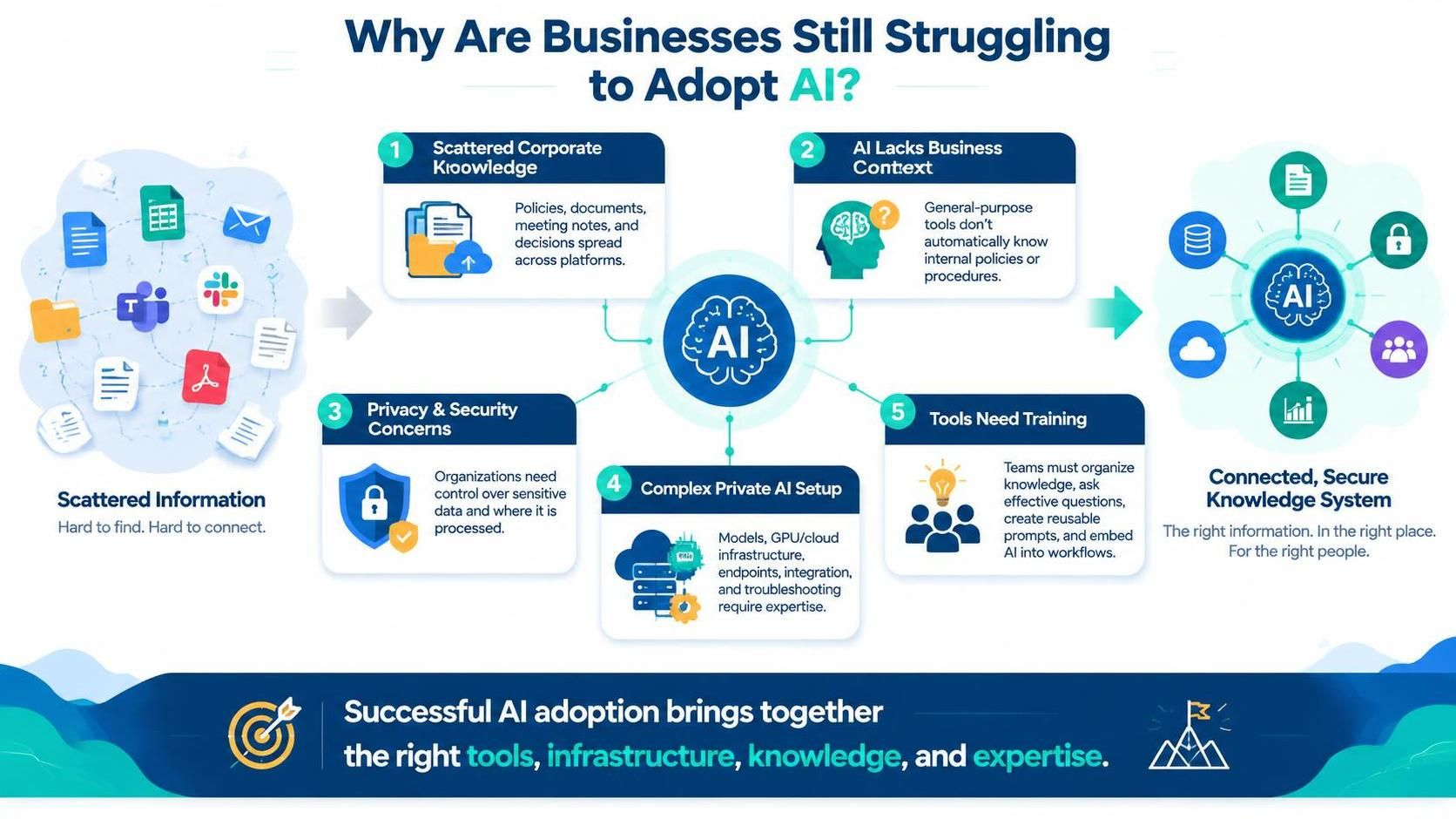
Businesses today face a paradox: Artificial Intelligence is more accessible than ever, yet many organizations struggle to integrate it effectively. The core issue is rarely the lack of AI technology itself, but rather the disconnect between general-purpose AI models and specific organizational needs. As illustrated in the architectural overview, the journey from “scattered information” to a “connected, secure knowledge system” requires more than just software; it demands a structured approach to infrastructure, data management, and expertise.
This tutorial explores how a comprehensive ecosystem—combining Visual Paradigm’s modeling capabilities with core AI components and training—solves the critical challenges of AI adoption. We will break down the architectural flow from problem identification to the deployment of a secure, context-aware AI environment.
1. The Challenge: Scattered Corporate Knowledge
The starting point for any successful AI initiative is recognizing where data resides. In most organizations, valuable knowledge is not centralized. It exists in disparate formats:
- Formal Documentation: Policies, standard operating procedures (SOPs), and technical specifications.
- Unstructured Data: Meeting notes, project updates, and internal guidelines.
- Fragmented Repositories: Information scattered across various folders, platforms, and individual employees’ devices.
When AI attempts to operate without access to this specific context, it fails to provide relevant answers. It becomes a generalist rather than a specialist, offering reasonable but potentially inaccurate advice that ignores internal policies or proprietary history.
2. The Architectural Solution: Bridging Context and Infrastructure
To solve this, the ecosystem moves beyond simple API integration. It establishes a private AI environment that acts as a bridge between raw data and intelligent processing. This architecture is built upon three critical pillars: the AI Core, the Knowledge Management Layer, and the Operational Interface.
The AI Core & Infrastructure
One of the most significant barriers to adoption is the complexity of setting up private AI infrastructure. Building this from scratch requires specialized knowledge in provisioning GPU servers, configuring cloud resources, and managing AI endpoints. The proposed solution addresses this by providing a unified environment where:
- Models are Evaluated and Provisioned: Organizations can select the right AI models for their specific tasks without needing to build the underlying engine from zero.
- Security is Centralized: By keeping the infrastructure private (self-hosted or secure cloud), sensitive data—such as financial records, intellectual property, and customer information—never leaves the organization’s controlled environment.
- Integration is Streamlined: The architecture handles the complex connectivity between applications and AI services, reducing the technical debt usually associated with custom AI development.
The Knowledge Management Layer
The AI Core is only as good as the data it consumes. The ecosystem integrates visual modeling tools that allow teams to map out their knowledge structures before feeding them into the AI. This ensures that:
- Structure is Applied: Unstructured documents are organized into a format the AI can understand.
- Context is Defined: The AI is explicitly taught the business logic and relationships between different data points.
- Security is Enforced: Access controls are applied at the data level, ensuring the AI only answers questions based on permissions.
3. From Tools to Competence: Training and Workflow Integration
Even with the best tools and infrastructure, the “human element” remains the final hurdle. Simply installing software does not guarantee adoption. The ecosystem addresses this through structured training and setup assistance.
Successful AI adoption requires employees to learn how to:
- Formulate Effective Questions: Learning how to prompt the AI to retrieve specific internal knowledge rather than general information.
- Create Reusable Prompts: Standardizing queries to ensure consistency across the organization.
- Embed AI into Workflows: Moving AI from a novelty to a standard part of daily operations.
By bringing together the right tools, infrastructure, knowledge, and expertise, businesses can transform their scattered data into a competitive advantage. The goal is not just to have an AI tool, but to have an intelligent system that knows the business, respects its security, and empowers its people.
4. The Result: A Connected, Secure Knowledge System
The ultimate outcome of this architectural approach is a system that is “Connected, Secure, and Knowledgeable.” Instead of the AI guessing based on public internet data, it becomes a partner that understands the organization’s unique context.
When a user asks, “What is our policy regarding X?” the system does not provide a generic answer. It retrieves the specific, latest internal document, ensuring compliance and accuracy. This is the true potential of AI in the enterprise: it is not about replacing human intelligence, but about augmenting it with immediate, secure access to the collective wisdom of the organization.

 English
 Arabic
 Chinese (Simplified)
 Dutch
 French
 German
 Italian
 Japanese
 Korean
 Portuguese
 Russian
 Spanish