


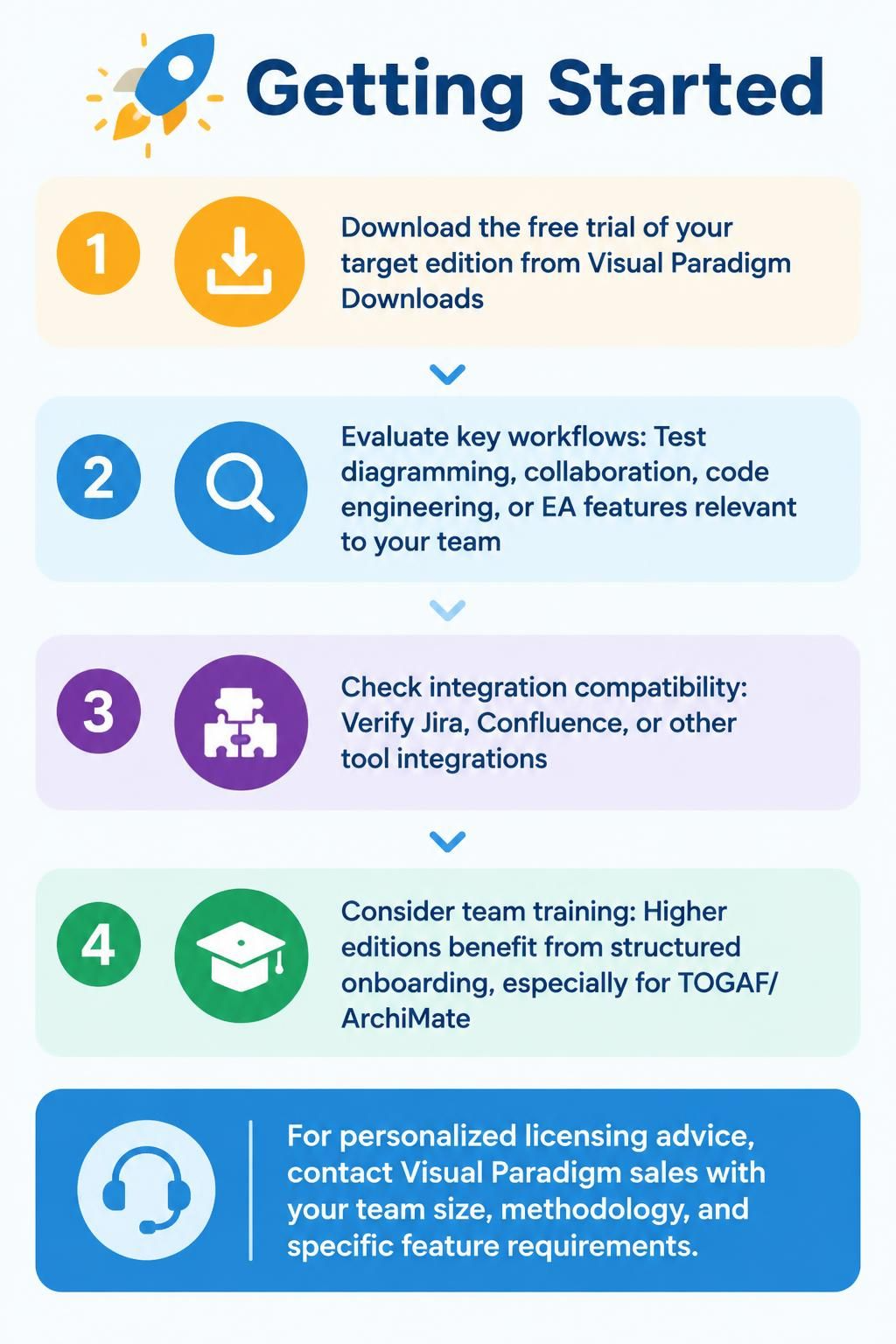
Welcome to the comprehensive guide on deploying Visual Paradigm within your organization. Selecting the right modeling tool is only the beginning; the true value lies in how effectively you integrate it into your existing engineering ecosystem. This tutorial walks you through the strategic lifecycle of adopting Visual Paradigm, moving from initial software acquisition to full-scale enterprise adoption.
Phase 1: Strategic Acquisition and Edition Selection
The journey begins with understanding that Visual Paradigm is not a monolithic tool, but a suite of solutions tailored for different engineering needs. The first critical step involves accessing the official Visual Paradigm Downloads portal. Here, you must select the appropriate trial edition—ranging from Community to Enterprise levels—based on your immediate project requirements.
Key Consideration: Do not simply download the default version. Evaluate the specific edition that aligns with your architectural methodology. If you are a startup looking for rapid prototyping, a standard edition may suffice. However, if you are a large-scale enterprise dealing with complex system requirements, you may need the full power of the Enterprise Architecture (EA) edition.
Phase 2: Workflow Evaluation and Feature Testing
Once the software is installed, the immediate next step is a rigorous evaluation of key workflows. This is not just about opening the software, but stress-testing its core capabilities against your team’s daily needs. You should focus your testing on four specific pillars:
- Diagramming: Test the speed and fluidity of drawing UML, BPMN, and Flowcharts. Does the canvas handle large diagrams without lag?
- Collaboration: If your team is distributed, verify how easily multiple users can view and comment on models in real-time.
- Code Engineering: For software development teams, test the round-trip engineering features. Can you generate code from your models and update models from code changes seamlessly?
- Enterprise Architecture (EA): If you follow frameworks like TOGAF or ArchiMate, verify that the specific modeling syntax and report generation tools function as expected.
Phase 3: Ecosystem Integration Verification
A modeling tool cannot exist in a vacuum. In modern DevOps and Agile environments, diagrams are living artifacts that must integrate with project management and documentation tools. Phase 3 requires you to check integration compatibility.
You must verify connectivity with tools such as Jira and Confluence. The goal is to ensure that:
- Requirements tracked in Jira are linked to your Visual Paradigm models.
- Architecture documentation can be automatically exported or synced to Confluence pages.
- Task dependencies are correctly visualized within the project timeline.
Phase 4: Structured Team Training and Onboarding
Finally, the adoption phase. While the software is powerful, its complexity often necessitates structured onboarding. This is particularly true for higher editions that support advanced methodologies like TOGAF (The Open Group Architecture Framework) and ArchiMate.
Do not rely solely on reading the user manual. Implement a training roadmap that includes:
- Foundational Modeling: Ensuring all team members understand standard UML notation.
- Methodology Adherence: Training on specific enterprise frameworks if your organization requires them.
- Advanced Customization: Teaching power users how to create custom templates and scripts for automation.
Conclusion: Scaling for Success
If you have reached a point where you require personalized licensing advice, or if your team size and specific feature requirements are complex, it is time to engage with Visual Paradigm sales. By providing them with your team size, methodology, and specific feature requirements, you can ensure you are on a path to a seamless, scalable, and highly effective modeling implementation.

 English
 Arabic
 Chinese (Simplified)
 Dutch
 French
 German
 Italian
 Japanese
 Korean
 Portuguese
 Russian
 Spanish