


The Sprint Retrospective is held after the Sprint Review and before the next Sprint Planning. It is a time-boxed meeting lasting at least three hours for a one-month Sprint. The retrospective is essentially an “improvement” session aimed at identifying potential pitfalls, past mistakes, and finding new ways to avoid them. Everyone participates—the Product Owner, the Scrum Master, the Development Team members, and optionally, stakeholders.
In other words, the Sprint Retrospective is about identifying what the team is doing well, what should continue, and what can be improved to make the next Sprint more enjoyable or productive. The principles of “inspect and adapt” play a key role here, making the next Sprint more efficient and enjoyable.
Sprint Cycle and Rituals
Each Sprint begins with two planning meetings to define the Sprint’s content: “What” — the first part of Sprint Planning, and “How” — the second part. Together, these two sessions are referred to as the Sprint Planning meeting.
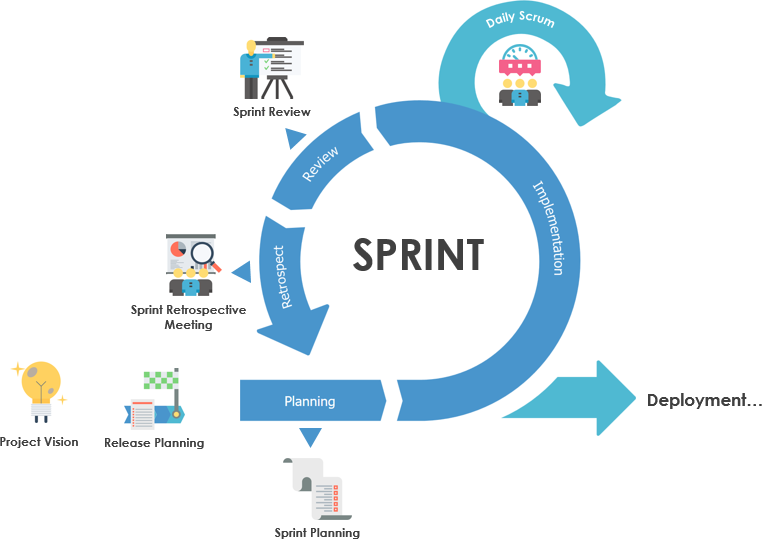
Sprint cycle
At the end of the Sprint, the Sprint Retrospective is conducted to allow the Scrum Product Owner to inspect whether all committed items are complete and correctly implemented for deployment.
Then, the Sprint Review is held to examine and improve the project execution process: what went well during the Sprint, what should continue, and what should be improved in the next Sprint.
5 Steps to Conduct a Sprint Retrospective
Typically, retrospectives are more structured than this. Most teams follow these five steps:
- Set the Stage – Define the goal; give people time to “arrive” and get into the right mindset
- Gather Data – Help everyone remember; create a shared pool of information (everyone sees the world differently)
- Generate Insights – Why did things happen the way they did? Identify patterns; see the big picture
- Decide What to Do – Choose some issues to address and create specific action plans on how to resolve them
- Close the Retrospective – Clarify follow-up actions; appreciate contributions; wrap up; how can the retrospective be improved?

Stages of Sprint Retrospective
Length of Sprint Retrospective Meeting
A general rule of thumb is that the Sprint Retrospective should not exceed 45 minutes per week of Sprint duration. The table below illustrates this rule:
| Total Sprint Duration | Retrospective Duration |
| 1 week | 45 minutes |
| 2 weeks | 90 minutes (1.5 hours) |
| 3 weeks | 135 minutes (2.25 hours) |
| 4 weeks | 180 minutes (3 hours) |
Note:
The exact length of the Sprint Retrospective can be influenced by:
- How many people are in the team?
- How fresh is the team?
- Are any team members remote?
Retrospective Questions
During the Sprint Retrospective, the team discusses:
- What went well in the Sprint?
- What went wrong in the Sprint?
- What did we learn in the Sprint?
- What should we do in the next Sprint?
1. What Went Well in the Sprint?
Ask questions to understand the reasons behind the success of the iteration by reflecting on all the positive aspects.
- What led to this success?
- What did we do differently to make it work?
- Which training, skills, or knowledge contributed to the difference?
- Which of your strengths made this possible?
- Which team strengths made this possible?
- How did team members’ contributions help achieve this?
- How did we achieve this?
2. What Went Wrong in the Sprint?
While this section shouldn’t evaluate individual performance or lead to punishment, it should gather insights and identify ways to fix issues in the upcoming Sprint. Focus on improvement rather than problems. This question reveals the difficulties, issues, and frustrations the team currently faces.
- How did things go wrong?
- What did you do incorrectly?
- How many people were involved in the mistake?
- Knew you were doing something wrong?
- Did you understand the mistake but still made it?
- Did you understand it but still made the error?
- How did we do?
3. What Did We Learn in the Sprint?
What did we learn from this Sprint? These questions help identify what worked and what didn’t. They encourage reflection on how we do our work. Examples may include:
- How was this Sprint executed?
- What went wrong in this Sprint?
- When did things go wrong?
- How did they go wrong?
- Which technique was useful?
- Which technique wasn’t useful?
- What went well during this Sprint?
- What didn’t go well during this Sprint?
- What can we learn from this Sprint to improve the next one?
4. What Should We Do in the Next Sprint?
This section focuses on identifying possible corrective actions based on past successes, failures, and learnings.
- How can we use individual strengths to solve problems?
- What should we do to prevent issues from recurring?
- What actions must be taken immediately to gain bandwidth and functionality?
- Identify one thing to change and explain how to change it?
- What strategies can be used to complete the work?
Action Plans
- What will you do in the upcoming Sprint to address this?
- How will you ensure success?
- When during the Sprint will you do this?
- Do you need help to complete this?
- What extra support do you need?
- How will you know you’ve completed it?
- What will you do after completing this in the Sprint?
Summary
The Sprint Retrospective can be seen as a “lessons learned” session. Well-crafted retrospective questions allow the team to reflect, while giving each member a sense of ownership—making the process truly Agile.
Use the questions provided above to inspire your team and yourself to improve in future Sprints. While these example questions are for reference only, feel free to customize them based on your team’s needs.


 English
 Arabic
 Chinese (Simplified)
 Dutch
Dutch French
 German
 Italian
 Japanese
 Korean
 Portuguese
 Russian
 Spanish