


Enterprise architecture is a discipline that requires precision, clarity, and effective communication. When dealing with complex systems, the sheer volume of information can overwhelm stakeholders. This is where ArchiMate Viewpoints become essential. They act as specialized lenses, allowing architects to present specific aspects of the enterprise architecture tailored to the needs of different audiences.
This guide explores the mechanics, applications, and strategic implementation of ArchiMate Viewpoints. We will move from fundamental definitions to advanced composition strategies, ensuring you understand how to leverage these tools for better decision-making and alignment.
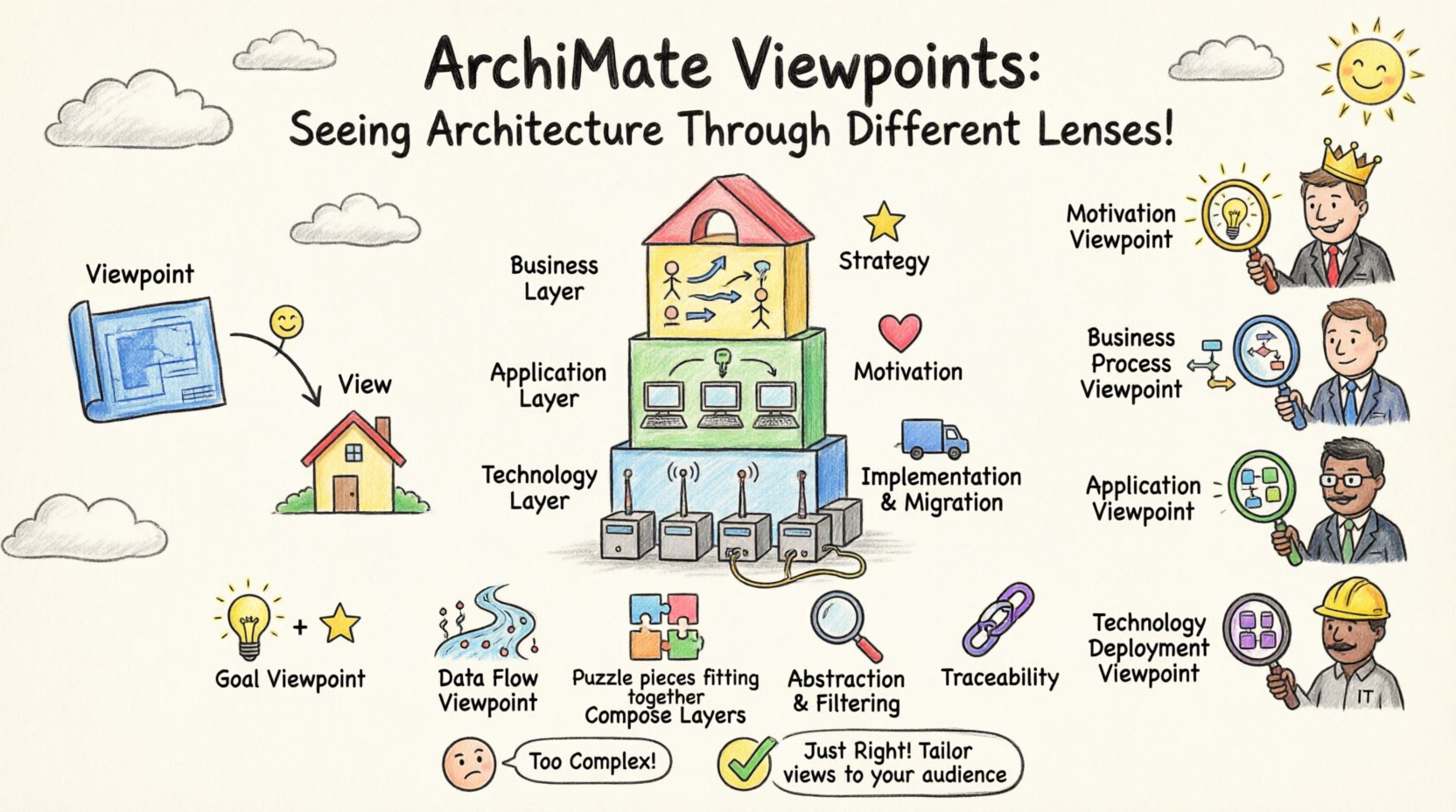
Understanding the Foundation 📚
Before constructing complex models, one must understand the distinction between a View and a Viewpoint. While often used interchangeably in casual conversation, they serve distinct purposes within the Architecture Definition Language.
- Viewpoint: A specification of the conventions for constructing and using a view. It defines the audience, concerns, and modeling languages.
- View: The representation of a set of related architecture artifacts for a particular set of stakeholders.
Think of the Viewpoint as the blueprint for the document you are creating, and the View as the document itself. A single Viewpoint can generate multiple Views for different stakeholders.
The motivation behind using Viewpoints is rooted in the ISO/IEC 42010 standard. It acknowledges that a single, monolithic model cannot satisfy everyone. The CTO requires a different perspective than the Business Analyst. Viewpoints facilitate this segmentation, ensuring that the right information reaches the right people without unnecessary noise.
The Layers and Aspects of Architecture 🧱
ArchiMate organizes architecture into three primary layers and three supporting aspects. Understanding how Viewpoints map to these structures is critical for effective modeling.
Core Layers
- Business Layer: Describes the business organization, business processes, business roles, and business objects. It focuses on the business value chain.
- Application Layer: Specifies the software systems and services that support the business layer. It includes application components and interfaces.
- Technology Layer: Represents the infrastructure where applications run. This includes hardware, network devices, and system software.
Supporting Aspects
- Strategy Layer: Focuses on high-level goals, principles, and drivers. It connects the business intent with the execution.
- Motivation Layer: Details the reasons behind decisions, such as goals, principles, and requirements.
- Implementation & Migration Layer: Describes the transition from the current state to the target state, including projects and deliverables.
A well-designed Viewpoint often spans multiple layers. For example, a Technology Viewpoint might include the Application layer to show how software relies on specific hardware infrastructure.
Key Viewpoint Categories 🎯
Not all viewpoints are created equal. Selecting the correct one depends on the specific architectural question being asked. Below are the primary categories used in practice.
1. Motivation Viewpoints
These views answer the “why” behind architectural decisions. They are crucial for governance and justification.
- Goal Viewpoint: Visualizes the objectives the architecture aims to achieve.
- Principle Viewpoint: Shows the rules and guidelines that constrain design choices.
- Driver Viewpoint: Identifies external or internal forces pushing for change.
2. Business Viewpoints
These focus on the operational capabilities of the organization.
- Process Viewpoint: Maps business processes and their interactions.
- Role Viewpoint: Defines responsibilities and who performs specific tasks.
- Interaction Viewpoint: Illustrates the flow of information between business actors.
3. Application and Technology Viewpoints
These are often the most detailed and technical.
- Function Viewpoint: Shows logical functions provided by applications.
- Node Viewpoint: Represents the physical nodes and their connectivity.
- Deployment Viewpoint: Maps application components to physical hardware.
4. Data Viewpoints
Data is the lifeblood of modern enterprises. These views ensure data integrity and flow.
- Data Object Viewpoint: Focuses on the entities and relationships within the data model.
- Data Flow Viewpoint: Traces how data moves between processes and applications.
Advanced Composition Strategies 🧩
As models grow in complexity, simple viewpoints may become insufficient. Advanced strategies involve composing viewpoints to address cross-cutting concerns.
Composing Layers
One common strategy is to combine layers into a single view. For instance, a Business-Application Integration View might combine the Business Layer and Application Layer. This helps identify gaps where business processes are not supported by adequate software.
When composing layers, maintain consistency in notation. Ensure that relationships are clearly defined. A relationship between a Business Process and an Application Component should be explicit.
Handling Complexity
Complexity management is a primary challenge. When a model becomes too dense, readability suffers. Use the following techniques to maintain clarity:
- Abstraction: Hide low-level details in high-level views. Show a group of nodes as a single logical node.
- Filtering: Use filters to display only relevant elements based on a specific criterion, such as ownership or status.
- Fragmentation: Split a large model into smaller, manageable fragments that relate to specific domains.
Traceability
Maintaining traceability across viewpoints is vital for impact analysis. If a business goal changes, you need to know which applications and technologies are affected. Use unique identifiers for elements to ensure links remain valid as the model evolves.
Managing Stakeholder Expectations 👥
The success of an architecture initiative depends heavily on stakeholder engagement. Viewpoints are the primary tool for this engagement.
Identifying Stakeholders
Begin by mapping stakeholders to their specific concerns. A typical matrix might look like this:
- Executive Management: Concerned with Strategy, Motivation, and high-level Business outcomes.
- Business Managers: Interested in Business Processes, Roles, and Service levels.
- IT Managers: Focus on Application capabilities, Technology infrastructure, and Performance.
- Developers: Require detailed Application and Technology specifications.
Designing for the Audience
Do not present a Technology Node View to a Business Manager. It will likely cause confusion. Instead, create a Business Service View that abstracts the underlying technical complexity.
Conversely, avoid oversimplifying for technical teams. Developers need to know specific interface contracts and deployment nodes. Tailor the granularity of the Viewpoint to the technical expertise of the reader.
Common Challenges & Solutions 🛠️
Implementing ArchiMate Viewpoints is not without difficulties. Common pitfalls can undermine the value of the architecture work.
Challenge 1: Inconsistency
Different architects may define similar viewpoints differently, leading to confusion. For example, one architect might define a “Process” differently than another.
- Solution: Establish a modeling standard. Define naming conventions, relationship types, and element definitions in a shared repository.
Challenge 2: Over-Engineering
Creating too many viewpoints can lead to maintenance nightmares. If every minor change requires updating ten different views, the model will become outdated quickly.
- Solution: Adopt a “minimum viable set” approach. Start with a core set of essential viewpoints. Add new ones only when a specific stakeholder need arises that cannot be met by existing views.
Challenge 3: Lack of Context
Stakeholders often struggle to understand how the model relates to their daily work.
- Solution: Include context in the Viewpoint description. Explain what is included and, crucially, what is excluded from the view. Use annotations to clarify assumptions.
Comparison of Common Viewpoints 📊
To assist in selection, the following table outlines the primary focus and audience for standard viewpoints.
| Viewpoint Name | Primary Focus | Typical Audience |
|---|---|---|
| Motivation Viewpoint | Goals, Principles, Drivers | Management, Governance |
| Business Process Viewpoint | Workflows, Activities | Business Analysts, Operations |
| Application Interaction Viewpoint | Data flow between systems | System Architects, Integration Leads |
| Technology Deployment Viewpoint | Hardware, Network, Infrastructure | Infrastructure Team, DevOps |
| Capability Viewpoint | Business and Application capabilities | Strategic Planners, Portfolio Managers |
Final Considerations for Implementation 🔄
Implementing a robust viewpoint strategy requires ongoing effort. It is not a one-time setup but a continuous process of refinement.
Regular reviews of the architecture model are necessary to ensure the viewpoints remain relevant. As the enterprise evolves, so do the stakeholder concerns. A Viewpoint that was critical five years ago may no longer be relevant today. Conversely, new regulatory requirements may necessitate new views.
Documentation is also key. The Viewpoint definition itself should be documented. Describe the purpose, the scope, and the conventions used. This ensures that new team members can understand and maintain the architecture without relying on tribal knowledge.
Integration with other frameworks is another consideration. While ArchiMate provides a solid foundation, it often complements other standards like TOGAF or ITIL. Ensure that your Viewpoints can map to these external requirements. For instance, a specific ArchiMate Viewpoint might satisfy a TOGAF Architecture Requirement Specification.
Finally, leverage tooling capabilities wisely. While specific software products vary, most modeling environments support the creation of views from a central repository. Use these features to automate the generation of views where possible. This reduces manual errors and ensures consistency across all documents produced.
By adhering to these principles and strategies, architects can create a coherent, understandable, and valuable representation of the enterprise. The goal is not just to build a model, but to build understanding. Viewpoints are the bridge between complex technical reality and strategic business clarity.
Effective architecture is about communication. ArchiMate Viewpoints provide the vocabulary and grammar to speak clearly to all parts of the organization. With careful design and maintenance, they become indispensable assets in the pursuit of digital transformation and operational excellence.

 English
 Arabic
 Chinese (Simplified)
 Dutch
Dutch French
 German
 Italian
 Japanese
 Korean
 Portuguese
 Russian
 Spanish