


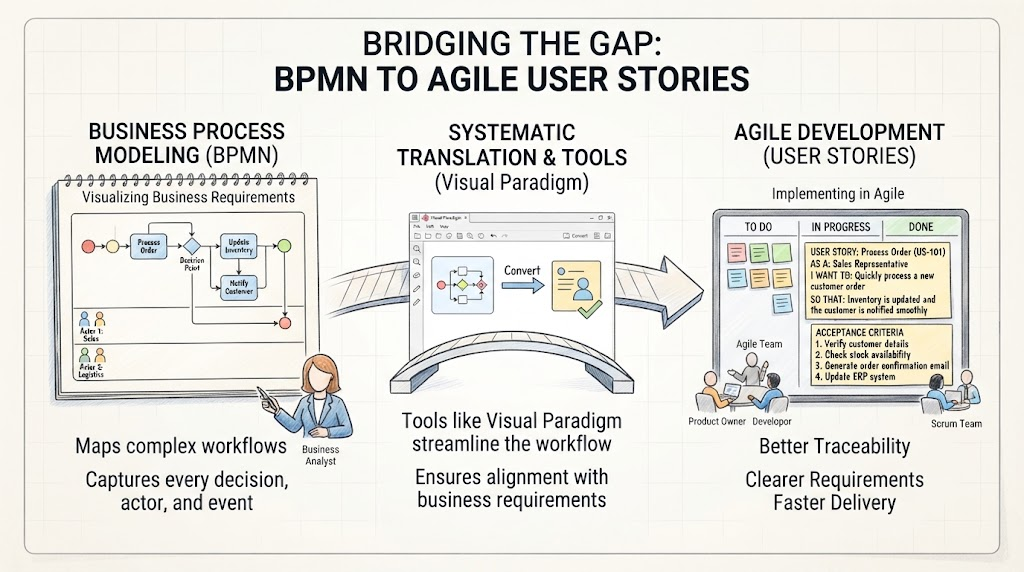
In the modern landscape of software development, a critical disconnect often emerges between the strategic vision of business stakeholders and the tactical execution of agile development teams. Business Analysts create detailed visual maps to understand complex workflows, while developers require concise user stories to build features. This tutorial explains how to effectively bridge this gap, transforming visual BPMN diagrams into actionable Agile artifacts using Visual Paradigm.
Understanding the Core Challenge: The “How” vs. The “What”
To solve the translation problem, we must first understand the distinct perspectives of the two methodologies:
- Business Process Model and Notation (BPMN): This is a process-centric language. It focuses on the how—the specific steps, decision gates, actors, and events that make up a workflow. It is excellent for capturing the full scope of logic and edge cases.
- Agile User Stories: This is a feature-centric language. It focuses on the what—the value delivered to the user. It is designed to be concise and fit on a single index card (or Jira ticket).
The challenge lies in the fact that a single BPMN diagram can contain dozens of decision nodes and parallel processes, while a user story typically addresses one specific goal. The solution is not to dump the entire process map into a ticket, but to decompose the process into manageable, value-driven increments.
Case Study: The “Process Order” Workflow
Let’s look at a common scenario: Processing a Sales Order. A typical BPMN diagram for this process might look like this:
- Start Event: Customer submits an order.
- Task: Process Order (Check data).
- Gateway: Decision Point (Is stock available?).
- Parallel Paths: If yes, Update Inventory. If no, Notify Customer.
- End Event: Order Complete or Rejected.
This diagram tells a complete story of the system’s logic, but it is too complex to be implemented as a single agile sprint task. We need to translate this visual map into a backlog of stories.
The Systematic Translation Approach
Visual Paradigm allows us to leverage its modeling capabilities to break down these diagrams. The translation strategy involves isolating specific user goals within the larger process flow.
Step 1: Identify the User Persona and Goal
Look at the BPMN diagram. Who is the primary actor? In our example, the actor is the Sales Representative. What is their immediate goal? To ensure a customer’s inventory is updated correctly.
Step 2: Decompose the Process Logic
Instead of trying to build the “Update Inventory” and “Notify Customer” logic simultaneously, we split them into distinct stories based on priority and flow.
- Story A (Happy Path): Focus on the successful flow where inventory is updated.
- Story B (Exception Path): Focus on the failure flow where the customer is notified.
Step 3: Drafting the User Story
Now, we take the logic from the BPMN diagram and map it to the standard Agile format:
USER STORY: Process Order (US-101)

AS A: Sales Representative
I WANT TO: Quickly process a new customer order
SO THAT: Inventory is updated and the customer is notified smoothly
Defining Acceptance Criteria from BPMN Gateways
One of the greatest advantages of having a BPMN diagram is the existence of explicit decision points (Gateways). These are perfect candidates for defining Acceptance Criteria (AC). In Visual Paradigm, you can link these criteria directly to the model elements.
For the “Process Order” scenario, the Acceptance Criteria derived from the BPMN decision gate would be:
- AC 1: Verify customer details are valid.
- AC 2: Check stock availability against the database.
- AC 3: If stock > 0, update the inventory count.
- AC 4: If stock = 0, generate a notification email to the customer.
By mapping these criteria directly to the BPMN logic, developers can verify that the code they write matches the business requirements exactly.
Implementing in the Agile Workflow
Once the User Stories and Acceptance Criteria are defined, they move into the Agile workflow (To Do, In Progress, Done). The Scrum Team uses the BPMN diagram as the source of truth. If a developer encounters an edge case, they refer back to the diagram to ensure they haven’t missed a branch of logic.
Tooling Spotlight: Visual Paradigm
To streamline this entire workflow, Visual Paradigm serves as the central hub for both modeling and requirements management. It bridges the gap between the visual and the textual.
Key Capabilities for BPMN-to-Agile Conversion
- Traceability: You can link specific BPMN tasks to specific User Stories. If a requirement changes, you can instantly see which part of the process map is affected.
- Collaboration: Business Analysts can create the BPMN model, and the Development Team can view the generated User Stories within the same environment, ensuring everyone is looking at the same data.
- Exporting: Visual Paradigm allows for the export of requirements directly into formats compatible with Agile project management tools, speeding up the setup of your sprint boards.
By adopting this systematic approach, teams move away from siloed documentation and toward a unified development process where visual models drive agile delivery.

 English
 Arabic
 Chinese (Simplified)
 Dutch
Dutch French
 German
 Italian
 Japanese
 Korean
 Portuguese
 Russian
 Spanish