


Enterprise planning is a complex endeavor that requires clarity, alignment, and precise communication. When leaders attempt to translate high-level vision into actionable steps, they often face a disconnect between strategy and execution. This is where structured modeling frameworks become essential. ArchiMate provides a standardized language for describing, analyzing, and visualizing enterprise architecture. However, the true power lies not just in the elements themselves, but in how ArchiMate Viewpoints are applied to specific planning contexts.
Viewpoints act as specialized lenses. They filter the vast amount of architectural information to present only what is relevant to a specific stakeholder or decision-making process. By leveraging these viewpoints effectively, organizations can derive strategic insights that drive better outcomes, reduce risk, and ensure alignment across departments.
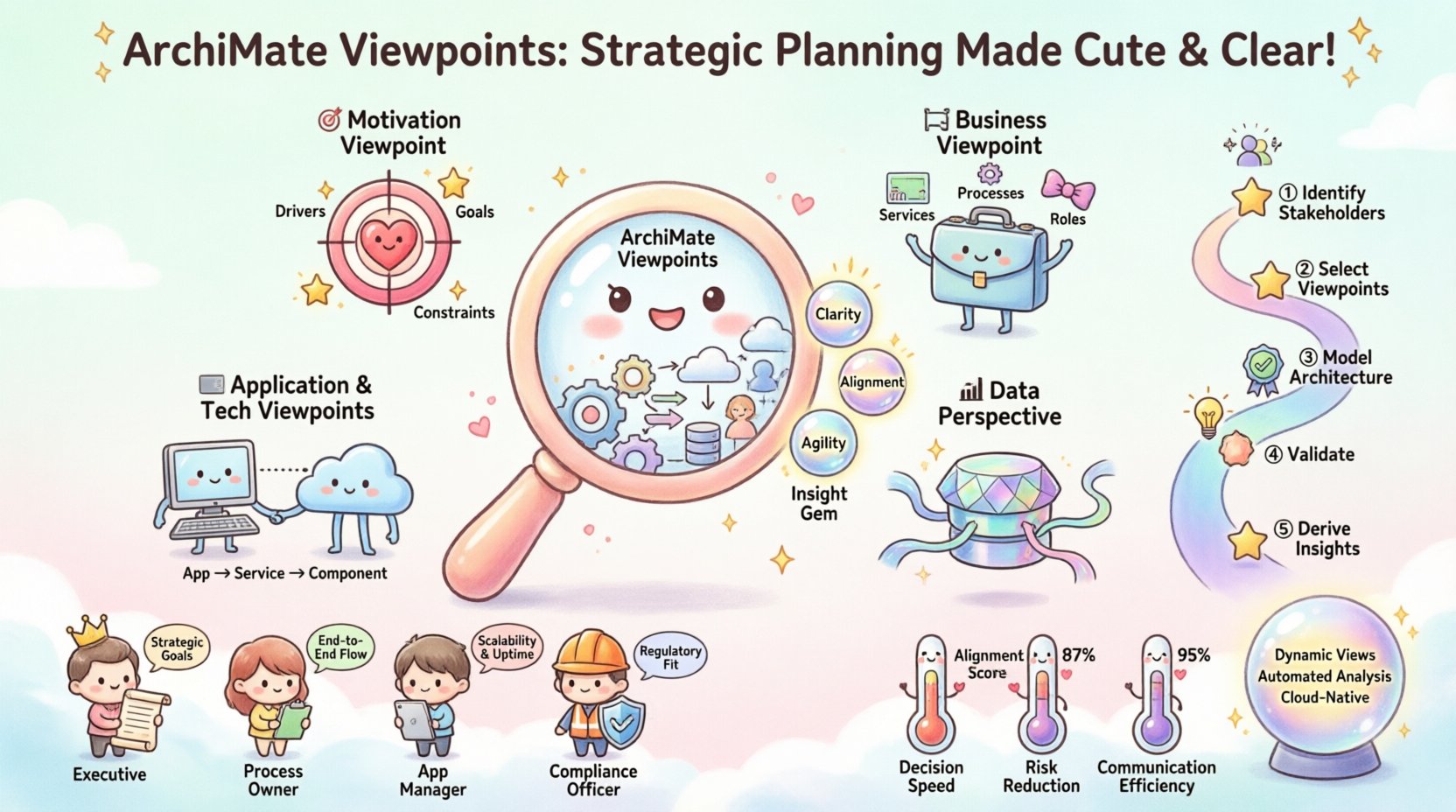
Understanding the Role of Viewpoints in Architecture 🧭
Enterprise architecture models can quickly become overwhelming if presented in their entirety. A single model attempting to show every business process, application, and technology component will confuse rather than clarify. Viewpoints solve this problem by defining the specific concerns of the audience.
Think of a viewpoint as a custom report generated from a larger database. It extracts specific data points based on the user’s needs. In the context of strategic planning, this means:
- Focusing on Relevance: Showing only the business capabilities that impact the strategic goal.
- Reducing Cognitive Load: Removing technical noise that distracts business stakeholders.
- Facilitating Communication: Providing a common language for IT and business leaders.
- Enabling Traceability: Linking high-level motivation to concrete implementation details.
Without viewpoints, models remain static artifacts. With them, they become dynamic tools for planning and decision-making.
The Motivation Viewpoint: Defining the Why 🎯
Strategy begins with intent. Before discussing processes or systems, an organization must understand the driving forces behind a change initiative. The Motivation Viewpoint is critical for this phase. It captures the rationale behind architectural decisions.
This viewpoint connects abstract strategic drivers to concrete goals and requirements. It answers questions such as:
- What is the business driver? (e.g., Market expansion, Regulatory compliance)
- What is the specific goal we aim to achieve?
- Are there any constraints or principles we must adhere to?
- How do we measure success?
By mapping these elements, planners can ensure that every subsequent architectural layer serves a defined purpose. If a technology investment cannot be traced back to a motivation element, it risks becoming a wasted resource.
The Business Viewpoint: Clarifying Capabilities and Processes 💼
Once the motivation is established, the focus shifts to the Business Layer. This is often the most critical layer for strategic planning because it defines what the organization does, not how it is supported technically.
Key elements in the Business Viewpoint include:
- Business Services: The value offered to external or internal customers.
- Business Processes: The sequences of actions that deliver services.
- Business Roles: The actors responsible for executing processes.
- Business Objects: The information entities used during processes.
When planning strategically, a Business Viewpoint helps identify gaps in capability. For instance, if a goal requires faster customer onboarding, the view might reveal a bottleneck in the “Verification” process. This insight allows leadership to target improvements directly rather than guessing.
The Application and Technology Viewpoints: Supporting the Strategy 🖥️
Strategy without support is merely a wish. The Application and Technology layers describe how the business capabilities are realized and sustained. While business stakeholders may not need deep technical details, planners must ensure these layers align with the business vision.
Application Viewpoint:
- Maps software applications to business services.
- Identifies which applications support which processes.
- Highlights redundancy or single points of failure.
Technology Viewpoint:
- Describes the infrastructure required (servers, networks, cloud).
- Shows how applications are deployed.
- Ensures scalability and performance meet strategic needs.
Using separate viewpoints for these layers prevents confusion. A business leader needs to know that an application supports a process, but they do not need to see the server configuration unless there is a direct impact on cost or availability.
The Data Perspective: Information as an Asset 📊
Data flows through every layer of the enterprise. Ignoring the Data Viewpoint can lead to silos and inconsistencies. Strategic planning must consider how information is created, stored, and shared.
Key considerations for the Data Viewpoint include:
- Which business objects are critical to the strategy?
- How does data flow between processes?
- Are there compliance requirements for data retention?
- How is data integrity maintained across systems?
Integrating data views into the planning process ensures that information architecture supports the business logic rather than hindering it.
Aligning Viewpoints with Stakeholders 🤝
Different stakeholders require different levels of detail. A one-size-fits-all approach to architecture modeling fails to engage decision-makers. A matrix approach helps match the correct viewpoint to the correct audience.
| Stakeholder Group | Primary Concern | Recommended Viewpoint | Focus Area |
|---|---|---|---|
| Executive Leadership | Strategic Alignment & ROI | Motivation & Business | Goals, Drivers, Capabilities |
| Business Process Owners | Efficiency & Flow | Business | Processes, Roles, Objects |
| Application Managers | Integration & Functionality | Application | Services, Functions, Components |
| Infrastructure Team | Performance & Availability | Technology | Nodes, Devices, Networks |
| Compliance Officers | Risk & Regulation | Motivation & Business | Principles, Requirements, Constraints |
Using this matrix ensures that the right information reaches the right people at the right time. It prevents technical teams from overwhelming executives with code-level details and helps business leaders understand the implications of technical debt.
Implementing Viewpoints in the Planning Process 🛠️
Integrating ArchiMate viewpoints into enterprise planning requires a structured approach. It is not enough to create diagrams; the diagrams must inform the strategy. The following steps outline a robust implementation process.
1. Identify Stakeholders and Concerns
Begin by listing all groups involved in the planning cycle. For each group, document their specific concerns. What questions do they need answered? What decisions do they need to make? This step defines the scope of the viewpoints you will create.
2. Select Appropriate Viewpoints
Based on the concerns identified, select the standard viewpoints that best address them. Do not force a single viewpoint to do all the work. Use the Motivation Viewpoint for the “Why,” the Business Viewpoint for the “What,” and the Technical Viewpoints for the “How.”
3. Model the Architecture
Create the models using the selected viewpoints. Ensure consistency in notation and naming conventions. A model is only useful if it is readable and maintainable. Avoid over-complicating the diagrams with unnecessary elements.
4. Validate with Stakeholders
Present the viewpoints to the relevant stakeholders. Ask them to confirm that the model accurately reflects their reality and needs. This validation step is crucial for buy-in. If stakeholders do not recognize their processes in the model, they will not trust the strategic insights derived from it.
5. Derive Actionable Insights
Use the validated models to identify gaps, risks, and opportunities. For example, if the Business Viewpoint shows a process that relies on a single legacy application, the strategic insight is a need for modernization or redundancy planning.
Common Challenges and How to Avoid Them ⚠️
While viewpoints are powerful, they are often misused. Recognizing common pitfalls can save time and resources during the planning phase.
- Over-Modeling: Creating models that are too detailed for the strategic level. Solution: Adhere to the principle of abstraction appropriate for the audience.
- Disconnected Layers: Business models that do not link to Application or Technology models. Solution: Ensure relationships are defined between layers to maintain traceability.
- Static Documentation: Creating models that are never updated. Solution: Integrate model updates into regular planning cycles and governance meetings.
- Lack of Governance: No one owns the quality of the viewpoints. Solution: Assign architecture owners responsible for maintaining specific viewpoints.
Measuring the Impact of Viewpoint Modeling 📈
How do you know if using ArchiMate viewpoints is adding value? You must measure the outcomes, not just the output. Look for indicators that demonstrate improved planning and decision-making.
Key Performance Indicators (KPIs) for Architecture:
- Decision Speed: Does the ability to visualize architecture reduce the time needed to make strategic decisions?
- Alignment Score: Do business units report higher alignment with IT initiatives after viewpoint implementation?
- Risk Reduction: Are there fewer unexpected failures or compliance issues due to better visibility of dependencies?
- Communication Efficiency: Is there less rework in requirements gathering because the architecture is clearer?
Tracking these metrics helps justify the investment in architecture capabilities and ensures the practice continues to evolve.
Future Trends in Enterprise Architecture Modeling 🔮
The landscape of enterprise planning is changing. As organizations become more agile, the way they use viewpoints must also adapt. Future trends suggest a shift towards:
- Dynamic Views: Moving from static diagrams to interactive models that update in real-time.
- Automated Analysis: Using algorithms to detect inconsistencies or risks within the viewpoints automatically.
- Integration with Operations: Linking architectural models directly to operational data for continuous monitoring.
- Cloud-Native Perspectives: Developing specific viewpoints that address cloud-specific concerns like elasticity and multi-tenancy.
Staying informed about these trends ensures that the architectural practice remains relevant and effective in supporting long-term strategic goals.
Final Thoughts on Strategic Planning 🌟
Enterprise planning is not just about drawing boxes and lines. It is about creating a shared understanding of the organization and its future direction. ArchiMate Viewpoints provide the structure needed to achieve this clarity.
By focusing on the specific concerns of different stakeholders, organizations can transform complex data into actionable intelligence. The Motivation Viewpoint ensures we do the right things. The Business Viewpoint ensures we do things right. The Application and Technology Viewpoints ensure we have the means to do them.
When implemented with discipline and a clear purpose, these viewpoints become the backbone of a resilient enterprise. They bridge the gap between vision and reality, allowing leaders to navigate change with confidence. The investment in clear architectural modeling pays dividends through better decisions, reduced risk, and a more agile organization.
Start by identifying the most critical strategic questions your organization faces. Then, select the viewpoints that best illuminate the answers. This focused approach will yield deeper insights and a stronger foundation for planning.

 English
 Arabic
 Chinese (Simplified)
 Dutch
Dutch French
 German
 Italian
 Japanese
 Korean
 Portuguese
 Russian
 Spanish