


🔷 Introduction to TOGAF®
TOGAF® (The Open Group Architecture Framework) is a proven enterprise architecture methodology and framework used by the world’s leading organizations to improve business efficiency. As the most prominent and reliable enterprise architecture standard, TOGAF ensures consistent standards, methods, and communication among enterprise architecture professionals.
Key Benefits for Practitioners:
-
✅ Greater industry credibility and career opportunities
-
✅ Freedom from proprietary method lock-in
-
✅ More efficient resource utilization
-
✅ Higher return on investment for architecture initiatives

🎯 Why Adopt TOGAF ADM?
The IT architecture must closely reflect the business goals of the organization. TOGAF provides specific techniques—such as business scenarios—to ensure business goals are properly understood by IT architects and reflected in the resulting architecture.
Top 10 Reasons to Adopt TOGAF ADM:
-
Comprehensive General Method – Covers end-to-end architecture development
-
Complementary Framework – Works alongside, not against, other frameworks
-
Widely Adopted – Industry-standard with global recognition
-
Tailorable – Adaptable to organizational and industry-specific needs
-
Free Perpetual License – Accessible without licensing costs
-
Vendor-Neutral Open Standard – Technology and tool agnostic
-
Avoids Reinvention – Leverages proven best practices
-
Business-IT Alignment – Bridges strategic goals with technical execution
-
Best Practice Foundation – Built on decades of real-world experience
-
Community-Driven Evolution – Practitioners can contribute to framework development
🔄 What Is the TOGAF Architecture Development Method (ADM)?
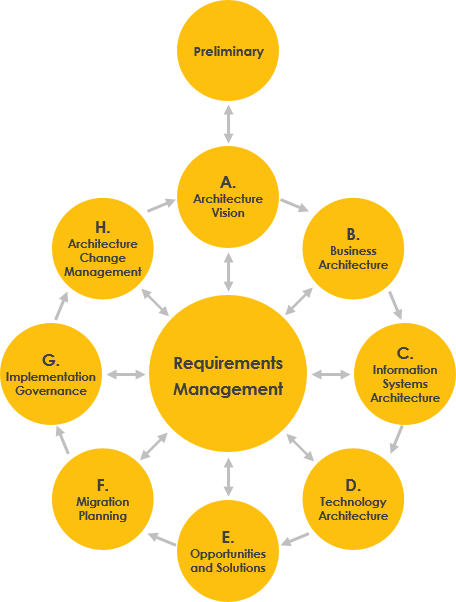
The Architecture Development Method (ADM) is the core of TOGAF—a systematic, iterative approach applied to develop an enterprise architecture that meets both business and information technology needs.
Primary Purposes of the ADM:
| Purpose | Description |
|---|---|
| Lifecycle Management | Describes a method for developing and managing the lifecycle of an enterprise architecture |
| Customizable Execution | May be tailored to organizational needs and employed to manage architecture planning activities |
The ADM is the result of continuous contributions from a large community of architecture practitioners worldwide.
🧩 TOGAF and ArchiMate: Complementary Standards
ArchiMate is a modeling standard introduced by The Open Group that provides a rich set of modeling notations and concepts for consistently modeling Enterprise Architectures within and across domains.
Common Questions Clarified:
❓ “What’s the difference between TOGAF and ArchiMate?”
❓ “TOGAF vs. ArchiMate—which should I use?”
The Relationship:
| Aspect | TOGAF | ArchiMate |
|---|---|---|
| Type | Enterprise Architecture Framework | Visual Modeling Language |
| Purpose | Guides how to develop and implement EA | Provides notation to describe EA visually |
| Compatibility | TOGAF 9.1+ works seamlessly with ArchiMate 2.1+ | Designed to complement TOGAF ADM phases |
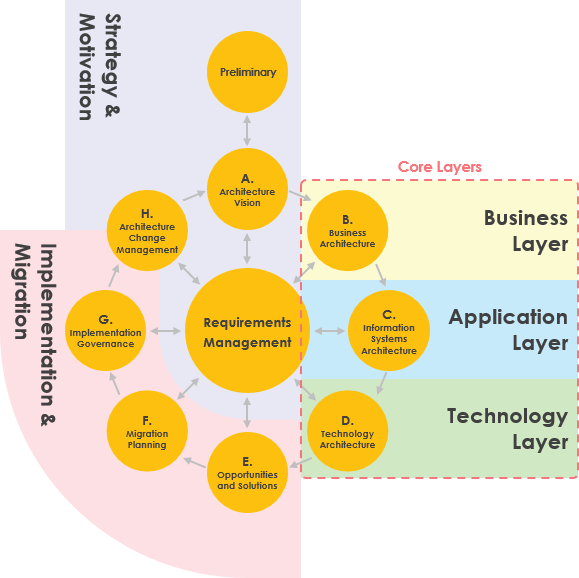
ArchiMate Core Layers & TOGAF Mapping:
🔹 ArchiMate Core Layers
The Business, Application, and Technology layers support modeling of the architecture domains defined by TOGAF:
-
Business Architecture
-
Information Systems Architecture (Data & Application)
-
Technology Architecture
🔹 Strategy and Motivation Extension
Enables modeling of:
-
Stakeholders
-
Drivers for change
-
Business goals, principles, and requirements
Supports TOGAF ADM phases: Requirements Management, Preliminary, Architecture Vision, and Architecture Change Management.
🔹 Implementation and Migration Extension
Enables modeling of:
-
Project portfolio management
-
Gap analysis
-
Transition and migration planning
Supports TOGAF ADM phases: Opportunities & Solutions, Migration Planning, and Implementation Governance.
🔄 TOGAF ADM Lifecycle: The Power of Iteration
The ADM supports iteration at three distinct levels:
1️⃣ Cycling Around the ADM
The circular presentation indicates that completion of one phase directly feeds into subsequent phases—architecture development is continuous, not linear.
2️⃣ Iterating Between Phases
Practitioners may return to earlier phases as new insights emerge (e.g., revisiting Business Architecture after completing Technology Architecture).
3️⃣ Cycling Within a Single Phase
Repeated execution of activities within one phase allows for progressive elaboration of architectural content.
📦 ADM Inputs, Steps, and Outputs
During application of the ADM process, outputs are produced based on inputs and steps according to each phase’s objective.
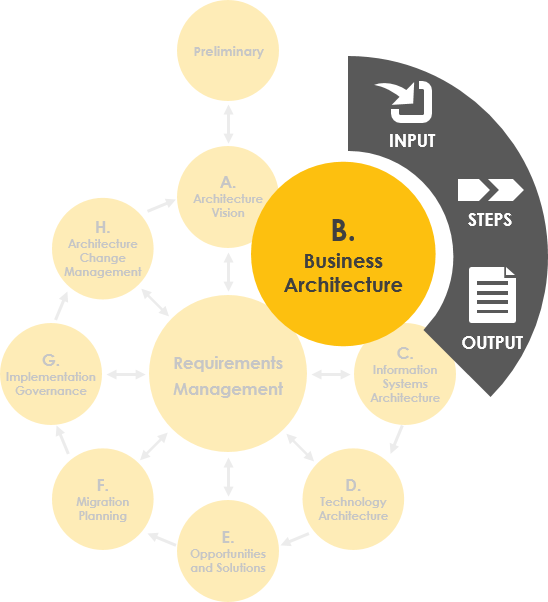
Example Outputs Include:
-
Process flows
-
Architectural requirements
-
Project plans
-
Project compliance assessments
-
Risk registers
-
Stakeholder maps
TOGAF defines a structural model to collate and present these work products consistently.
Key Concepts:
| Term | Definition |
|---|---|
| Deliverable | A contractually specified work product, formally reviewed, agreed, and signed off by stakeholders. Typically archived or transitioned to an Architecture Repository. |
| Artifact | A work product created during architecture development (e.g., diagrams, matrices, lists). |
| Building Block | A reusable component of architecture capability (Architecture Building Block) or implementation (Solution Building Block). |
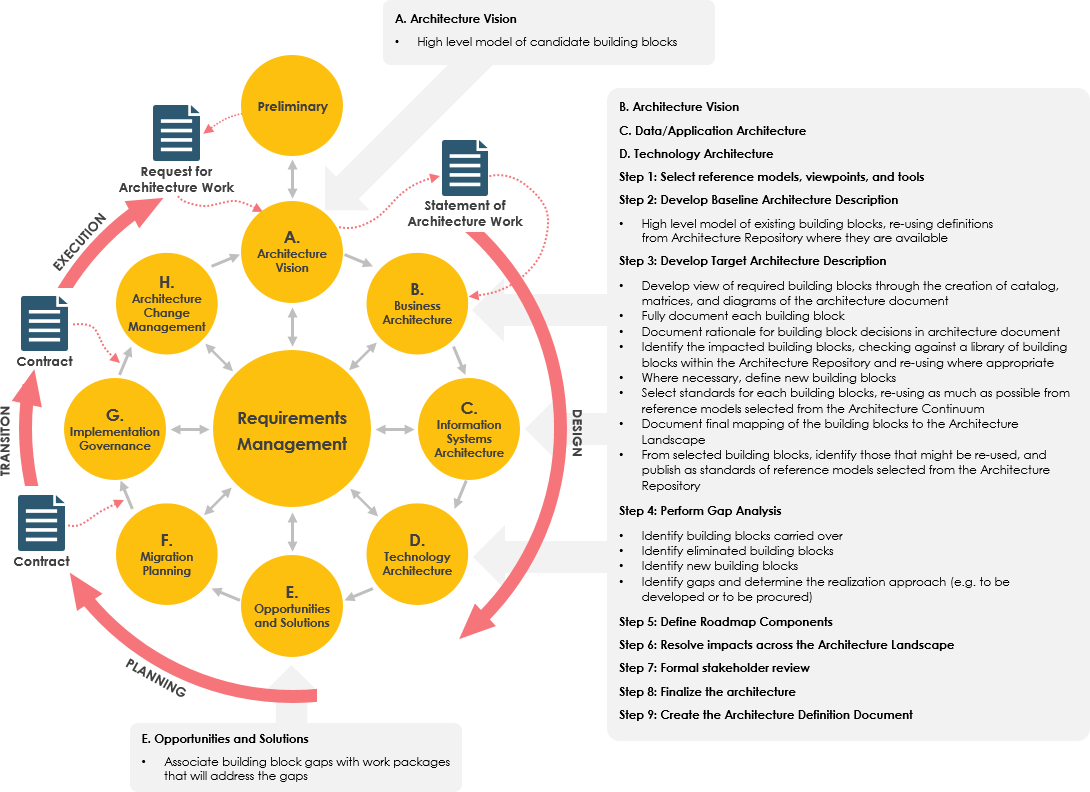
💡 Note: Deliverables are suggestions and need not be followed exactly. Each should be versioned to track changes.
🗂️ ADM Phase-by-Phase Guide
🟦 Preliminary Phase: Prepare the Foundation
Preparation and initiation activities to create an Architecture Capability
Key Activities:
-
Customize TOGAF framework for organizational context
-
Define architecture principles and governance structure
-
Establish Architecture Repository and tools
Output Deliverables:
-
Tailored architecture framework
🟩 Phase A: Architecture Vision
Define scope, stakeholders, and high-level vision; obtain approval to proceed
Key Activities:
-
Identify stakeholders and concerns
-
Define scope and constraints
-
Create high-level Architecture Vision
-
Develop Statement of Architecture Work
Output Deliverables:
-
Architecture roadmap
-
Tailored architecture framework
🟨 Phase B: Business Architecture
Develop Business Architecture to support the agreed Architecture Vision
Key Activities:
-
Model baseline (as-is) and target (to-be) business architectures
-
Perform gap analysis
-
Define business processes, organization structures, and capabilities
Output Deliverables:
-
Architecture roadmap
🟪 Phase C: Information Systems Architectures
Develop Data and Application Architectures to support the Vision
Key Activities:
-
Define baseline and target Data Architecture
-
Define baseline and target Application Architecture
-
Perform gap analysis and identify candidate building blocks
Output Deliverables:
-
Architecture roadmap
🟥 Phase D: Technology Architecture
Develop Technology Architecture to support the agreed Vision
Key Activities:
-
Model baseline and target technology infrastructure
-
Identify platforms, networks, and technical standards
-
Perform gap analysis and define technology building blocks
Output Deliverables:
-
Architecture roadmap
🟧 Phase E: Opportunities & Solutions
Identify implementation projects and delivery vehicles
Key Activities:
-
Consolidate gaps across Business, Data, Application, and Technology architectures
-
Identify candidate projects and work packages
-
Evaluate implementation options and dependencies
Output Deliverables:
-
Architecture roadmap
-
Implementation and migration plan
🟫 Phase F: Migration Planning
Finalize detailed Implementation and Migration Plan
Key Activities:
-
Prioritize projects based on value, risk, and dependencies
-
Develop detailed migration roadmap with timelines
-
Define transition architectures and interim states
Output Deliverables:
-
Architecture building blocks
-
Architecture roadmap
-
Change request Implementation and migration plan
-
Implementations governance plan
🟦 Phase G: Implementation Governance
Provide architectural oversight during implementation
Key Activities:
-
Monitor implementation projects for architectural compliance
-
Assess solution building blocks against architecture definitions
-
Manage architecture change requests during deployment
Output Deliverables:
-
Change request
-
Compliance assessment
-
Solution building blocks
🟪 Phase H: Architecture Change Management
Manage ongoing change to the deployed architecture
Key Activities:
-
Monitor business and technology changes impacting architecture
-
Assess change requests and determine impact
-
Trigger new ADM cycles when significant changes occur
Output Deliverables:
-
Architecture change requests
-
Updated architecture repository
-
Lessons learned documentation
🔁 Requirements Management (Cross-Cutting)
Manage architecture requirements throughout the ADM lifecycle
Key Principle: Every stage of the project should be based on and validate business requirements. Requirements are captured, prioritized, traced, and validated across all ADM phases.
📊 ADM Phase Summary Table
| TOGAF ADM Phase | Phase Objective |
|---|---|
| Preliminary | Prepares the organization for a successful architecture project |
| A. Architecture Vision | Sets scope, constraints, expectations; validates business context; creates Statement of Architecture Work |
| B. Business Architecture | Develops baseline (as-is) and target (to-be) Business Architecture; analyzes gaps |
| C. Information Systems Architectures | Develops baseline and target Data & Application Architectures; analyzes gaps |
| D. Technology Architecture | Develops baseline and target Technology Architecture; analyzes gaps |
| E. Opportunities and Solutions | Identifies major implementation projects and delivery vehicles |
| F. Migration Planning | Analyzes costs, benefits, risks; produces detailed implementation roadmap |
| G. Implementation Governance | Ensures implementation projects conform to the defined architecture |
| H. Architecture Change Management | Ensures architecture evolves to meet changing enterprise needs |
| Requirements Management | Ensures every stage is grounded in validated business requirements |
✅ Key Takeaways
The TOGAF ADM is a comprehensive, iterative, and adaptable method that:
🔹 Recommends a logical sequence for architecture development phases
🔹 Supports iteration at multiple levels (within phases, between phases, and around the cycle)
🔹 Leverages TOGAF assets, processes, and best practices
🔹 Integrates seamlessly with other frameworks and deliverables
🔹 Enables continuous improvement through Requirements Management
By following the ADM, organizations can systematically develop architectures that align business strategy with technology execution—delivering measurable value and sustainable competitive advantage.
📚 Reference List
Architecture Principles: Explains the foundational guidelines that shape architectural decisions and ensure consistency across enterprise initiatives.
Architecture Repository: Details the structured storage system for architecture artifacts, models, and reference materials to support reuse and governance.
Business Principles, Goals, and Drivers: Covers how to identify and document the strategic business elements that guide architecture development.
Organization Model for Enterprise Architecture: Describes the governance structures, roles, and responsibilities needed to execute enterprise architecture effectively.
Request for Architecture Work: Explains the formal trigger document that initiates an architecture development cycle and defines its scope.
Architecture Vision: Outlines how to create a high-level, stakeholder-aligned vision that guides the entire architecture effort.
Capability Assessment: Details methods for evaluating organizational readiness and maturity to undertake architecture initiatives.
Communications Plan: Provides guidance on engaging stakeholders and managing information flow throughout the architecture lifecycle.
Statement of Architecture Work: Defines the formal agreement between architects and stakeholders on scope, deliverables, schedule, and responsibilities.
Architecture Definition Document: Describes the comprehensive output documenting baseline/target architectures, gaps, and roadmap components.
Architecture Requirements Specification: Explains how to capture, prioritize, and manage functional and non-functional requirements throughout the ADM.
More about TOGAF ADM Guide-through: Interactive tools and templates to support practical application of the TOGAF ADM methodology.
More about Just-in-Time TOGAF Templates: Pre-built, customizable templates aligned with TOGAF deliverables to accelerate architecture documentation.
More about ArchiMate tools: Visual modeling capabilities for creating ArchiMate diagrams that complement TOGAF ADM phases.
Try Visual Paradigm FREE: Download a free trial of Visual Paradigm to explore TOGAF and ArchiMate modeling capabilities hands-on.

 English
 Arabic
 Chinese (Simplified)
 Dutch
Dutch French
 German
 Italian
 Japanese
 Korean
 Portuguese
 Russian
 Spanish