


In the complex landscape of enterprise architecture, clarity is often the most scarce resource. Leaders face a constant challenge: how to convey intricate structural relationships to diverse stakeholders without causing confusion or analysis paralysis. The Enterprise Architecture Meta-Model (ArchiMate) provides a standardized language, but language alone is not enough. To communicate effectively, one must understand ArchiMate Viewpoints.
This guide provides a structured approach to selecting, defining, and applying viewpoints. It is designed for architects, directors, and decision-makers who need to translate technical models into actionable business intelligence. By mastering the logic behind viewpoint selection, organizations can ensure that every architectural artifact serves a specific purpose and aligns with strategic goals. 🚀
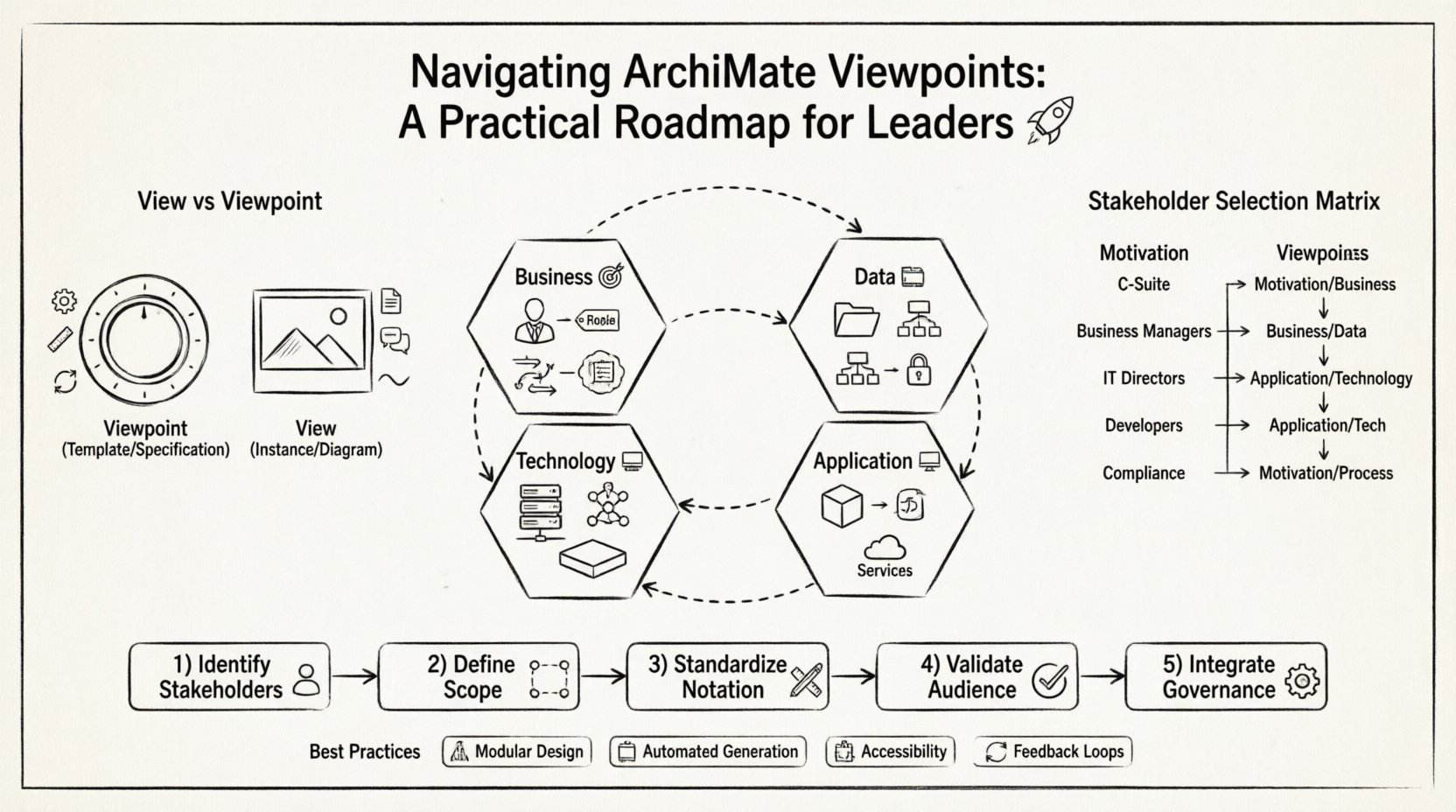
What Are Architecture Viewpoints? 🧩
An ArchiMate Viewpoint is a specification that defines how information is presented to a specific audience. It is not the model itself, but rather the lens through which the model is viewed. Think of it as a filter that highlights specific aspects of the enterprise while suppressing irrelevant details. This abstraction is critical for managing complexity.
Without viewpoints, an enterprise architecture model becomes an overwhelming monolith. A single diagram attempting to show business processes, application logic, infrastructure, and financial motivations simultaneously will fail to communicate effectively. Viewpoints solve this by segmenting information based on context.
Key Characteristics of a Viewpoint
- Target Audience: Defined by role, function, or interest level. A CFO requires different data than a Lead Developer.
- Language: The specific subset of ArchiMate concepts allowed in the view.
- Notation: The visual style and layout conventions used for presentation.
- Questions: The specific inquiries the view is designed to answer.
The Distinction Between View and Viewpoint 👁️
Confusion often arises between a view and a viewpoint. Understanding this difference is fundamental to maintaining a coherent architecture repository.
- Viewpoint: The template or specification. It is the rule set. It exists before the diagram is drawn. It defines how to build the view.
- View: The result or instance. It is the actual diagram or report generated using the viewpoint. It exists after the data is modeled.
Consider the analogy of a camera. The Viewpoint is the camera setting (macro, portrait, landscape). The View is the actual photograph taken with those settings. You do not take a photo without settings, nor do you have a setting without the resulting image.
| Aspect | Viewpoint | View |
|---|---|---|
| Nature | Abstract Specification | Concrete Instance |
| Duration | Reusable Template | One-time Output |
| Change | Static (Updated rarely) | Dynamic (Changes with data) |
| Purpose | Define Standards | Communicate Data |
Core Viewpoint Categories 📊
ArchiMate defines several standard viewpoints. While the framework allows for custom definitions, adhering to standard categories ensures interoperability and understanding across the industry. Below are the primary categories used in practice.
1. Business Viewpoint 👔
This category focuses on the organization’s operational structure. It answers questions regarding capabilities, processes, and roles.
- Key Concepts: Business Actor, Business Role, Business Function, Business Process, Business Object.
- Typical Users: Business Managers, Operations Directors, Process Owners.
- Goal: Aligning business strategy with operational execution.
2. Data Viewpoint 📂
Data is the backbone of modern enterprise. This viewpoint maps information objects and their relationships. It is often integrated with business modeling to show what data supports which process.
- Key Concepts: Data Object, Data Structure, Data Role, Data Access.
- Typical Users: Data Architects, Information Stewards, Compliance Officers.
- Goal: Ensuring data integrity and accessibility across functions.
3. Application Viewpoint 💻
This layer describes the software systems that automate business functions. It bridges the gap between business needs and technical implementation.
- Key Concepts: Application Function, Application Component, Application Interface, Application Service.
- Typical Users: Software Architects, System Integrators, Developers.
- Goal: Managing application lifecycle and service availability.
4. Technology Viewpoint 🖥️
This viewpoint deals with the infrastructure required to support applications. It includes hardware, networks, and platforms.
- Key Concepts: Device, System Software, Network, Data Store.
- Typical Users: Infrastructure Managers, IT Operations, Security Teams.
- Goal: Ensuring physical and logical resource availability.
5. Motivation Viewpoint 🎯
Why are we doing this? This viewpoint connects the technical and business layers to strategic intent. It is crucial for justifying investments.
- Key Concepts: Goal, Principle, Requirement, Stakeholder, Assessment.
- Typical Users: Executives, Portfolio Managers, Project Sponsors.
- Goal: Aligning initiatives with organizational strategy.
Selecting the Right Viewpoint for Your Audience 🎯
Creating a viewpoint is not a one-size-fits-all activity. A poorly chosen viewpoint leads to disengagement. Leaders must match the viewpoint to the specific needs of the stakeholder group. The following matrix provides a framework for this decision-making process.
| Stakeholder Group | Primary Concern | Recommended Viewpoint Focus |
|---|---|---|
| C-Suite Executives | Strategic Value & ROI | Motivation & High-Level Business |
| Business Managers | Process Efficiency | Business & Data |
| IT Directors | System Integration | Application & Technology |
| Developers | Component Logic | Application & Technology |
| Compliance Auditors | Regulatory Adherence | Motivation & Business Process |
When selecting a viewpoint, consider the granularity. A high-level strategic view should not contain low-level technical details. Conversely, a technical design view should not be cluttered with abstract strategic goals. Precision in selection prevents cognitive overload.
Building Your Viewpoint Strategy 🗺️
Implementing a robust viewpoint strategy requires a methodical approach. It is not enough to simply create diagrams; you must define the standards that govern them. Follow this roadmap to establish a sustainable architecture practice.
Step 1: Identify Stakeholders and Their Needs
Begin by cataloging all groups that interact with the architecture. Do not assume what they need. Interview them. Ask specific questions about the decisions they make daily. If a stakeholder cannot use the information to make a decision, the viewpoint is unnecessary.
Step 2: Define the Scope and Boundaries
Every view has a scope. What is included, and what is excluded? Define the boundaries clearly. For example, a Business Process view might include the interaction between departments but exclude the specific server hardware running the software. Clear boundaries prevent scope creep.
Step 3: Standardize Notation and Symbols
Consistency is key to readability. Decide on a visual language. Use the same shape for the same concept across all views. If a Business Actor is represented by a stick figure in one diagram, it must be a stick figure in every diagram. This reduces the learning curve for anyone consuming the architecture.
Step 4: Validate with the Audience
Before publishing, test the viewpoint. Show it to a representative from the target audience. Ask them to interpret it. If they misunderstand a relationship or concept, the viewpoint needs revision. Validation ensures the communication is effective, not just technically accurate.
Step 5: Integrate with Governance Processes
Views should not exist in a vacuum. Integrate them into governance meetings. Use the Business Viewpoint to review process changes. Use the Motivation Viewpoint to approve projects. When viewpoints are tied to decision-making gates, their value increases significantly.
Common Challenges in Implementation ⚠️
Even with a clear roadmap, organizations face hurdles when adopting viewpoint standards. Recognizing these pitfalls early allows for mitigation strategies.
- Over-Modeling: Trying to create a single view that answers every question. This leads to cluttered diagrams that no one reads. Accept that multiple views are necessary.
- Inconsistent Naming: Using different terms for the same concept in different viewpoints. This creates confusion about what constitutes a specific function or service. Maintain a central glossary.
- Lack of Context: Providing a view without explaining the time frame or scope. A process diagram from last year may not reflect current operations. Always date and version your views.
- Static Documentation: Creating views that are never updated. Architecture is dynamic. If the model changes but the view remains the same, the view becomes misleading. Establish a review cycle.
Best Practices for Sustainable Architecture 🛡️
To ensure long-term success, architects must treat viewpoints as living artifacts. Here are practices that support sustainability.
- Modular Design: Build views from reusable components. If you change a standard icon, it should update across all views automatically.
- Automated Generation: Whenever possible, generate views from the underlying model data. Manual drawing is prone to error and drift. Automated generation ensures the view always matches the source of truth.
- Accessibility: Ensure views are accessible to all stakeholders. If a view requires specialized software to view, it limits adoption. Use formats that are widely understood.
- Feedback Loops: Create a mechanism for stakeholders to report issues with the views. If a diagram is confusing, the feedback should lead to an update in the viewpoint specification.
Measuring the Value of Viewpoints 📏
How do you know if your viewpoint strategy is working? Quantitative and qualitative metrics can help.
- Decision Speed: Are stakeholders making decisions faster because the architecture is clear?
- Query Reduction: Are you receiving fewer questions about basic architectural relationships?
- Adoption Rate: How many teams are actively using the generated views in their planning?
- Consistency Score: How often do different views contradict each other? A lower contradiction rate indicates better standardization.
Future-Proofing Your Approach 🔄
The technology landscape evolves rapidly. New tools, platforms, and methodologies emerge constantly. Your viewpoint strategy must be adaptable.
Stay informed about updates to the ArchiMate standard. The language itself may evolve to accommodate new paradigms like cloud-native architectures or AI integration. A flexible viewpoint specification allows you to incorporate new concepts without rewriting the entire governance framework.
Furthermore, consider the rise of data-driven architecture. Modern architectures rely heavily on telemetry and real-time data. Future viewpoints may need to incorporate dynamic data streams rather than static representations. Prepare your models to support this shift by ensuring your underlying data is robust and granular.
Summary of Strategic Impact 📝
Effective use of ArchiMate Viewpoints transforms architecture from a documentation exercise into a strategic asset. It bridges the gap between high-level strategy and low-level execution. By defining clear lenses through which to view the enterprise, leaders can ensure that every stakeholder sees the information they need to succeed.
This roadmap provides the structure needed to navigate complexity. It emphasizes standardization, audience alignment, and continuous improvement. When implemented correctly, viewpoint management reduces risk, accelerates delivery, and fosters a shared understanding of the enterprise structure across the organization.
Start by auditing your current documentation. Identify where the views are unclear or missing. Apply the selection matrix to prioritize gaps. Then, build the viewpoints that will drive clarity for your team. The investment in structure pays dividends in execution.

 English
 Arabic
 Chinese (Simplified)
 Dutch
Dutch French
 German
 Italian
 Japanese
 Korean
 Portuguese
 Russian
 Spanish