


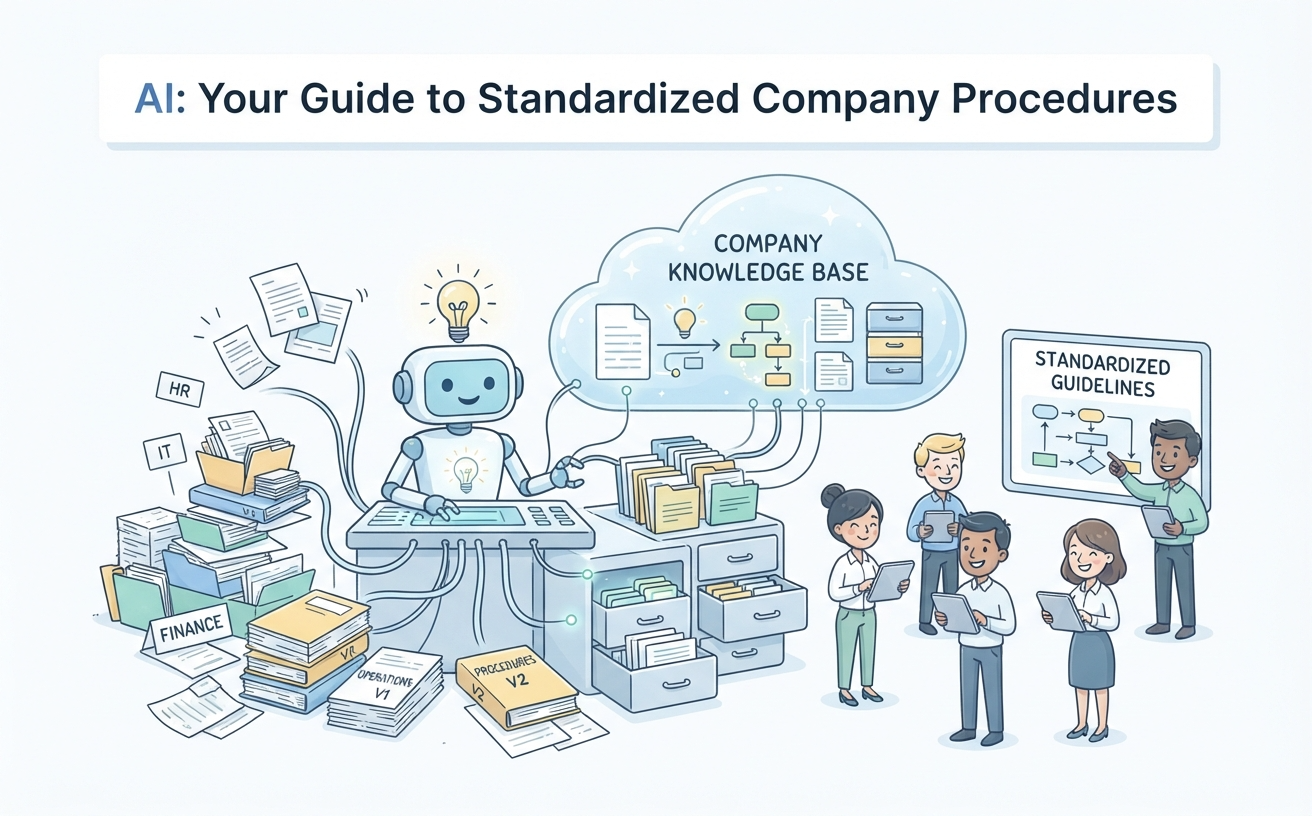
Most organizations have internal procedures and company guidelines. They may cover everything from approving expenses and handling customer complaints to onboarding employees, requesting IT support and managing project documentation.
Having these procedures documented, however, does not guarantee that employees can find or follow them consistently.
Guidelines may be scattered across shared folders, intranet pages, PDF documents and departmental manuals. Different teams may maintain their own versions, while employees may rely on old instructions or ask colleagues whenever they are unsure what to do.
AI can help address this problem by making internal guidance easier to access and understand. When connected to approved company knowledge, an AI assistant can help employees find relevant procedures, summarize instructions and navigate routine questions.
It can also help organizations review their documentation and identify possible inconsistencies. The result can be a more consistent way of working—without requiring employees to search through lengthy manuals every time they need an answer.
Why Businesses Struggle to Keep Procedures Consistent
As organizations grow, their internal procedures tend to evolve. New systems are introduced, responsibilities change, departments develop their own practices and policies are updated to reflect new requirements.
Over time, several problems can emerge.
Procedures are stored in too many places
Employees may need to consult a staff handbook, departmental guide, shared document folder or internal website to find the information they need. They may not know which source contains the latest instructions.
Different departments interpret guidance differently
A company-wide policy may be understood in different ways by different teams. Even when everyone intends to follow the same rules, variations in interpretation can lead to inconsistent practices.
Documents become outdated
Procedures often change when the organization introduces new tools, adjusts approval responsibilities or revises its operating practices. If old documents remain accessible, employees may unknowingly follow superseded instructions.
Employees have difficulty understanding lengthy documents
A procedure may be accurate but difficult to use. Long paragraphs, technical language and complicated exception rules can make it challenging for employees to identify the steps relevant to their situation.
Knowledge depends too heavily on colleagues
When employees cannot find an answer, they often ask a manager or an experienced colleague. This can interrupt other people’s work and create inconsistent answers, particularly when different colleagues rely on different versions of the guidance.
These problems are not necessarily caused by a lack of documentation. Often, the organization needs a better way to organize, maintain and make its existing knowledge accessible.
How AI Can Help Employees Follow Internal Procedures
An AI assistant connected to selected company documents can provide a more convenient way for employees to interact with internal guidance.
Instead of searching through multiple folders or reading an entire policy document, an employee can ask a question in natural language.
For example:
- What is the procedure for requesting annual leave?
- Which approvals are needed before purchasing new equipment?
- What information should I collect when handling a customer complaint?
- How do I request access to an internal system?
- What steps should a new employee complete during their first week?
The AI assistant can retrieve relevant information from the selected knowledge sources and present a concise explanation. Where supported, it may also identify the source document so the employee can check the full procedure.
This approach is often associated with retrieval-augmented generation (RAG). The system retrieves relevant content from selected information sources and uses it as context when generating a response.
It is important to understand that this does not automatically update or retrain the AI model whenever a company document changes. The knowledge sources and retrieval configuration need to be maintained so that the assistant can use current, approved information.
Seven Practical Ways AI Can Improve Procedure Consistency
1. Make Company Guidelines Easier to Find
One of the simplest ways AI can help is by making internal information searchable through ordinary questions.
Imagine an employee who wants to understand the company’s travel expense policy. Instead of locating a handbook, opening the relevant section and interpreting several paragraphs, the employee could ask:
What expenses can I claim during a business trip, and what supporting documents do I need to provide?
An AI assistant connected to the approved expense policy could retrieve the relevant guidance and summarize the requirements.
This is particularly useful for organizations with many internal documents or employees who do not regularly use the systems where those documents are stored.
2. Provide Consistent Answers to Routine Questions
Employees often ask the same procedural questions repeatedly. HR, finance, IT and operations teams may spend considerable time answering questions that are already covered by internal documentation.
An AI assistant can help provide a consistent first point of reference for these routine enquiries.
For example, an HR assistant could help employees locate information about leave applications, onboarding requirements and internal training procedures. An IT support assistant could explain how to submit a service request or follow an approved troubleshooting guide.
Consistency depends on using the same authoritative information sources and maintaining them properly. If the underlying documents conflict, an AI assistant may also produce incomplete or inconsistent answers.
3. Guide Employees Through Multi-Step Procedures
Some company procedures involve several steps, conditions and approvals. Employees may understand the overall policy but still be unsure what to do first or which department to contact.
AI can help break an existing procedure into a more manageable sequence.
For example, an employee preparing a purchase request might ask:
Walk me through the company’s purchasing procedure. What information should I prepare before submitting a request?
The assistant could summarize the documented steps, such as preparing a business justification, obtaining quotations, submitting the request and securing the required approval.
For more complex procedures, the organization can provide approved checklists or workflow diagrams alongside the written policy. The AI assistant can then help employees understand the documented process.
However, unless it is specifically integrated with an authorized workflow system, an AI-generated explanation should not be treated as an actual approval or transaction.
4. Help Employees Understand Exceptions and Special Cases
Internal procedures often contain exceptions. A standard purchasing process, for example, may differ for urgent purchases, recurring services or high-value equipment.
Employees may struggle to identify which conditions apply to their situation.
AI can help them explore the relevant sections of an approved procedure by asking follow-up questions and explaining documented conditions in simpler language.
For instance, an employee might ask:
Does the normal purchasing procedure apply to an urgent equipment replacement, or is there a separate process?
The assistant can help locate the relevant exception guidance. If the documents do not clearly address the situation, it should direct the employee to the responsible manager or department rather than inventing a rule.
5. Identify Conflicting or Outdated Procedures
AI can also help the people responsible for maintaining company guidelines.
Suppose a business has several documents describing its customer complaint process. One document says complaints should be escalated after two working days, while another refers to a five-day period.
A reviewer could ask an AI tool to compare the documents and highlight differences in escalation timelines, responsible roles or required actions.
Similar reviews can help identify:
- Different versions of the same procedure.
- Conflicting approval limits or responsibilities.
- References to retired systems or outdated forms.
- Missing steps in a documented workflow.
- Unclear terminology or inconsistent department names.
These findings should be treated as items for investigation, not automatic proof that a policy is incorrect. The document owner must decide which information is authoritative and approve any changes.
6. Help Create and Improve Procedure Documentation
Some organizations have procedures that are followed in practice but are not documented clearly. Others have documents that contain lengthy explanations but lack a simple step-by-step structure.
AI can assist process owners when they prepare or revise internal documentation.
For example, a manager could provide an existing procedure and ask AI to:
- Rewrite complex instructions in clearer language.
- Organize a procedure into numbered steps.
- Identify roles and responsibilities mentioned in the document.
- Extract required inputs, approvals and outputs.
- Prepare a draft checklist for employees.
- Suggest questions that should be clarified by the process owner.
AI can also help turn a written description into a visual process model, making responsibilities and decision points easier to understand.
Any revised procedure must still be checked by the appropriate subject matter experts and formally approved through the organization’s established process.
7. Support Employee Onboarding and Training
New employees need to learn how the organization works. This includes understanding internal policies, departmental procedures, communication practices and the tools they are expected to use.
Traditional onboarding often involves reading a collection of documents and attending introductory sessions. Employees may remember the general guidance but forget specific details when they encounter a task several weeks later.
An AI assistant can provide an additional way to revisit approved guidance after onboarding.
For example, a new employee could ask:
- What should I do before organizing a meeting with an external customer?
- Where can I find the guidelines for handling company equipment?
- What is the process for requesting access to a shared project folder?
- Which document explains the company’s information-handling rules?
This makes internal knowledge available when employees need it, rather than limiting access to the initial training period.
AI Does Not Replace Good Procedure Management
Making procedures accessible through AI is useful, but it does not solve every problem associated with internal documentation.
If an organization has outdated policies, unclear responsibilities or contradictory instructions, AI cannot reliably determine which rule management intends employees to follow.
In fact, making poor documentation easier to search can spread confusion more quickly.
Before introducing AI, organizations should establish a few basic practices.
Identify authoritative documents
Determine which documents represent approved company guidance. Drafts, historical versions and informal notes should not be confused with current policies.
Assign document owners
Each important procedure should have an accountable owner or department responsible for reviewing its accuracy and initiating updates when business practices change.
Maintain version information
Documents should make it reasonably clear which version is current, when it was approved and when it should next be reviewed, where applicable.
Establish an approval process
AI-generated revisions should remain drafts until reviewed and approved by the appropriate people. The organization should retain its normal governance and approval arrangements.
Control access to internal information
Some procedures may be intended for all employees, while others may contain restricted operational, financial, HR or security information. Access permissions should reflect those differences.
These practices provide the foundation for a more dependable AI-assisted procedure management environment.
How to Introduce AI for Internal Procedures
Organizations do not need to connect every policy and procedure to AI immediately. A focused implementation can start with a small collection of frequently used guidance.
Step 1: Choose a department or procedure category
Start with an area where employees regularly ask similar questions. Common examples include HR policies, IT support procedures, purchasing guidelines, travel expenses or customer service processes.
A focused starting point makes it easier to assess whether AI is helping employees find the information they need.
Step 2: Collect and review the existing documents
Gather the relevant procedures, policy documents, checklists and supporting material. Identify outdated versions, duplicate files and unresolved differences.
Confirm which documents are authoritative before making them available to the AI assistant.
Step 3: Organize the knowledge sources
Group documents logically and record useful information such as department, document owner, version and approval status. Apply appropriate access restrictions to sensitive material.
Good organization helps both employees and AI systems work with a clearer collection of information.
Step 4: Connect the selected knowledge to an AI assistant
Make the approved documents available to an AI solution that supports retrieval from selected knowledge sources.
Test the assistant using realistic employee questions. Include straightforward questions, ambiguous requests and questions about exceptions to see whether it retrieves appropriate guidance or acknowledges when the documents do not provide an answer.
Step 5: Establish clear boundaries for AI responses
Employees should understand that AI provides assistance based on available information. It does not replace official policy documents, management decisions or required approval processes.
For important matters, the assistant should direct employees to the relevant source or responsible person. Organizations should also decide which types of questions require human review.
Step 6: Train employees and gather feedback
Show employees how to ask questions, check source information and recognize situations that require escalation.
Collect feedback about missing documents, confusing answers and recurring questions. These insights can help the organization improve both its knowledge collection and its procedures.
Step 7: Maintain and expand the system
Review knowledge sources regularly and update them when policies change. Once the initial implementation is working well, consider extending it to other departments or procedure categories.
Expansion should follow demonstrated business value and appropriate governance, rather than simply making every company document available at once.
Measuring the Benefits
To understand whether AI is improving procedure consistency, organizations should look at practical outcomes rather than relying only on usage statistics.
Possible measures include:
- Time spent finding guidance: Can employees locate the correct procedure more quickly?
- Repeated enquiries: Are HR, finance, IT or operations teams receiving fewer routine questions?
- Procedure adherence: Are employees following the documented steps more consistently?
- Documentation quality: Are outdated, duplicated or conflicting procedures being identified and resolved?
- Employee confidence: Do employees feel more confident about where to find and how to interpret internal guidance?
- Onboarding experience: Can new employees access relevant instructions when they need them?
Where possible, establish a baseline before implementation and compare results after employees have had time to adopt the new approach. Combine quantitative measures with feedback from employees and process owners.
Connecting Company Knowledge with AI: The Visual Paradigm Approach
Organizations looking to make internal procedures more accessible can benefit from combining knowledge management, AI-assisted retrieval and tools for creating structured documentation.
Visual Paradigm’s Private AI for Enterprise Knowledge solution brings together capabilities that can support this approach:
- NotesKeep: A knowledge management environment for organizing company notes and documents.
- AI Chatbot: Enables employees to ask natural-language questions about selected knowledge sources and explore relevant information.
- OpenDocs: Supports the creation and organization of documentation and reports.
- Diagram editing tools: Help teams create visual representations of business processes, workflows and other structured models.
- Implementation and support services: Include assistance with software and AI endpoint setup, team training and ongoing technical advisory.
For example, a company could organize its approved operating procedures and departmental guidelines in a knowledge environment, allow employees to ask questions through an AI assistant, and use diagramming tools to develop clearer visual explanations of important workflows.
The solution can be configured around different deployment approaches, including self-hosted AI infrastructure or a connection to a cloud AI provider through an organization-managed account and endpoint. The appropriate arrangement depends on the organization’s data-handling, infrastructure and operational requirements.
The objective is not simply to add a chatbot to an existing workplace. It is to make company knowledge more useful and accessible, while supporting the creation and maintenance of the documents and models employees rely on.
Final Thoughts
Consistent procedures are important for efficient business operations, but documentation alone does not guarantee consistent execution. Employees need to be able to find the right information, understand what it means and know when to seek clarification.
AI can help bridge this gap by making approved company guidelines easier to search, summarize and apply. It can also assist process owners in reviewing documentation, identifying possible inconsistencies and preparing clearer procedures.
The strongest results come when AI is introduced alongside good document ownership, version control, access management and human approval processes.
With these foundations in place, organizations can make internal knowledge more accessible and help employees work with greater confidence and consistency.
Frequently Asked Questions
Can AI help standardize business processes?
Yes. AI can help employees find approved procedures, understand documented steps and access consistent guidance. It can also assist process owners in comparing documents and preparing clearer workflow descriptions. However, the organization remains responsible for defining, approving and maintaining its processes.
Can an AI assistant answer questions about company policies?
Yes, if it is connected to relevant and appropriately selected policy documents. Employees can ask questions in natural language and receive responses based on retrieved information. Important answers should be checked against authoritative documents, particularly when a policy is ambiguous or involves an exception.
Can AI identify conflicting company procedures?
AI can compare selected documents and highlight possible differences, such as inconsistent approval steps, responsibilities or timelines. These findings need to be reviewed by the relevant document owners, who determine which information is correct and whether revisions are necessary.
Does AI automatically update company guidelines when policies change?
Not necessarily. An organization must maintain its knowledge sources and ensure that the AI solution retrieves the appropriate current information. Changes to official procedures should continue to follow the company’s review and approval process.
Can AI replace internal policy and procedure manuals?
AI can provide a more convenient way to access and understand internal guidance, but it should not automatically replace official policy documents. Employees and managers may still need authoritative documents for formal reference, compliance, approvals and record keeping.

 English
 Arabic
 Chinese (Simplified)
 Dutch
 French
 German
 Italian
 Japanese
 Korean
 Portuguese
 Russian
 Spanish