


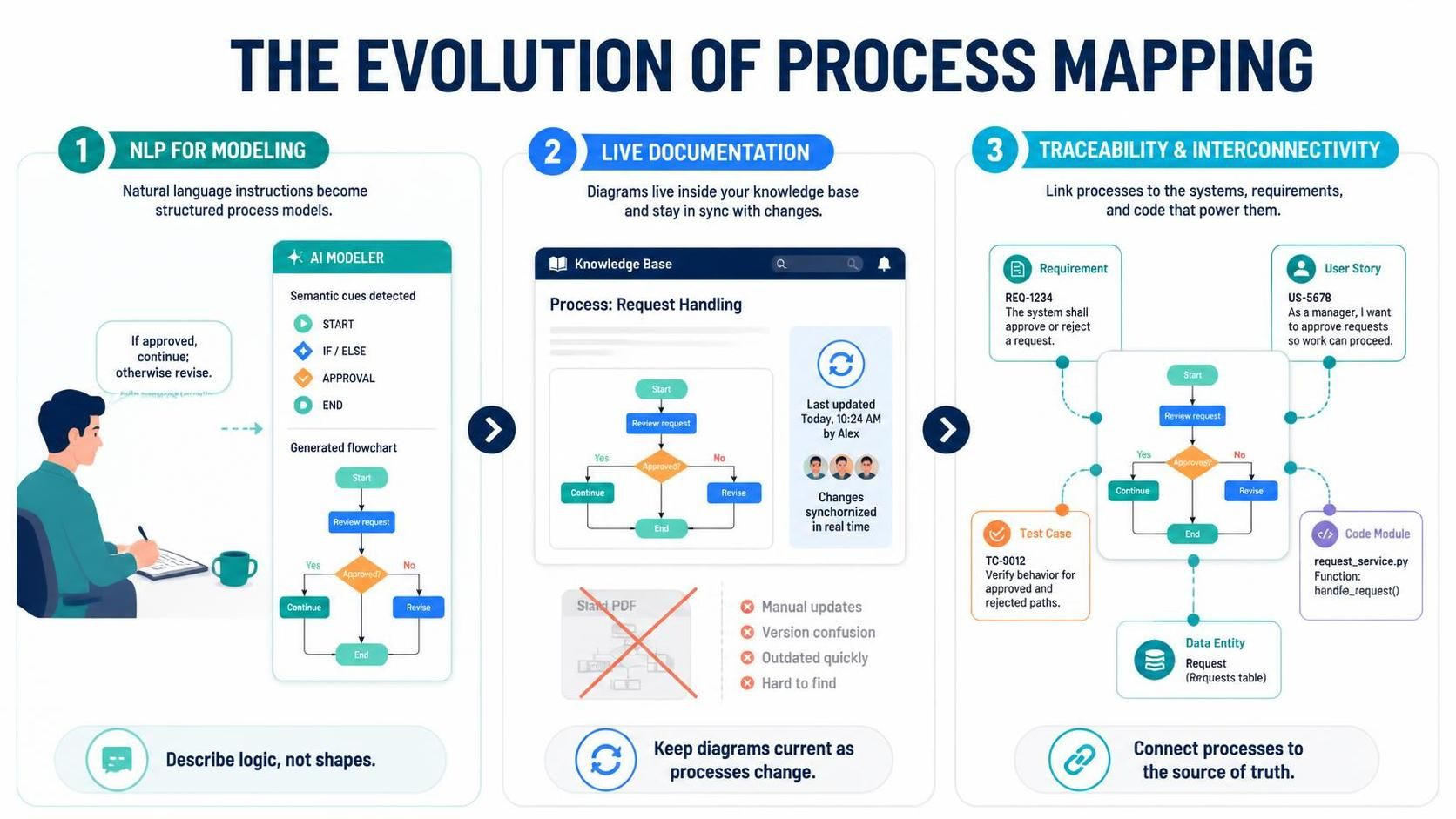
The landscape of business process modeling has undergone a significant paradigm shift. Historically, creating a professional flowchart was a manual, time-consuming exercise of dragging shapes onto a canvas. However, the emergence of AI-driven tooling has transformed this workflow into a semantic, logic-based discipline. This tutorial explores the three critical pillars of this evolution: Natural Language Processing (NLP) for modeling, the transition to live documentation, and the establishment of deep traceability.
1. Natural Language Processing (NLP) for Modeling
The first major leap in process mapping is the move away from shape-based thinking. In the past, a modeler had to visualize a “rectangle” for a process or a “diamond” for a decision. Today, AI tools allow us to think in terms of logic and steps.
Modern systems utilize Natural Language Processing to interpret semantic cues within your text. Instead of manually drawing a decision node, you describe the logic. The AI identifies keywords such as if/else, start, end, and approval, automatically structuring these concepts into a formal diagram.
The Semantic Transformation
Consider the following example of how a simple instruction is parsed by an AI Modeler. The system does not just read the text; it understands the structural intent.
%% Input Logic
User Input: "If approved, continue; otherwise revise."

%% AI Interpretation
Semantic Cues Detected:
1. Condition: [If approved] -> Decision Node
2. Action: [continue] -> Process Node
3. Action: [otherwise revise] -> Process Node

%% Generated Model
diagram:
  Start
  --> ReviewRequest
  --> Decision{Approved?}
  Decision -- Yes --> Continue
  Decision -- No --> Revise
  Revise --> ReviewRequest
2. The Shift to Live Documentation
Once a diagram is created, the challenge often lies in maintaining it. Traditional static images in PDFs become obsolete the moment a process changes. If a process flows differently on a Tuesday than on a Monday, a static image fails to represent the reality of the business.
Modern tooling introduces the concept of Live Documentation. Flowcharts now live within the knowledge base itself, ensuring that the visual representation is dynamic. When a process changes, the diagram updates in real-time, keeping the knowledge base accurate.
Static vs. Dynamic
The difference between the old method and the new approach can be summarized by the following comparison:
- Static (PDF): Requires manual updates, prone to version confusion, and outdated quickly.
- Dynamic (Live): Automatically synchronized, ensures “Single Source of Truth,” and eliminates “hard to find” documentation issues.
  Process: Request Handling
  Last updated: Today, 10:24 AM by Alex

    🔄 Changes synchronized in real time
3. Traceability and Interconnectivity
The final evolution in process mapping is the integration of the diagram into a larger ecosystem. A professional flowchart is no longer just a picture; it is a node in a larger system. This is achieved through traceability and interconnectivity.
In a mature modeling environment, every element of your flowchart should link to the artifacts that power it. This creates a comprehensive web of information connecting the visual process to the underlying requirements, user stories, and code.
Building the Ecosystem
To achieve this, you must link your diagram elements to the following external entities:
- Requirements (REQ): Link process steps to specific system requirements to ensure compliance.
- User Stories (US): Connect logic branches to the user stories that defined them.
- Test Cases (TC): Map the “Yes” and “No” paths to specific test cases for validation.
- Code Modules: Link the logic to the actual function or script (e.g.,
handle_request()) that executes the step.
// Example of Traceability Data Structure
{
  "process_node": "Approval",
  "linked_artifacts": {
    "requirement": "REQ-1234",
    "user_story": "US-5678",
    "test_case": "TC-9012",
    "code_module": "request_service.py::handle_request"
  }
}
By establishing these connections, you create a single source of truth where a change in the code triggers a review of the process map, and a change in the requirement updates the logic flow. This interconnectivity is the hallmark of modern enterprise architecture.

 English
 Arabic
 Chinese (Simplified)
 Dutch
 French
 German
 Italian
 Japanese
 Korean
 Portuguese
 Russian
 Spanish