


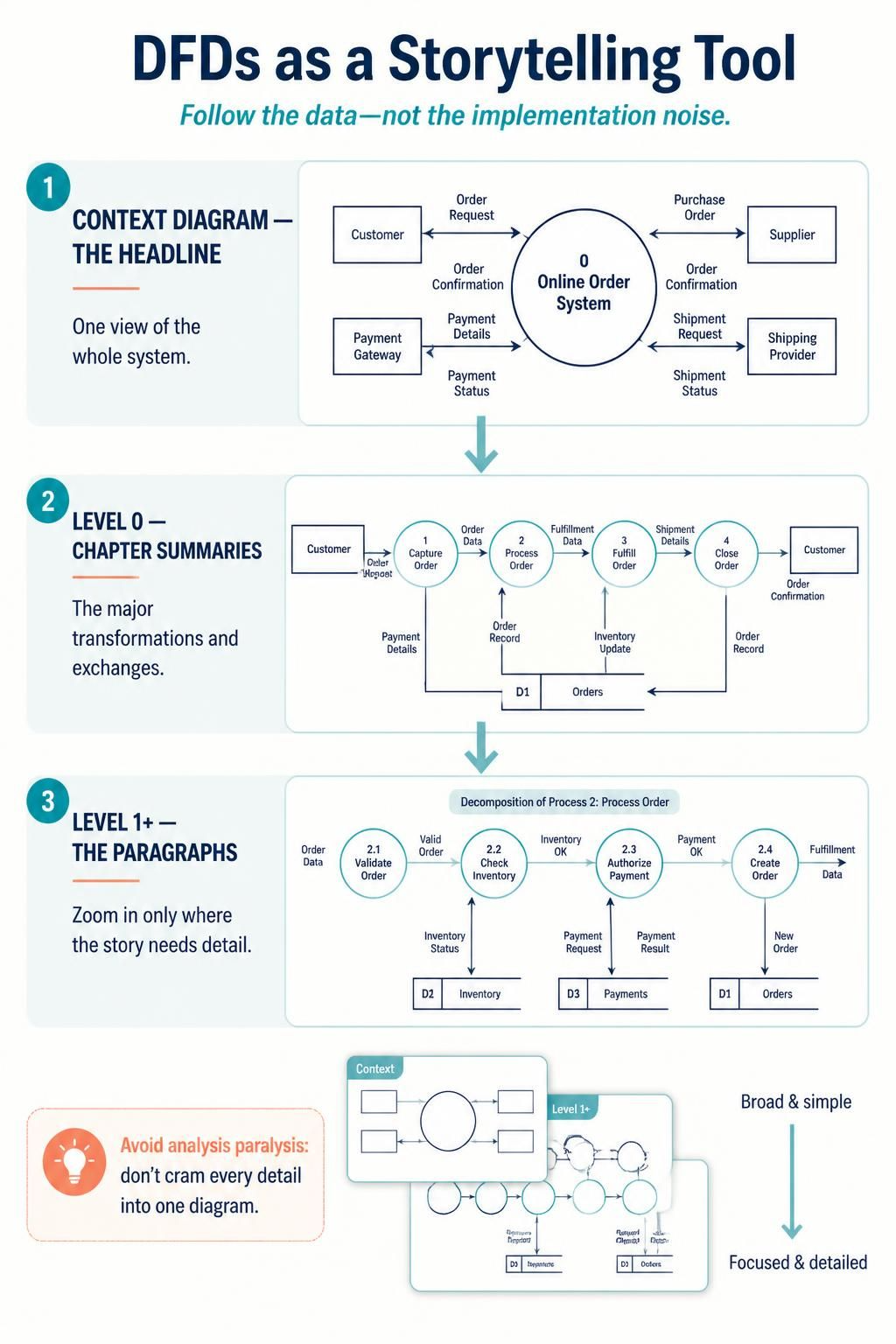
In the complex world of software architecture and business analysis, clarity is currency. When stakeholders, developers, and designers look at a system, they often see different things: code modules, user interfaces, or database schemas. But what binds these elements together is data. How does information enter the system? How is it transformed? Where does it rest? And how does it leave?
Data Flow Diagrams (DFDs) answer these questions by stripping away the noise of control logic, timing, and implementation details. They focus purely on the movement and transformation of data. However, a common pitfall in creating DFDs is analysis paralysis—trying to map every single detail in one massive, unreadable diagram.
This guide introduces a refined perspective on DFDs: Top-Down Decomposition as a Narrative Tool. Instead of viewing decomposition merely as a technical requirement, we view it as a storytelling technique. We start with the “headline” (the Context Diagram), move to the “chapter summaries” (Level 0), and then dive into the “paragraphs” (Level 1+) only where necessary.
The Narrative Arc of System Architecture
Using Visual Paradigm combined with AI assistance allows us to treat system modeling like writing a novel. You don’t write the entire manuscript at once; you outline the chapters first. Here is how this narrative structure applies to Data Flow Diagrams.
1. The Context Diagram: The Headline
Imagine opening a book and reading the blurb on the back cover. That is your Context Diagram. It provides a high-level view of the entire system as a single process, often labeled as Process 0.
The goal here is not to show how the system works, but what it does in the grand scheme of things. You identify the primary external entities (actors) and the major data flows that cross the system boundary.
- Process 0 (The System): In our example, this is the “Online Order System.”
- External Entities: These are the “Customer,” “Supplier,” “Payment Gateway,” and “Shipping Provider.”
- The Flow: Notice the “Order Request” entering and the “Order Confirmation” leaving. This tells the story of the system’s primary purpose immediately.
2. Level 0: Chapter Summaries
Once the reader understands the premise, they look at the Table of Contents. This is your Level 0 DFD. It decomposes the “Online Order System” into its major functional areas. These are the “chapters” of your story.
At this level, we break the single process into the major sub-processes. We must ensure data balance—any data flow entering a sub-process in Level 0 must match the flows in the Context Diagram.
- Process 1 (Capture Order): The initial intake of information.
- Process 2 (Process Order): The core logic of the system.
- Process 3 (Fulfill Order): The physical or digital delivery.
- Process 4 (Close Order): The conclusion and archiving.
Here, we also introduce our first Data Store (D1), representing where “Orders” are kept between these major steps.
3. Level 1+: The Paragraphs
Finally, we zoom in. If a chapter is confusing, you write a paragraph to explain it. In DFD terms, this is Level 1 decomposition. You only decompose a process in Level 0 if it is complex enough to warrant further explanation.
For example, looking at Process 2: Process Order, we see it is the engine of the system. We break it down into specific steps:
- 2.1 Validate Order: Ensuring data integrity.
- 2.2 Check Inventory: Verifying stock levels against Data Store D2.
- 2.3 Authorize Payment: Interacting with Data Store D3 (Payments) and the external Gateway.
- 2.4 Create Order: The finalization step.
This “zoom-in” capability prevents the “analysis paralysis” mentioned earlier. You keep the diagram clean and focused, only revealing the details when the reader needs them.
Best Practices for Clean Modeling
When using tools like Visual Paradigm to generate these diagrams, especially with AI assistance, remember to avoid “cramming” every detail into one view. The vertical flow of decomposition is your friend. If a diagram becomes cluttered, it is a signal to move that detail to a child diagram (Level 1+).
By following the Broad & Simple to Focused & Detailed approach, you ensure that your architecture documentation serves as a powerful communication tool for both technical and non-technical stakeholders.

 English
 Arabic
 Chinese (Simplified)
 Dutch
 French
 German
 Italian
 Japanese
 Korean
 Portuguese
 Russian
 Spanish