


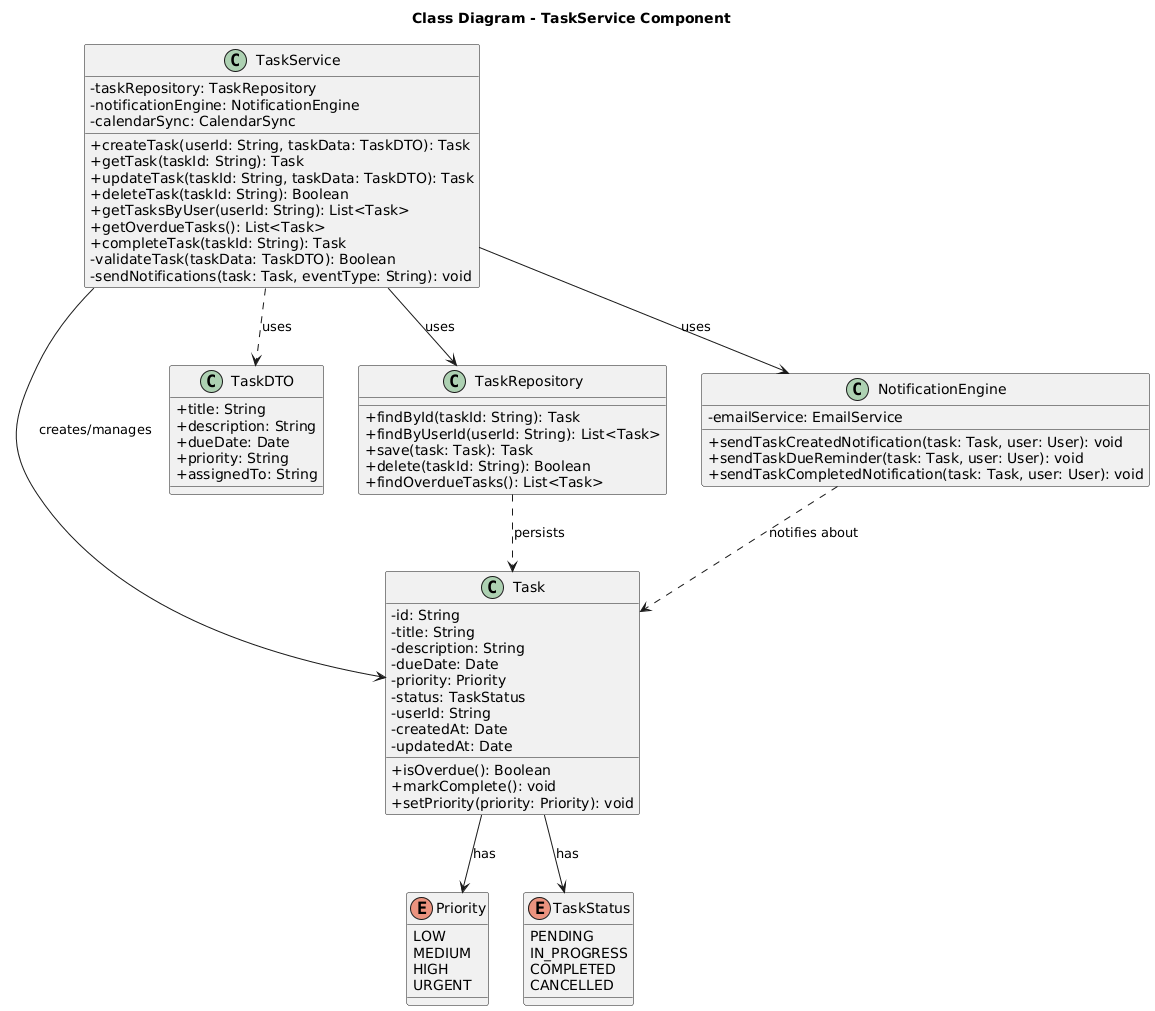
In the world of software architecture, moving from high-level system design down to the implementation details is a critical journey. While high-level diagrams show what the system does, code-level diagrams like the Class Diagram reveal how the system is built. In this tutorial, we will dissect a specific Class Diagram for a TaskService Component. We will explore the relationships between service layers, data transfer objects (DTOs), and domain entities, providing a blueprint for building maintainable, decoupled software systems.
Understanding the Core Components
The diagram centers around a TaskService, which acts as the orchestrator for task management. In a standard N-tier architecture, the Service Layer is the brain that coordinates business logic without exposing the complexities of data storage directly to the user.
Let’s break down the primary actors in this diagram:
- TaskService: The main controller. It holds references to a
TaskRepository(for data access), aNotificationEngine(for side effects), and aCalendarSync(for integrations). Notice how it relies on interfaces or abstract types (implied by the design) rather than concrete implementations, a hallmark of good design. - Task: This is your Domain Entity. It represents the core business object. It contains data (title, due date) and behavior (checking if it’s overdue).
- TaskDTO: The Data Transfer Object. This is a lightweight object used to pass data between the client and the server. It typically contains fewer fields than the Entity (e.g., it lacks the
createdAttimestamp) to optimize network traffic. - TaskRepository: This class handles the “persistence” logic. It knows how to save a Task to a database or retrieve it by ID, shielding the Service from SQL or NoSQL queries.
Decoding the Relationships
The power of a Class Diagram lies in the lines connecting these boxes. These lines describe the dependencies and interactions between your code modules.
1. The “Uses” Relationship (Service to Service)
Look at the solid lines connecting TaskService to TaskRepository and NotificationEngine. The diagram labels these as uses. This represents a dependency injection pattern.
It implies that TaskService requires these other components to function. When you call createTask, the service uses the repository to save the data and the notification engine to alert the user. This separation allows you to swap out the notification engine (e.g., from email to SMS) without rewriting the core task logic.
2. The “Creates/Manages” Relationship (Service to Entity)
The curved line connecting TaskService to Task is labeled creates/manages. This indicates that the service is responsible for the lifecycle of the Task entity. It creates new instances, modifies their state, and deletes them. This is where business logic lives—ensuring that a task isn’t created with an invalid ID or a future date.
3. The “Persists” Relationship (Repository to Entity)
The dashed line connecting TaskRepository to Task is labeled persists. This is a classic repository pattern relationship. The repository is the only part of the system that should know how to interact with the database. It “persists” the Task object, translating the object’s state into rows and columns.
4. The “Notifies About” Relationship (Engine to Entity)
The dashed line from NotificationEngine to Task labeled notifies about suggests an observer or event-driven pattern. The engine doesn’t control the task, but it reacts to the state of the task (e.g., when a task is marked as completed).
Implementation Strategy
To implement this architecture effectively, you would write code that adheres to the following flow:
- The API Controller receives a request and converts it into a
TaskDTO. - The Controller calls
TaskService.createTask(). TaskServicevalidates the data and maps the DTO to a newTaskentity.TaskServicecallsTaskRepository.save(task)to store it.TaskServicecallsNotificationEngine.sendTaskCreatedNotification(task)to alert the user.
@startuml
title Class Diagram - TaskService Component

skinparam classAttributeIconSize 0

class TaskService {
    - taskRepository: TaskRepository
    - notificationEngine: NotificationEngine
    - calendarSync: CalendarSync

    + createTask(userId: String, taskData: TaskDTO): Task
    + getTask(taskId: String): Task
    + updateTask(taskId: String, taskData: TaskDTO): Task
    + deleteTask(taskId: String): Boolean
    + getTasksByUser(userId: String): List
    + getOverdueTasks(): List
    + completeTask(taskId: String): Task
    - validateTask(taskData: TaskDTO): Boolean
    - sendNotifications(task: Task, eventType: String): void
}

class Task {
    - id: String
    - title: String
    - description: String
    - dueDate: Date
    - priority: Priority
    - status: TaskStatus
    - userId: String
    - createdAt: Date
    - updatedAt: Date

    + isOverdue(): Boolean
    + markComplete(): void
    + setPriority(priority: Priority): void
}

enum Priority {
    LOW
    MEDIUM
    HIGH
    URGENT
}

enum TaskStatus {
    PENDING
    IN_PROGRESS
    COMPLETED
    CANCELLED
}

class TaskDTO {
    + title: String
    + description: String
    + dueDate: Date
    + priority: String
    + assignedTo: String
}

class TaskRepository {
    + findById(taskId: String): Task
    + findByUserId(userId: String): List
    + save(task: Task): Task
    + delete(taskId: String): Boolean
    + findOverdueTasks(): List
}

class NotificationEngine {
    - emailService: EmailService

    + sendTaskCreatedNotification(task: Task, user: User): void
    + sendTaskDueReminder(task: Task, user: User): void
    + sendTaskCompletedNotification(task: Task, user: User): void
}

TaskService --> TaskRepository : uses
TaskService --> NotificationEngine : uses
TaskService --> Task : creates/manages
TaskService ..> TaskDTO : uses
Task --> Priority : has
Task --> TaskStatus : has
TaskRepository ..> Task : persists
NotificationEngine ..> Task : notifies about

@enduml
Refining the Model: Enums and Data Types
Notice the Priority and TaskStatus boxes at the bottom. These are enum types (enumerations). In software modeling, using enums instead of raw strings (like “high”, “pending”) is a critical best practice. It prevents errors where a developer might accidentally type “Pendng” instead of “PENDING”, ensuring data integrity across the application.
Furthermore, observe the TaskDTO. It is distinct from the Task entity. The Task entity contains internal implementation details like createdAt and updatedAt. The TaskDTO only exposes data relevant to the user (like title and description). This separation is known as the DTO Pattern, which is essential for securing your backend and optimizing API performance.
Conclusion
By visualizing the TaskService component through this Class Diagram, we gain a clear roadmap for development. We see that the system is designed with separation of concerns: the Service manages logic, the Repository manages data, and the Engine manages side effects. This modularity makes the system scalable and easier to test, as you can mock the TaskRepository when testing the TaskService without needing a real database connection.

 English
 Arabic
 Chinese (Simplified)
 Dutch
 French
 German
 Italian
 Japanese
 Korean
 Portuguese
 Russian
 Spanish