


The modern enterprise architecture landscape has historically been plagued by fragmentation. Teams often found themselves siloed in specialized tools: one for data modeling, another for agile management, and a third for cloud architecture. The introduction of the Visual Paradigm Unified Platform represents a paradigm shift, moving away from disjointed applications toward a cohesive, interconnected ecosystem.
This tutorial explores the architectural philosophy behind the Unified Platform, demonstrating how it consolidates local desktop power with cloud-based collaboration and AI-driven efficiency.
1. The Architecture of Unification: Desktop and Cloud Convergence
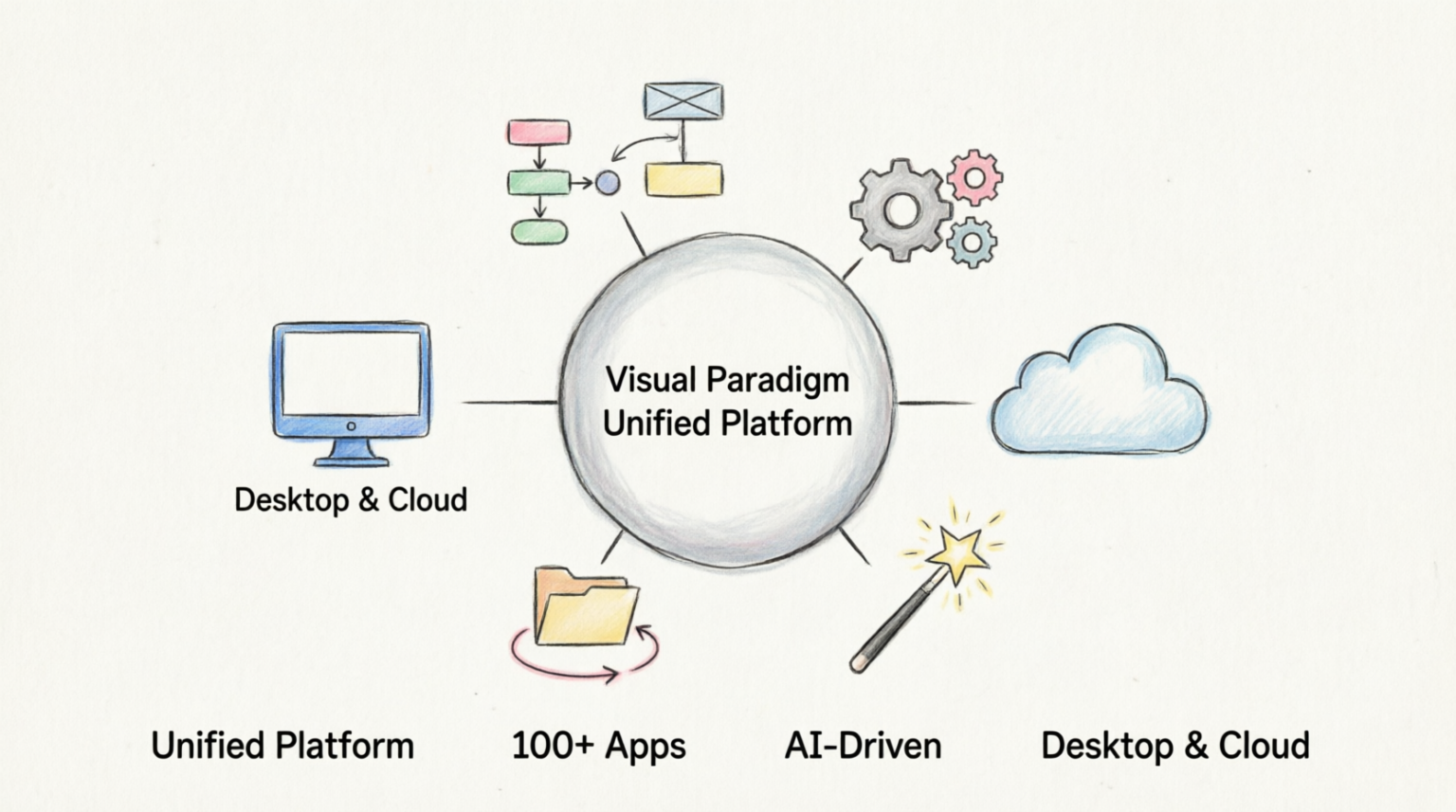
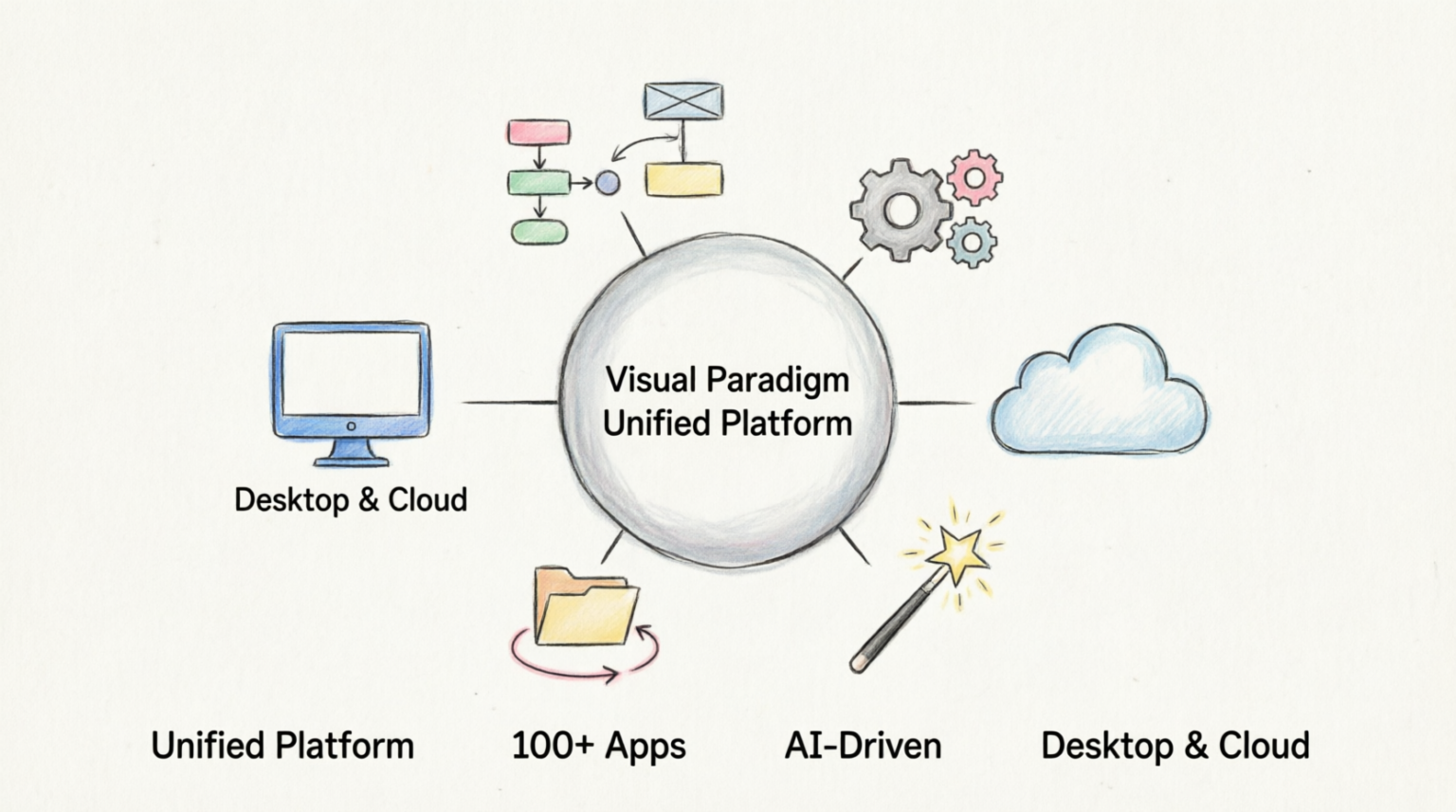
At the heart of the Visual Paradigm ecosystem is the bridge between the robust processing power of the Desktop and the accessibility of the Cloud. In legacy systems, these were often competing entities where saving a file to the cloud meant losing local capabilities or vice versa. The Unified Platform architecture eliminates this dichotomy.
The system operates on a single-file ecosystem model. Whether you are designing a complex Enterprise Architecture diagram on your local machine or collaborating on a Project Plan in the cloud, the underlying data model remains consistent. This architecture ensures that:
- Single Source of Truth: Data created locally is instantly synchronized with cloud repositories without manual export/import cycles.
- Context Preservation: Teams can switch between environments without losing the “context” of the project, effectively eradicating data silos.
System Interaction Flow
Visually, this architecture functions as a central hub. The diagram below illustrates how the Unified Platform acts as the central node connecting various workflows, tools, and storage mediums.
@startuml
skinparam componentStyle rectangle

title Visual Paradigm Unified Platform Architecture

component "Desktop Environment" as Desktop
component "Cloud Environment" as Cloud
component "Unified Platform Core" as Core

Desktop --|> Core : Local Modeling & Data
Cloud --|> Core : Collaboration & Sync
Core --> "100+ Apps" : Unified Access
Core --> "AI Engine" : Deep Integration
Core --> "File System" : Single Ecosystem

note right of Core
  Eliminates Siloed Data

  Bridges Desktop & Cloud

  Consolidates Workflows
end note
@enduml
2. Consolidating Multi-App Workflows
One of the most significant architectural decisions in the Unified Platform is the consolidation of over 100 distinct applications into a single space. In previous versions, a product team might use one tool for software architecture, another for business process modeling, and a third for agile sprint planning.
The Unified Platform treats these workflows not as separate silos but as interconnected layers of a single project. This allows for fluid transitions:
- Strategy to Execution: You can take a high-level business strategy diagram and automatically generate the corresponding software architecture models and project tasks.
- Seamless Context Switching: Instead of opening three different programs, the user navigates through a unified interface, maintaining the data relationships between the different models.
3. Accelerating Production via AI Integration
The final pillar of this architecture is the deep integration of Generative AI. Unlike “bolt-on” AI features found in other tools, the Visual Paradigm platform embeds AI directly into the creative workflow. This is not merely a chatbot interface; it is a functional engine that understands the underlying modeling syntax.
The AI integration serves three primary functions:
- Concept to Diagram: Rapidly transition raw text and ideas into production-ready diagrams.
- Documentation Generation: Automatically create presentations and reports based on the models.
- Code Generation: Generate applications and code snippets directly from the architectural models.
Conclusion
The Visual Paradigm Unified Platform is more than a software update; it is a fundamental reimagining of how creative and analytical work is performed. By integrating local desktop data with cloud collaboration and embedding AI directly into the core workflow, it creates a single, cohesive ecosystem that eliminates friction and accelerates production.

 English
 Arabic
 Chinese (Simplified)
 Dutch
 French
 German
 Italian
 Japanese
 Korean
 Portuguese
 Russian
 Spanish