


Enterprise architecture often struggles with a fundamental disconnect: the models created by architects do not resonate with the people who make business decisions. This gap exists because technical documentation frequently lacks context, focusing too heavily on components and too little on value. To bridge this divide, organizations must utilize structured perspectives that translate complex architectural decisions into meaningful business narratives. ArchiMate Viewpoints serve as the mechanism for this translation.
A viewpoint defines a specific way of looking at an architecture. It determines which elements, relationships, and rules are visible for a particular audience. By selecting the right viewpoint, architects ensure that the right stakeholders see the information they need to understand how the enterprise supports its goals. This guide explores how to apply these perspectives effectively to drive alignment between IT capabilities and business objectives.
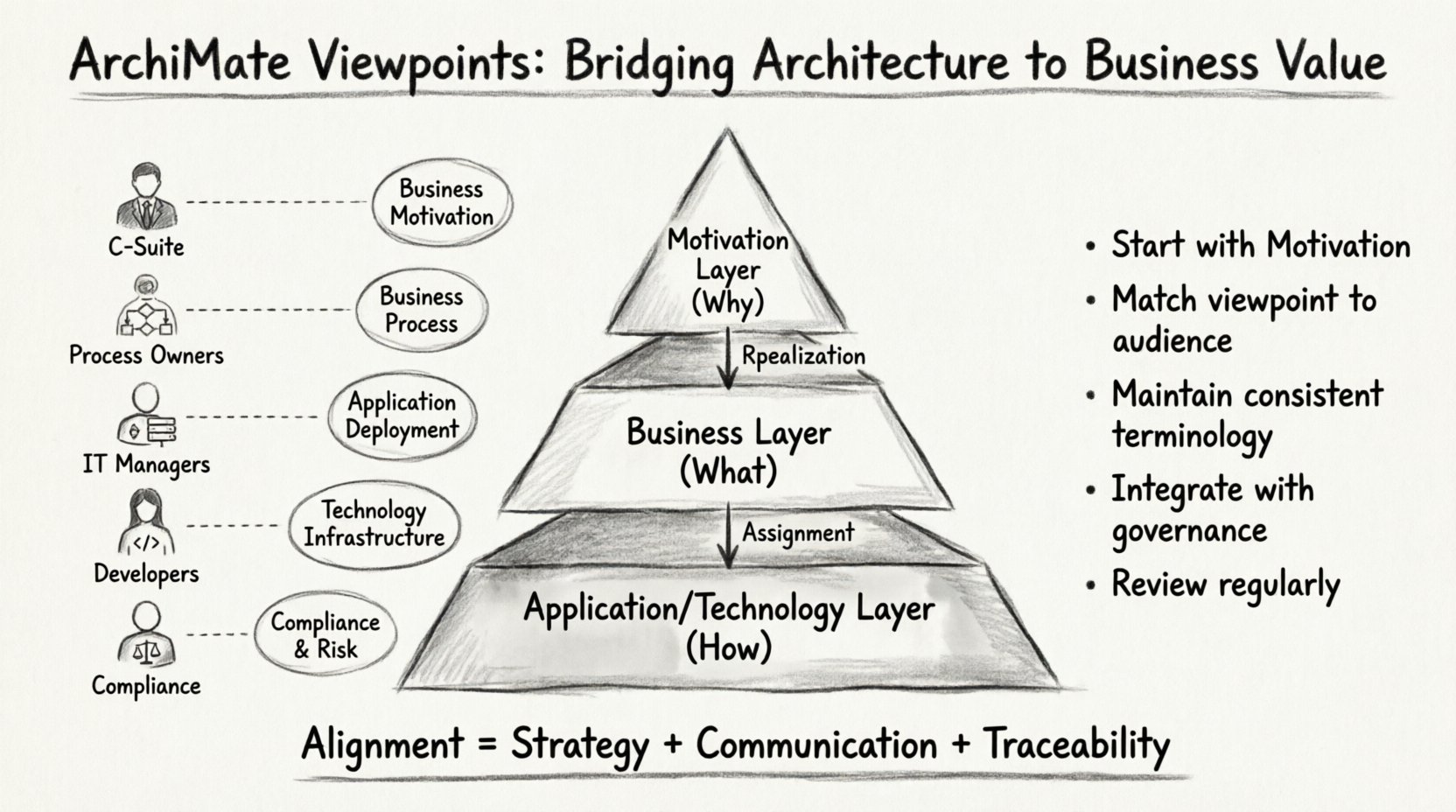
🔍 Understanding ArchiMate Viewpoints
An architecture model contains a vast amount of information. It is impossible to show every detail to every person involved in the organization. A business executive does not need to see the configuration of a server node, nor does a developer need to see the high-level strategic goals of the company in granular detail. This is where the concept of a viewpoint becomes essential.
A viewpoint is a template for a view. It specifies:
- Stakeholder concerns: What questions need to be answered?
- Modeling rules: Which elements and relationships are allowed?
- Language: The specific terminology used to describe the architecture.
- Abstractness: The level of detail required for the specific purpose.
When aligned correctly, these templates ensure that communication remains focused. They prevent information overload and reduce the risk of misinterpretation. Instead of presenting a monolithic model, architects present tailored perspectives that address specific business problems.
The Difference Between View and Viewpoint
It is crucial to distinguish between these two terms:
- Viewpoint: The abstract definition or template. It is the set of rules.
- View: The actual instance of the model created using that template. It is the concrete representation.
Think of a viewpoint as a blueprint for a specific type of map. The view is the actual map drawn for a specific journey. You can have multiple views based on the same viewpoint for different projects or different timeframes.
🏛️ Core Viewpoint Families and Their Business Value
ArchiMate organizes its viewpoints into several families. Each family targets different layers of the enterprise and different types of stakeholders. To achieve business alignment, one must understand which family addresses which concern.
1. Motivation Layer Viewpoints
The motivation layer is often the missing link in alignment. It connects the “why” to the “what”. Without this layer, IT investments appear as arbitrary costs rather than strategic enablers.
- Business Motivation: Defines the goals, drivers, and principles behind business decisions.
- Gap Analysis: Compares the current state against the desired future state.
- Value Chain: Illustrates how activities create value for the customer.
Using these viewpoints allows leadership to trace a specific software requirement back to a high-level strategic goal. This traceability is the foundation of alignment. When a project is initiated, the motivation viewpoint ensures it is linked to a valid business driver.
2. Business Layer Viewpoints
This layer represents the core operations of the organization. It describes how the business functions, who performs the work, and what value is delivered.
- Business Process Viewpoint: Shows the flow of activities and processes. It helps identify bottlenecks and inefficiencies.
- Business Service Viewpoint: Focuses on the services provided to external and internal customers. It clarifies what the business actually delivers.
- Business Role Viewpoint: Identifies the actors responsible for specific functions.
- Business Object Viewpoint: Maps the data entities used in business operations.
For business alignment, the Business Service Viewpoint is particularly powerful. It shifts the conversation from “we need a new database” to “we need to improve the customer onboarding service.” This language is immediately understood by non-technical stakeholders.
3. Application and Technology Layer Viewpoints
While these layers are technical, they must still serve the business. Viewpoints here should be used sparingly with business stakeholders unless they relate directly to service delivery or risk.
- Application Deployment Viewpoint: Shows which applications run on which platforms.
- Technology Node Viewpoint: Illustrates the infrastructure landscape.
- Application Communication Viewpoint: Details the data flow between systems.
When presenting these to business leaders, the focus should remain on availability, security, and cost, rather than configuration details. The viewpoint must filter out technical noise and highlight business impact.
📊 Mapping Viewpoints to Stakeholders
Effective alignment requires matching the right viewpoint to the right audience. A matrix of stakeholders and their required viewpoints ensures that communication is efficient.
| Stakeholder Group | Primary Concern | Recommended Viewpoint | Key Question Answered |
|---|---|---|---|
| C-Suite / Executives | Strategy, ROI, Risk | Motivation, Business Value | Does this investment support our strategic goals? |
| Business Process Owners | Efficiency, Workflow | Business Process, Business Service | How does this change our daily operations? |
| IT Managers | Integration, Maintenance | Application Deployment, Technology | What systems need to be updated? |
| Developers / Engineers | Implementation, Interfaces | Application Interface, Technology Node | How do we build and connect this? |
| Compliance Officers | Risk, Regulation | Security, Motivation (Principles) | Are we meeting regulatory requirements? |
This table serves as a reference for architects designing communication strategies. It prevents the common error of showing a technology map to a business owner, which leads to confusion and disengagement.
🔗 Bridging the Gap: Strategy to Implementation
Alignment is not a single event; it is a continuous process of verification. The architecture must evolve as the business evolves. ArchiMate provides specific mechanisms to maintain this connection.
Traceability Chains
A critical aspect of alignment is traceability. Every technical component should be traceable back to a business requirement. Viewpoints facilitate this by defining the scope of relationships.
- Realization: Shows how a lower-level element implements a higher-level goal.
- Specification: Defines the details of a higher-level element.
- Assignment: Links an actor to a function or service.
When using a Business Value Viewpoint, for example, an architect can visualize how a specific application function contributes to a business process, which in turn contributes to a business goal. This visualization makes the abstract concrete.
The Motivation Layer as the Anchor
Many organizations neglect the Motivation Layer. They start modeling with Business Processes or Applications. This is a strategic error. Without the Motivation Layer, the model lacks context.
By starting with Drivers and Goals, architects establish the criteria for success. Every subsequent decision in the Business, Application, or Technology layers can be evaluated against these criteria. If a new technology does not support a defined Goal or Principle, it is rejected. This governance mechanism ensures that IT spending remains aligned with business strategy.
🛠️ Practical Implementation Steps
Implementing a viewpoint-driven approach requires discipline. It is not enough to simply install a modeling tool and start drawing. The following steps outline a robust implementation strategy.
1. Define Stakeholder Needs
Before creating any models, identify who will use them. Interview key stakeholders to understand their concerns. Ask them what decisions they need to make and what information would help them make those decisions. This ensures the viewpoints are built around actual needs, not theoretical structures.
2. Select Standard Viewpoints
Do not reinvent the wheel. Adopt the standard ArchiMate viewpoints as a baseline. This ensures consistency across the organization. If a standard viewpoint does not meet a specific need, modify it slightly, but document the deviation clearly. Consistency reduces cognitive load for users.
3. Establish Modeling Rules
Define strict rules for what can and cannot be included in each viewpoint. For example, a Business Process Viewpoint should not include Application Software components unless necessary to explain a failure point. Overloading a view with irrelevant elements dilutes its effectiveness.
4. Integrate with Governance
Link the viewpoints to the enterprise governance process. Use the Business Value Viewpoint during budget approval meetings. Use the Motivation Viewpoint during strategy workshops. If the models are not part of the decision-making process, they will become outdated artifacts.
5. Regular Review Cycles
Architecture is dynamic. Review the views regularly. Are the goals still valid? Has the business process changed? Update the viewpoints to reflect the current reality. An outdated model is worse than no model at all.
⚠️ Common Pitfalls to Avoid
Even with a solid strategy, organizations often stumble during execution. Awareness of common pitfalls helps maintain alignment.
Over-Modeling
Creating a model that is too detailed is a frequent mistake. Architects often feel compelled to model everything to prove completeness. However, a business stakeholder does not need to see every interface. Keep the abstraction level appropriate for the audience.
Neglecting the Motivation Layer
As mentioned earlier, skipping the motivation layer creates a disconnect. If the “why” is missing, the “what” becomes meaningless. Ensure every business service is linked to a goal or principle.
Inconsistent Terminology
Using different terms for the same concept in different views causes confusion. Ensure that the vocabulary in the Business Viewpoint matches the vocabulary used in the Business Strategy documents. Language alignment is as important as model alignment.
Static Documentation
Treating the architecture as a static document to be filed away is a failure mode. Architecture must be a living system. Use the viewpoints to drive active discussions, not just for passive reporting.
📈 Measuring Success
How do you know if the viewpoints are improving alignment? There are several indicators to look for.
- Decision Speed: Does the architecture group enable faster decision-making?
- Stakeholder Engagement: Are business leaders actively using the models in meetings?
- Reduced Rework: Are projects being built correctly the first time because requirements were clear?
- Traceability: Can any technical component be traced back to a business driver?
If business leaders ask questions like “Why do we need this system?” and the answer is a clear reference to a Goal in the Motivation Viewpoint, alignment is working.
🚀 Future-Proofing the Architecture
The business landscape changes rapidly. New regulations, market shifts, and technological advancements occur constantly. Viewpoints provide a flexible structure to accommodate these changes without rebuilding the entire model.
When a new strategic goal emerges, it is added to the Motivation Layer. Existing views can be adjusted to show how current capabilities support the new goal. If a capability is no longer needed, it is marked as a gap or obsolete in the Assessment Viewpoint. This agility is essential for long-term alignment.
Furthermore, the standardization of viewpoints allows for scalability. As the organization grows, new departments can adopt the same modeling conventions. This ensures that the architecture remains coherent across the enterprise, facilitating better collaboration and integration.
📝 Summary of Best Practices
To maximize the value of ArchiMate Viewpoints for business alignment, consider the following checklist:
- Start with the Motivation Layer to establish context.
- Select viewpoints based on stakeholder needs, not technical convenience.
- Maintain consistent terminology across all views.
- Integrate models into governance and decision-making processes.
- Review and update models regularly to reflect reality.
- Focus on value and impact rather than technical specifications for business audiences.
- Use traceability to link IT investments to business goals.
By adhering to these practices, organizations can transform their architecture function from a documentation exercise into a strategic asset. The goal is not to create perfect models, but to create clear communication channels that ensure technology serves the business effectively.
🤝 The Role of the Architect
The architect plays a pivotal role in this ecosystem. They are the translators between the business language and the technical language. Their ability to select the right viewpoint determines the success of the communication.
An effective architect does not just draw diagrams; they facilitate understanding. They ask the right questions to uncover the underlying business concerns. They understand that a diagram is only as good as the conversation it sparks. Therefore, the selection of a viewpoint is a strategic choice that influences the outcome of business discussions.
🌐 Integration with Other Frameworks
ArchiMate is often used alongside other frameworks such as TOGAF. Viewpoints provide the visual and structural layer that brings these frameworks to life. While TOGAF provides the process, ArchiMate provides the content representation.
For example, the Architecture Development Method (ADM) in TOGAF relies on architecture views to produce deliverables. ArchiMate Viewpoints map directly to these deliverables. This integration ensures that the process is supported by concrete, visual models. It bridges the gap between the methodology and the actual architecture.
🔒 Security and Compliance Considerations
Security is a critical aspect of business alignment. Regulatory requirements often dictate how data and systems must be handled. Viewpoints such as the Security Viewpoint allow architects to visualize compliance requirements.
By modeling security controls within the same framework as business processes, organizations can ensure that security is not an afterthought. It becomes an integral part of the business design. This approach helps in audits and demonstrates compliance to regulators.
📌 Final Thoughts
Alignment is the cornerstone of successful enterprise architecture. It requires more than just good intentions; it requires structured tools and clear communication. ArchiMate Viewpoints offer a proven method for achieving this clarity. By tailoring perspectives to specific audiences and linking technical details to business motivations, organizations can ensure that their technology investments deliver real value.
The journey toward better alignment is continuous. It requires commitment to modeling standards, regular reviews, and active engagement with stakeholders. However, the payoff is significant. When the business and IT speak the same language, decisions become faster, risks become manageable, and innovation becomes sustainable.

 English
 Arabic
 Chinese (Simplified)
 Dutch
Dutch French
 German
 Italian
 Japanese
 Korean
 Portuguese
 Russian
 Spanish