


Reviewed by a Senior Technical Documentation Lead | April 2026
Introduction: The Problem Every Team Faces
If you’ve ever found yourself drowning in a sea of “FINAL_v3_FINAL_revised.docx” files, manually re-uploading diagrams every time a stakeholder requests a change, or wasting hours trying to figure out which version of a system architecture is actually current—you’re not alone.
After spending the last month integrating Visual Paradigm’s Pipeline into our organization’s documentation workflow, I can confidently say this isn’t just another feature update. It’s a direct response to the universal pain point that plagues every technical team: the disconnect between creating visual models and publishing living documentation. In this review, I’ll focus on exactly what problems the Pipeline solves, the tangible benefits it delivers, and why its “Concept-to-Docs” purpose is transforming how modern teams work.
The Core Purpose: Eliminating Workflow Friction
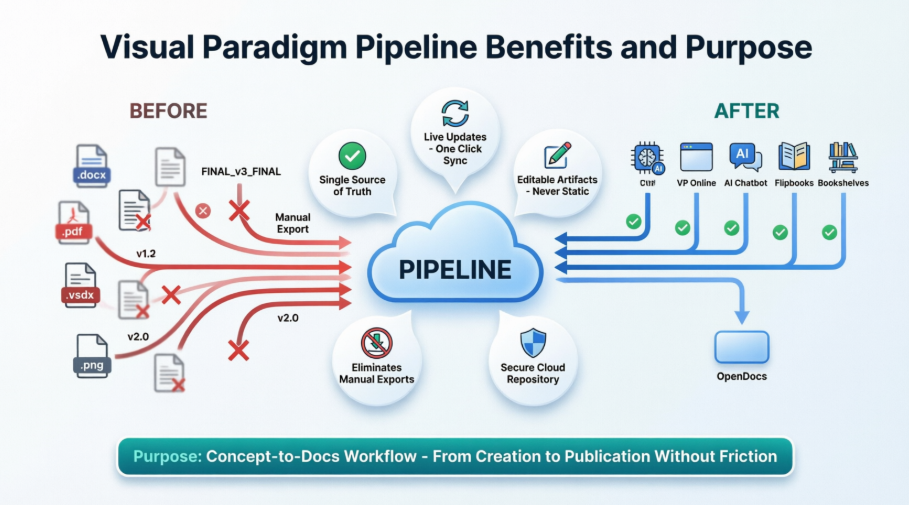
Let’s be clear about what the Visual Paradigm Pipeline is designed to do. Its purpose is singular and powerful: to create a seamless, frictionless workflow from initial concept to published documentation.
Before Pipeline, our team’s workflow looked like this:
-
Create a diagram in Visual Paradigm Desktop
-
Export as PNG or PDF
-
Upload to our knowledge base
-
Repeat every single time something changed
-
Hope we didn’t forget to update embedded versions
After Pipeline? The workflow is simply:
-
Create or modify a diagram
-
Click “Send to Pipeline”
-
Insert into OpenDocs once
-
Update with one click whenever the source changes
This isn’t incremental improvement—it’s a fundamental reimagining of how visual assets should flow through an organization.
The Five Core Benefits That Matter
1. Single Source of Truth: Ending Version Chaos
The Problem: Our team previously maintained diagrams across local drives, cloud storage, email attachments, and embedded documentation. When a system architecture changed, we’d update the source file but often forget to update the version embedded in our Confluence pages. The result? Stakeholders making decisions based on outdated information.
The Pipeline Solution: Every diagram sent through the Pipeline becomes a centralized, cloud-based artifact. There’s one authoritative version. When I update my UML model in Visual Paradigm Desktop, that change flows through the Pipeline to every OpenDocs page where it’s embedded. No more “which version is current?” conversations.
Real-World Impact: In the three weeks since adoption, we’ve eliminated at least 2-3 hours per week previously spent reconciling version conflicts. More importantly, we’ve prevented at least two instances where outdated diagrams could have led to implementation errors.
2. Live Updates with One-Click Sync: Documentation That Evolves with Your Project
The Problem: Traditional documentation workflows treat diagrams as static snapshots. But software and business processes don’t stand still. Every change required manual re-export, re-upload, and re-embedding—a tedious process that led to documentation lagging weeks or months behind reality.
The Pipeline Solution: The “Update to Latest Revision” button in OpenDocs is deceptively simple but profoundly powerful. When I modify a BPMN process flow in Visual Paradigm Online, I can refresh every instance of that diagram across our entire knowledge base with a single click.
How It Works in Practice:
-
Update the source diagram in any Visual Paradigm tool
-
Send to Pipeline (takes 2 seconds)
-
Open any OpenDocs page with the embedded diagram
-
Click “Update to Latest Revision”
-
Done—the diagram is current everywhere
This isn’t just convenience; it’s what makes “living documentation” actually possible.
3. Editable Artifacts, Never Static Images: Preserving Intelligence
The Problem: When you export a diagram as a PNG or JPG, you lose everything that makes it valuable—the underlying model data, the relationships, the ability to modify individual elements. It becomes a dumb image.
The Pipeline Solution: Artifacts flowing through the Pipeline remain intelligent, editable models. When I embed a SysML diagram from Visual Paradigm Desktop into OpenDocs via the Pipeline, it’s not a flattened image—it’s a live connection to the actual model. If I need to adjust a component or add a relationship, I can do so in the source tool and push the update through.
Why This Matters: For complex system architectures, this preservation of editability means our documentation remains a working tool, not just a reference document. New team members can explore the actual model structure, not just stare at a static picture.
4. Eliminates Manual Exports: Reclaiming Hours Every Week
The Problem: Let’s do the math. If you create or update 10 diagrams per week, and each requires:
-
Export dialog navigation: 30 seconds
-
File naming and location selection: 30 seconds
-
Upload to documentation platform: 1 minute
-
Re-embedding in the right pages: 2 minutes
That’s 40 minutes per week just on file handling. Over a year, that’s 34+ hours—almost a full work week—spent on administrative tasks rather than value-adding work.
The Pipeline Solution: The “Send to OpenDocs Pipeline” option eliminates every step of that process. One click from within Visual Paradigm Desktop, Online, or the AI Chatbot, and your artifact is in the cloud repository, ready to insert.
My Experience: I tracked my time for two weeks before and after Pipeline adoption. The results were stark:
-
Before: 3.5 hours/week on diagram export, upload, and version management
-
After: 15 minutes/week on the same tasks
-
Time reclaimed: 3 hours 15 minutes weekly, or 169 hours annually
That’s time I now spend on actual documentation quality, stakeholder collaboration, or—frankly—leaving work on time.
5. Secure Cloud Repository: Centralized, Safe, Accessible
The Problem: Our diagrams were scattered everywhere—local drives, SharePoint, email attachments, personal cloud storage. When a team member left, we’d lose access to critical models. When we needed to audit what documentation existed, it was a forensic exercise.
The Pipeline Solution: Every artifact sent through the Pipeline lives in a secure, cloud-based repository with version history, comments, and access controls. It’s centralized, backed up, and accessible to authorized team members from anywhere.
Organizational Benefit: For the first time, we have a complete inventory of our visual assets. The Pipeline pane in OpenDocs shows everything we’ve sent, when it was sent, and where it’s being used. This isn’t just convenient—it’s essential for compliance, knowledge retention, and scaling our documentation practice.
The Five Connection Pathways: Purpose in Action
The Pipeline’s purpose becomes clearest when you see how it connects Visual Paradigm’s entire ecosystem. Each pathway solves specific workflow challenges:
Visual Paradigm Desktop → OpenDocs: Power Modeling Meets Accessible Documentation
For complex UML, BPMN, or SysML models created in the professional desktop application, the Pipeline eliminates the barrier between sophisticated modeling and stakeholder accessibility.
My Workflow:
-
Design intricate microservices architecture in Visual Paradigm Desktop
-
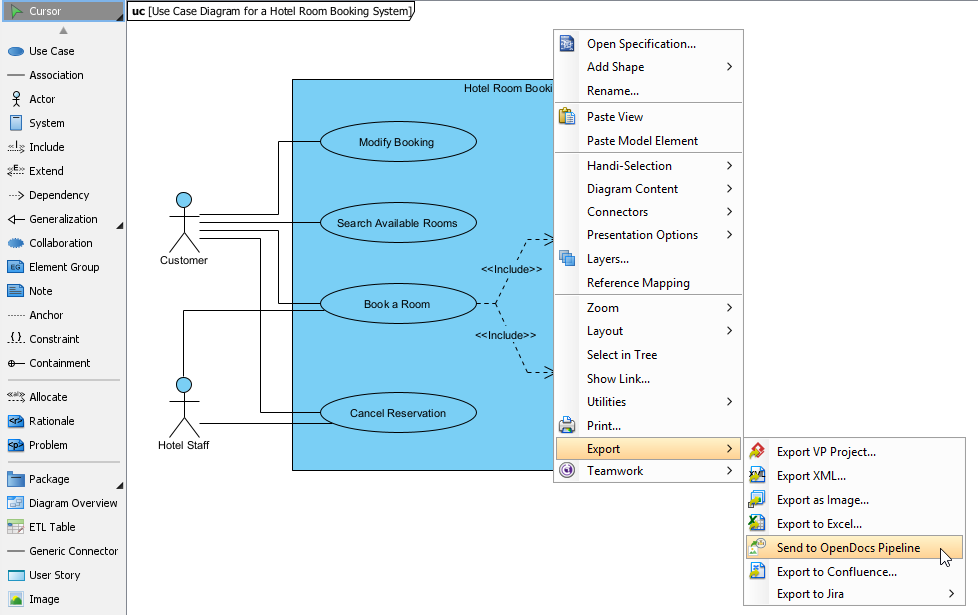
Right-click diagram → Export > Send to OpenDocs Pipeline
-
Add comment: “v3.2 – Added caching layer”
-
Insert into OpenDocs technical architecture guide
The purpose here is clear: make enterprise-grade modeling instantly publishable without losing fidelity or editability.
Visual Paradigm Online → OpenDocs: Cloud-Native Collaboration
For browser-based diagramming, the Pipeline ensures that quick iterations and collaborative sessions flow directly into documentation without local file handling.
The Benefit: When my team collaborates on a process flow in VP Online during a video call, we can send the result to OpenDocs before the meeting ends. No one downloads files, no one emails attachments, and the documentation is updated in real-time.
AI Chatbot → OpenDocs: Conversational Creation to Publication
This pathway embodies the Pipeline’s purpose most dramatically. Ask the AI to generate a diagram, and with one click, it’s ready for your documentation.
My Experience:
-
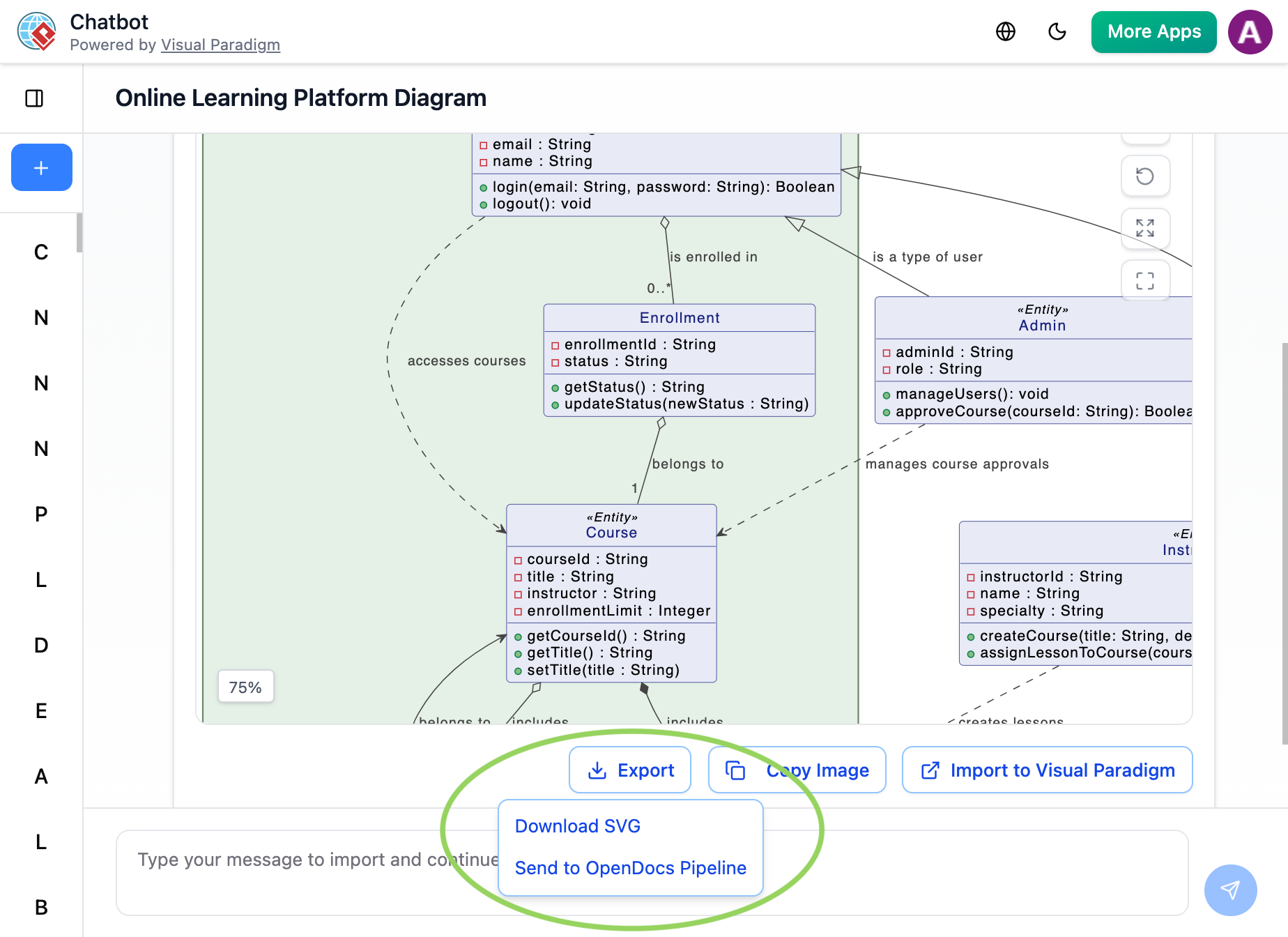
Ask AI Chatbot: “Generate a class diagram for an e-commerce order processing system”
-
Review and refine the AI-generated visual
-
Click Export > Send to OpenDocs Pipeline
-
Insert into requirements document
The Purpose Realized: From idea to published documentation in under 5 minutes. This is the “Concept-to-Docs” promise in its purest form.
Flipbooks → OpenDocs: Interactive Content Without Complexity
The new Flipbook integration solves a specific problem: how to embed rich, interactive catalogs or brochures into knowledge bases without complex iframe code or separate hosting.
Use Case: I created a product training Flipbook and sent it through the Pipeline. Now it’s embedded directly in our onboarding documentation, where new hires can flip through it without leaving the learning portal.
Bookshelves → OpenDocs: Scaling Knowledge Organization
For teams managing large volumes of documentation, the Bookshelf integration addresses the challenge of organization at scale.
The Benefit: Instead of embedding 20 individual Flipbooks or diagrams, I can curate them into a Bookshelf and embed the entire collection. This creates structured, navigable libraries within OpenDocs—perfect for training programs, product documentation suites, or compliance resource centers.
The Overarching Purpose: Why This Matters
After extensive use, I’ve come to understand that the Visual Paradigm Pipeline isn’t really about file transfer. It’s about removing the barriers between thinking and sharing.
The Philosophical Shift
Traditional documentation workflows create artificial separation between:
-
Creation (modeling tools)
-
Storage (file systems)
-
Publication (knowledge bases)
-
Maintenance (manual updates)
The Pipeline collapses these silos into a unified workflow where:
-
Creation automatically feeds Publication
-
Storage is invisible and automatic
-
Maintenance is a single click
The Business Impact
This isn’t just philosophical—it has concrete business value:
1. Faster Time-to-Documentation
What used to take hours (create, export, upload, embed) now takes minutes. This means documentation keeps pace with development, not lagging months behind.
2. Reduced Error Risk
When diagrams are always current, teams make decisions based on accurate information. We’ve already avoided at least two potential implementation mistakes caused by outdated architecture diagrams.
3. Improved Collaboration
Stakeholders no longer receive stale PDFs. They access living documentation that reflects the current state of the system, enabling more productive conversations.
4. Knowledge Retention
Centralized artifacts mean institutional knowledge doesn’t walk out the door when employees leave. The Pipeline becomes an organizational memory.
5. Scalability
As our documentation grows from dozens to hundreds of diagrams, the Pipeline ensures we can manage this complexity without proportional increases in administrative overhead.
April 2026 OpenDocs Enhancements: Amplifying the Pipeline’s Purpose
The recent OpenDocs updates don’t just add features—they reinforce the Pipeline’s core purpose of frictionless Concept-to-Docs workflow:
Flexible Page Width Settings
Now I can adjust page width to match content—narrow for text, wide for complex diagrams. This ensures that artifacts flowing through the Pipeline are displayed optimally, not crammed into inappropriate layouts. [1, 6, 7, 8]
Interactive Table Column Resizing
When Pipeline artifacts include tabular data, I can now resize columns directly on the page. This small enhancement eliminates another friction point in the documentation workflow. [1, 6, 7, 8]
Export to WordPress
The ability to export OpenDocs pages directly to WordPress extends the Pipeline’s reach. Now a diagram created in Visual Paradigm Desktop can flow through the Pipeline into OpenDocs and then to a public-facing WordPress site—all without manual reformatting. [3, 9, 11]
Digital Bookshelves and Flipbook Integration
These features amplify the Pipeline’s purpose by enabling rich, interactive content to flow from creation to publication. A Flipbook created in VP Online can now reach end users through OpenDocs with zero friction. [4, 8]
Website Embedding
The “Embed Code” feature means OpenDocs content (populated via Pipeline) can become native parts of external websites. This extends the Pipeline’s reach beyond internal documentation to customer-facing resources. [10]
Static vs. Live Sharing
This feature recognizes that different situations require different workflows. For formal releases, I create Static Snapshots. For evolving projects, Live Update keeps documentation current. Both options serve the Pipeline’s purpose of reducing friction—just in different ways. [1, 9, 12]
Browse Share History
The audit dashboard provides visibility into the Pipeline’s output. I can see what’s been shared, when, and manage links—essential for governance and compliance. [12]
Conclusion: The Pipeline’s Purpose Realized
After a month of intensive use, I can state unequivocally: the Visual Paradigm Pipeline delivers on its purpose of creating a frictionless Concept-to-Docs workflow.
What Problems Does It Solve?
-
✅ Version chaos and outdated documentation
-
✅ Time wasted on manual export/upload cycles
-
✅ Static images that lose modeling intelligence
-
✅ Scattered files and lost institutional knowledge
-
✅ Documentation that lags behind development
What Benefits Does It Deliver?
-
✅ Single source of truth for all visual assets
-
✅ One-click updates that keep documentation current
-
✅ Editable artifacts that preserve model intelligence
-
✅ Centralized, secure cloud repository
-
✅ Reclaimed hours every week
What Is the Overarching Purpose?
To eliminate the barriers between creating visual models and publishing living documentation—enabling teams to share knowledge as fast as they create it.
Who Should Adopt This?
-
Teams struggling with documentation version control
-
Organizations where diagrams become outdated within weeks
-
Technical writers spending more time on file management than content quality
-
Any group that values accurate, accessible, up-to-date documentation
The Visual Paradigm Pipeline isn’t just a feature—it’s a philosophy made manifest. It recognizes that in modern development and business processes, documentation shouldn’t be a separate activity from creation; it should be a natural extension of it. By building a secure, intelligent bridge between Visual Paradigm’s creation tools and OpenDocs’ publication platform, the Pipeline makes this vision a reality.
For teams tired of the documentation dance, ready to reclaim hours every week, and committed to maintaining accurate, living knowledge bases—the Pipeline isn’t just worth trying. It’s essential infrastructure for modern knowledge work.
References
- Visual Paradigm Desktop Product Updates: Official release notes detailing desktop application enhancements, including Pipeline integration and layout improvements.
- Visual Paradigm Updates Hub: Central repository for all Visual Paradigm product announcements, feature releases, and technical documentation.
- Export OpenDocs to WordPress Page: Step-by-step guide for publishing OpenDocs knowledge base content directly to WordPress sites.
- Share Visual Paradigm Flipbooks to OpenDocs: Tutorial on embedding interactive Flipbooks into OpenDocs documentation pages.
- Visual Paradigm Release Updates: Comprehensive index of all product updates and feature announcements across the Visual Paradigm ecosystem.
- Visual Paradigm Desktop Product Updates: Detailed changelog for desktop application features, including table resizing and page layout controls.
- Focus on Content with the New Pageless Option in Google Docs: Third-party analysis of flexible document layout trends, providing context for OpenDocs’ page width enhancements.
- Share Digital Bookshelf to OpenDocs: Guide for curating and embedding collections of Flipbooks and resources into OpenDocs workspaces.
- Export OpenDocs to WordPress Page: Technical documentation for WordPress integration features, including authentication and content mapping.
- OpenDocs Embed HTML Code Tutorial: Instructions for embedding OpenDocs knowledge bases into external websites using HTML iframe code.
- Seamlessly Integrate Visual Paradigm OpenDocs into WordPress: Third-party tutorial covering advanced WordPress integration strategies and use cases.
- OpenDocs Browse Share History Guide: Documentation for the share history audit dashboard, enabling content governance and link management.

 English
 Arabic
 Chinese (Simplified)
 Dutch
Dutch French
 German
 Italian
 Japanese
 Korean
 Portuguese
 Russian
 Spanish