


Introduction: Why I Decided to Overhaul Our Underwriting Desk
If you have ever worked in insurance operations, you know the specific kind of dread that comes with a “paper-based workflow.” At SecureLife Insurance, where I recently consulted as a process improvement lead, our underwriting department was drowning. We weren’t just slow; we were inconsistent. One underwriter would approve a risk that another would reject, and premium calculations were often done on spreadsheets that hadn’t been updated since 2019.
I decided to document our journey from manual chaos to a structured, automated workflow using Business Process Model and Notation (BPMN). This isn’t just a theoretical case study—it is a review of what actually happens when you stop relying on email chains and start modeling your business processes. Below, I break down how we transformed our workflow, the specific BPMN model we used, and my honest take on the results.
The Reality Check: What We Were Dealing With
Before we drew a single flowchart, we had to admit that our current state was unsustainable. Workflows, at their core, are simply the flow of tasks within an organization. They can be manual (like making a sandwich), automated (like calculating equations), or a hybrid. Ours was a messy hybrid of the worst kind.
Our challenges were textbook examples of why manual processing fails at scale:
-
Inconsistencies: Without a standardized guide, different underwriters applied varying criteria to similar risks.
-
Delays: Physical files were misplaced on desks, and digital requests sat in email inboxes for days without action.
-
Human Error: Manual calculation errors in premium estimations led to financial discrepancies and compliance headaches.
We needed a way to capture all relevant information: who is involved, what they are responsible for, how tasks are handed off, and which steps can be automated.
The Solution: Mapping the New Workflow
Developing a workflow is a process of gathering relevant information, modeling the process, and then testing and refining it. For SecureLife, we moved away from vague verbal instructions and created a visual BPMN diagram.
Below is the exact workflow model we implemented to standardize our underwriting process:
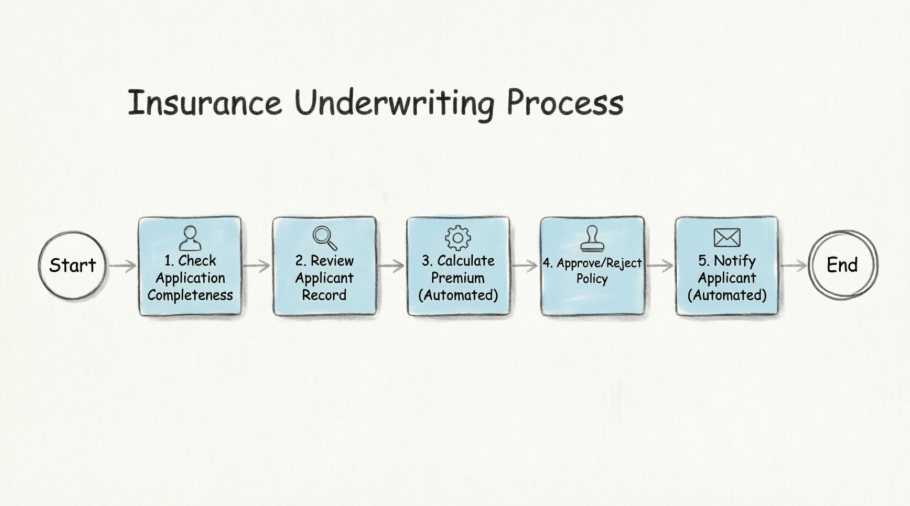
(Note: The diagram above illustrates the five-step BPMN process flow adopted by SecureLife Insurance, moving from manual intake to automated notification.)
Breaking Down the Five Steps
Here is how we translated our business needs into the visual model shown above:
-
Determine Order is Complete (Manual Task): Represented by a user icon, this step is handled by an intake clerk. Their sole responsibility is verifying that the application form is fully filled out and all medical records are attached. No underwriting happens until this gate is passed.
-
Check Record of Applicant (Manual Task): Another user-task, this time performed by an underwriter. This involves a deep dive into the applicant’s medical history and risk factors. Because this requires human judgment, we kept it manual but standardized the checklist used.
-
Determine Premium of Policy (Service/Automated Task): Notice the gear icon in the diagram? That represents automation. Instead of a human calculator, an actuarial software engine now calculates the risk score and suggests a premium based on pre-set algorithms. This eliminated our calculation errors overnight.
-
Approve or Reject Policy (Manual Task): Back to a user icon. A senior underwriter reviews the automated suggestion from Step 3 and makes the final decision. The system supports them, but the human retains accountability.
-
Notify Applicant of Approval or Rejection (Automated Task): The envelope/checkmark icon indicates an automated message event. The system immediately sends a personalized email or letter to the applicant, removing the days-long delay of manual correspondence.
Key Concepts That Made This Work
Through this implementation, three concepts became the pillars of our new system:
-
Process Modeling: Creating the visual representation (the diagram above) wasn’t just about drawing boxes; it was about forcing us to understand exactly how work moves through the organization. You cannot fix what you cannot see.
-
Task Hand-offs: The arrows between the boxes represent critical hand-off points. We learned that most delays happened between steps, not during them. By defining these hand-offs explicitly, we reduced the “dead air” between the intake clerk and the underwriter.
-
Automation: We didn’t automate everything. We specifically targeted Steps 3 and 5 because they were high-volume, low-judgment tasks. Replacing human effort with software logic here increased speed and accuracy without removing the necessary human oversight in Steps 2 and 4.
My Verdict: The Benefits We Actually Saw
After six months of running this new workflow, here is my honest assessment of the impact:
-
Scalability is Real: The automated components (premium calculation and notifications) allowed us to handle a 40% higher volume of applications without hiring additional staff. The system doesn’t take lunch breaks.
-
Accountability is Built-In: Because each task is logged in the workflow engine, management can easily identify bottlenecks. If applications are piling up at “Check Record of Applicant,” we know exactly who is overloaded and can redistribute work instantly.
-
Risk Reduction: Standardizing the “Determine Premium” step ensured that every applicant is assessed by the same actuarial standards. We saw a significant drop in compliance flags and financial discrepancies.
Guidelines for Effective Implementation (Lessons Learned)
If you are planning to implement a similar workflow, here are the guidelines I wish someone had given me at the start:
-
Start with “As-Is”: Do not skip this. Map out the current, messy process before trying to design the ideal “To-Be” process. You will be surprised at how many shadow processes exist.
-
Involve the End-Users: The underwriters knew where the bottlenecks were better than management did. When we involved them in designing the workflow, adoption was smooth. When we tried to dictate it from above initially, resistance was high.
-
Iterate Relentlessly: A workflow is not “set it and forget it.” We monitored performance metrics weekly and adjusted steps as the business environment changed. The first version of our model was good; the third version was great.
Beyond Insurance: Where Else This Applies
While this case study focuses on insurance underwriting, the principles are universal. I have seen this same BPMN approach successfully applied in:
-
Onboarding: Streamlining the hiring process for new employees, ensuring no equipment or access rights are forgotten.
-
IT Service Management: Handling requests for software access or hardware procurement with clear SLAs.
-
Supply Chain: Managing the movement of materials from procurement to final delivery with real-time visibility.
Conclusion
Implementing this BPMN workflow at SecureLife Insurance taught me that process modeling is fundamentally an exercise in organizational clarity. The diagram itself is valuable, but the conversations it sparks are invaluable. By distinguishing between what should be manual and what should be automated, and by making hand-offs explicit, we didn’t just speed up underwriting—we made it fairer, more accurate, and more scalable.
For any mid-sized firm struggling with growth pains, my advice is simple: Stop trusting memory and email. Start modeling your workflows. The initial investment in mapping your “As-Is” process pays for itself the moment you eliminate your first bottleneck.


 English
 Arabic
 Chinese (Simplified)
 Dutch
Dutch French
 German
 Italian
 Japanese
 Korean
 Portuguese
 Russian
 Spanish