


Enterprise architecture is often described as the blueprint for organizational change. However, a blueprint that no one reads is merely a collection of lines and symbols. The true power of an architecture repository lies not in the density of the models it contains, but in the clarity with which information is presented to specific audiences. This is where the concept of the ArchiMate Viewpoint becomes critical. It acts as the bridge between complex technical reality and actionable business insight.
Many organizations struggle with architecture fatigue. Stakeholders are bombarded with diagrams that are too dense, too abstract, or simply irrelevant to their daily responsibilities. By adopting a strategic approach to viewpoint design, teams can transform their architecture work from a compliance exercise into a value-generating asset. This guide explores the mechanics, strategy, and implementation of ArchiMate viewpoints to ensure your architectural efforts resonate with the people who matter most.
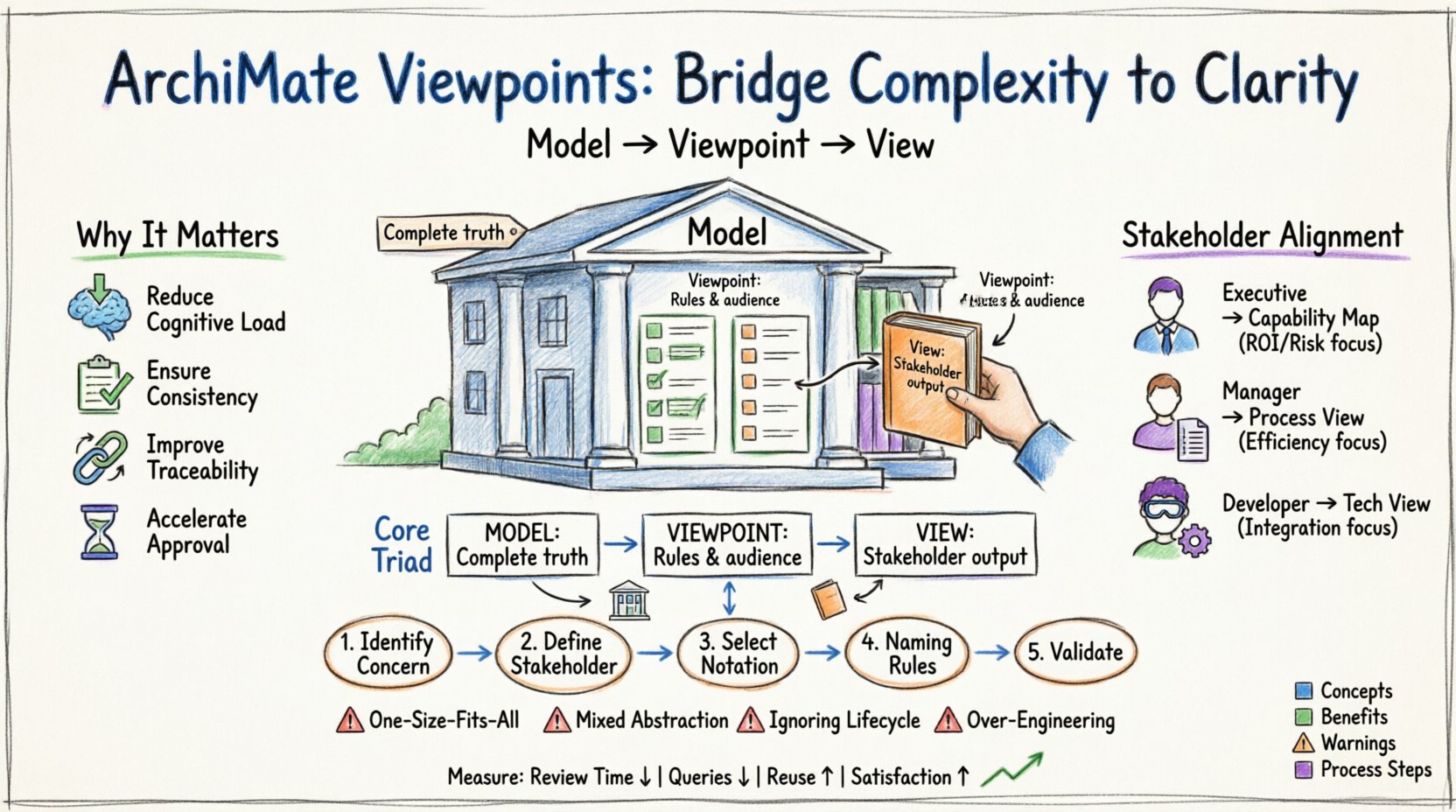
🧩 Understanding the Core Triad: Model, View, and Viewpoint
To implement viewpoints effectively, one must first distinguish between three distinct but related concepts within the ArchiMate standard. Confusion here often leads to poor documentation strategies.
- Architecture Model: This is the complete set of architectural descriptions. It is the comprehensive truth of the system, containing every detail about applications, processes, and infrastructure.
- View: A view is the specific representation of the architecture for a particular stakeholder. It is what the stakeholder actually sees. A view is a subset of the model, filtered by specific criteria.
- Viewpoint: This defines the rules for creating a view. It specifies the target audience, the concerns being addressed, the modeling language conventions, and the specific notation to be used.
Think of the Model as the entire library. The Viewpoint is the catalog system that tells you which books are relevant for a specific subject. The View is the actual book you take off the shelf to read. Without a defined Viewpoint, you are throwing random books at readers and hoping they find what they need.
🎯 Why Strategic Viewpoint Adoption Matters
Adopting viewpoints is not just about following a standard; it is about communication efficiency. In a complex enterprise, different stakeholders operate in different mental spaces. A CIO thinks about investment and risk. A developer thinks about interfaces and dependencies. A business manager thinks about process flow and value streams.
When an architect presents a single, dense model to all of these roles, the message is lost. Strategic viewpoint adoption solves this by:
- Reducing Cognitive Load: Stakeholders see only the information relevant to their decisions.
- Ensuring Consistency: Viewpoints enforce naming conventions and notation rules, ensuring that a “Process” always looks the same across all documents.
- Improving Traceability: When views are derived from specific viewpoints, it is easier to trace back to the underlying model to find the source of truth.
- Accelerating Approval: When stakeholders understand the diagram immediately, the review and approval cycle shortens significantly.
📊 Common Viewpoint Categories and Their Use Cases
ArchiMate provides several standard viewpoints, but they must be applied with intent. Below is a table mapping common viewpoint types to their primary use cases and target audiences.
| Viewpoint Name | Primary Focus | Target Audience | Key Elements Used |
|---|---|---|---|
| Business Process View | How work gets done | Business Analysts, Operations Managers | Processes, Actors, Business Objects |
| Application Usage View | Software support for processes | Application Managers, Developers | Applications, Business Processes, Data Objects |
| Technology Infrastructure View | Hardware and Network | Infrastructure Engineers, SysAdmins | Nodes, Devices, Communication Paths |
| Capability Map View | Organizational Skills | Strategic Planners, C-Level | Business Capabilities, Value Streams |
| Gap Analysis View | Current vs. Future State | Project Managers, Change Leads | Current and Target states of all layers |
Notice that the Business Capability Map is distinct from the Business Process View. A capability describes what an organization can do (e.g., “Manage Customer Accounts”), while a process describes the sequence of steps to achieve a goal (e.g., “Onboard New Customer”). Using the correct viewpoint ensures you are answering the right question.
👥 Aligning Viewpoints with Stakeholder Concerns
The most effective architecture teams begin by identifying the concerns of their stakeholders before drawing a single shape. This is known as the “Concern-Driven” approach. If you skip this step, you risk creating beautiful diagrams that fail to inform decision-making.
1. The Executive Perspective
Executives require high-level strategic alignment. They do not need to know the specific server names or the version numbers of the software stack. They need to see where value is created and where costs are incurred.
- Key Concern: ROI, Risk, Strategic Alignment.
- Recommended Viewpoint: Capability Map or Value Stream.
- Design Rule: Limit the diagram to one or two pages. Use color coding to indicate status (Green = On Track, Red = At Risk).
2. The Functional Management Perspective
Department heads and functional managers care about process efficiency and hand-offs between teams. They need to understand where bottlenecks occur in the flow of work.
- Key Concern: Process Efficiency, Hand-offs, SLA compliance.
- Recommended Viewpoint: Business Process View.
- Design Rule: Highlight the interfaces between departments. Show the actors responsible for each step.
3. The Technical Implementation Perspective
Developers and engineers need to know how systems interact. They require precise information about interfaces, data flows, and deployment nodes.
- Key Concern: Integration points, Data formats, Dependencies.
- Recommended Viewpoint: Application Component View or Technology Deployment View.
- Design Rule: Include technical constraints. Show the interfaces explicitly defined by the ArchiMate language.
🛠️ The Process of Designing a Viewpoint
Creating a viewpoint is a governance activity that should happen before model creation. It sets the rules of engagement for the entire architecture work. Follow this structured process to ensure robust adoption.
Step 1: Identify the Concern
Ask: “What decision will be made using this view?” If the view does not directly support a decision, it should be discarded or merged. For example, if the decision is about budget allocation, the view must show cost centers and value streams, not just server locations.
Step 2: Define the Stakeholder Group
Who is the primary consumer? Is it a single person, a team, or an entire department? Define the role clearly. A viewpoint for “IT Management” is different from “IT Staff” because the former cares about strategy and the latter cares about implementation details.
Step 3: Select the Notation and Language
Decide which ArchiMate layers are visible. For a business view, hide the Application and Technology layers entirely to reduce noise. For a technical view, the Business layer might be hidden or simplified to a single layer.
Step 4: Establish Naming Conventions
Ensure that all elements within the view follow the same naming standard. If one process is named “Order Processing” and another “Process Order”, the view looks unprofessional and confusing. Consistency builds trust.
Step 5: Review and Validate
Before publishing, have a stakeholder representative review the viewpoint. Ask them: “Does this diagram answer the questions you need to answer?” If they say yes, the viewpoint is ready.
🚧 Common Pitfalls to Avoid
Even with the best intentions, teams often stumble when implementing viewpoints. Recognizing these traps early can save months of rework.
Pitfall 1: The One-Size-Fits-All Diagram
Creating a single “Master Diagram” that tries to show everything for everyone. This is the fastest way to ensure no one understands anything. A diagram that contains every layer and every relationship is usually useless for decision-making.
Pitfall 2: Inconsistent Abstraction Levels
Mixing high-level capabilities with low-level database fields in the same view. If you zoom in on a process, do not suddenly switch to showing table schemas. Keep the abstraction level consistent within a single view.
Pitfall 3: Ignoring the Lifecycle
Creating a viewpoint and never updating it. As the enterprise changes, the concerns of stakeholders change. A Viewpoint created five years ago might no longer serve the current business strategy. Schedule regular reviews of your viewpoint catalog.
Pitfall 4: Over-Engineering the View
Adding too many constraints or rules to the viewpoint. The goal is clarity, not rigidity. If the rules make it hard to create the view, stakeholders will stop using the system. Keep the rules necessary and sufficient.
🔗 Integrating Viewpoints with Governance Frameworks
ArchiMate is often used in conjunction with frameworks like TOGAF. Viewpoints play a crucial role in the Architecture Development Method (ADM) phases.
- Phase A (Architecture Vision): Use high-level Capability and Value Stream viewpoints to set the vision.
- Phase B (Business Architecture): Utilize Business Process and Organization viewpoints to detail the scope.
- Phase C (Information Systems): Apply Application and Data viewpoints to define the solution.
- Phase D (Technology): Use Infrastructure and Deployment viewpoints for the physical environment.
By mapping viewpoints to ADM phases, you ensure that the right information is delivered at the right time during the architecture lifecycle. This integration prevents the common issue of “architecture by accident,” where models are built without a clear purpose.
🔄 Maintenance and Governance of Viewpoints
A viewpoint is a living document. It requires governance to remain effective over time. Here are key strategies for maintaining your viewpoint strategy.
1. Version Control
Just like code, viewpoints should be versioned. If you change the rules of a Business Process Viewpoint, record the change. This allows teams to understand why a diagram looked different in last year’s report compared to this year’s.
2. Cataloging
Maintain a central catalog of all approved viewpoints. This document should explain the purpose, audience, and creator of each viewpoint. This prevents team members from creating duplicate or conflicting viewpoints.
3. Training and Onboarding
When new architects join the team, they must be trained on the existing viewpoint standards. This ensures that the repository remains consistent regardless of who is working on it.
4. Feedback Loops
Implement a mechanism for stakeholders to provide feedback on the views they receive. If a stakeholder consistently says a diagram is unclear, update the viewpoint to address that confusion.
📈 Measuring the Impact of Viewpoint Adoption
How do you know if your strategic adoption is working? You need to measure the effectiveness of your architecture communication. Consider tracking the following metrics:
- Review Cycle Time: Does it take less time to get approval on a proposal when it uses a standard Viewpoint?
- Query Accuracy: Do stakeholders ask fewer clarification questions about the diagrams?
- Model Reuse: Are models being reused more often because they are easier to understand?
- Stakeholder Satisfaction: Conduct periodic surveys with stakeholders to gauge their perception of the architecture work.
If these metrics improve over time, it indicates that the viewpoints are successfully bridging the gap between technical design and business value.
🌟 Future-Proofing Your Architecture
The landscape of enterprise architecture is constantly evolving. New technologies, new business models, and new regulatory requirements will emerge. A strategic approach to viewpoints allows you to adapt quickly.
When a new technology is introduced, such as cloud computing or AI, you do not need to rebuild your entire modeling system. You simply create a new Viewpoint or modify an existing one to accommodate the new elements. The underlying model remains the source of truth, while the Viewpoint adapts to the new context.
This flexibility is the hallmark of a mature architecture practice. It moves the discipline from being a static documentation exercise to a dynamic enabler of organizational agility.
📝 Summary of Key Takeaways
Implementing ArchiMate Viewpoints strategically is essential for effective Enterprise Architecture. It shifts the focus from building complex models to delivering clear insights. By aligning viewpoints with stakeholder concerns, maintaining governance, and avoiding common pitfalls, organizations can ensure their architecture work drives real value.
Remember that the goal is not complexity for complexity’s sake. The goal is clarity. When stakeholders can look at a diagram and immediately understand the implications for their role, the architecture function has succeeded. Start by auditing your current diagrams. Do they have a defined viewpoint? If not, begin the process of defining them. It is a small investment that yields significant returns in communication efficiency and decision-making speed.
Adopting this disciplined approach ensures that your architecture remains relevant, useful, and aligned with the strategic direction of the enterprise. It transforms the abstract into the actionable, turning blueprints into blueprints for success.

 English
 Arabic
 Chinese (Simplified)
 Dutch
Dutch French
 German
 Italian
 Japanese
 Korean
 Portuguese
 Russian
 Spanish