


Introduction
In the fast-paced world of software architecture, the transition from abstract requirements to concrete class structures is often where design quality is won or lost. For decades, CRC (Class-Responsibility-Collaborator) Cards have been the gold standard for lightweight object-oriented analysis. They allow teams to focus on what a system does rather than how it is implemented, fostering collaboration and clarity. However, traditional physical index cards suffer from a critical flaw in today’s digital-first world: they lack persistence, version control, and seamless integration into developer workflows.
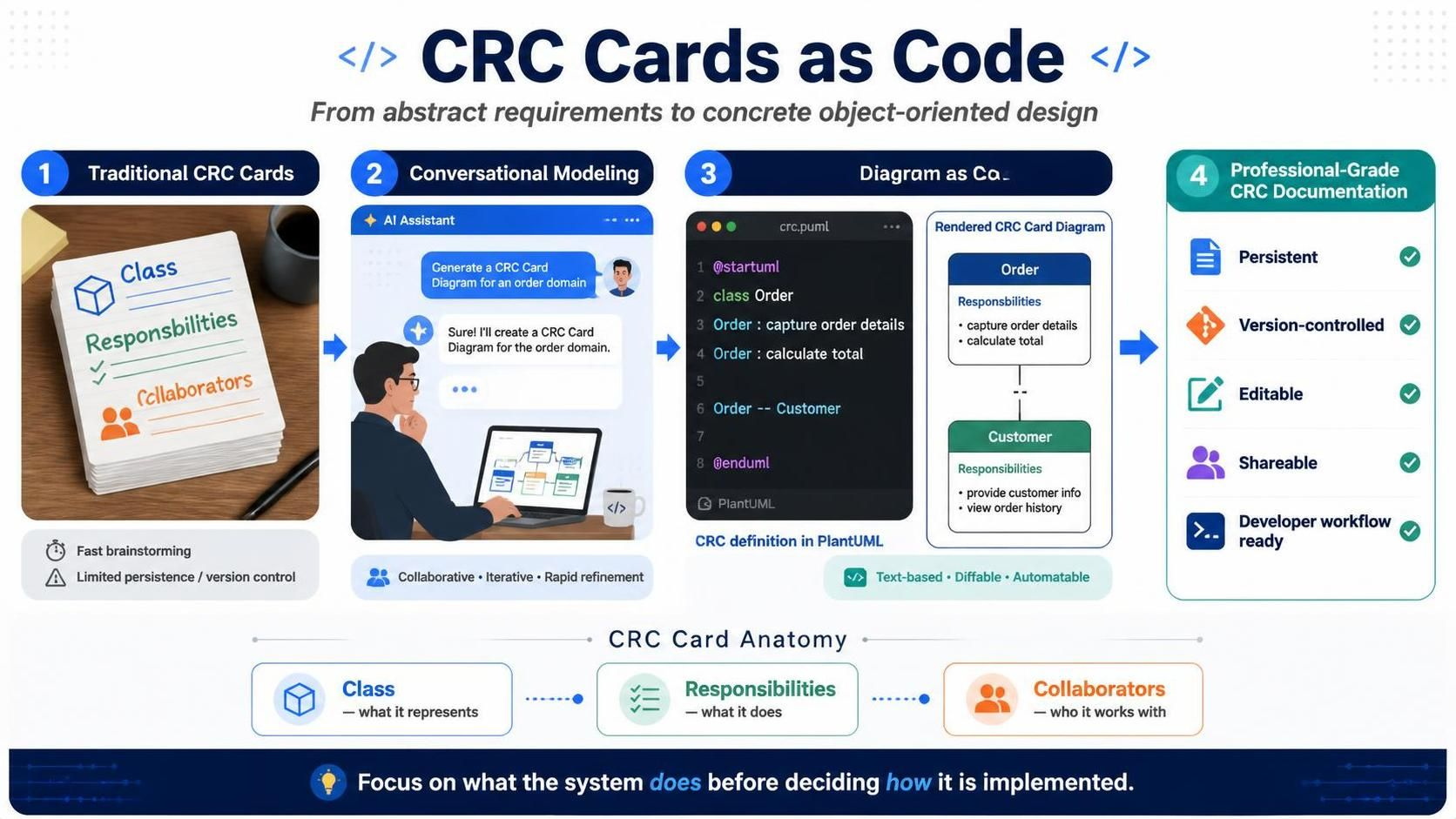
The solution lies in treating diagrams as code. With the latest enhancements to the Visual Paradigm AI Diagramming Chatbot, architects can now generate professional-grade CRC Card Diagrams using a specialized PlantUML syntax extension. This approach bridges the gap between rapid brainstorming and rigorous documentation, enabling teams to define, refine, and share domain models through simple conversational prompts and editable code blocks. This guide explores how to leverage Visual Paradigm’s ecosystem to master CRC modeling as code.
Key Concepts: The Anatomy of a CRC Card
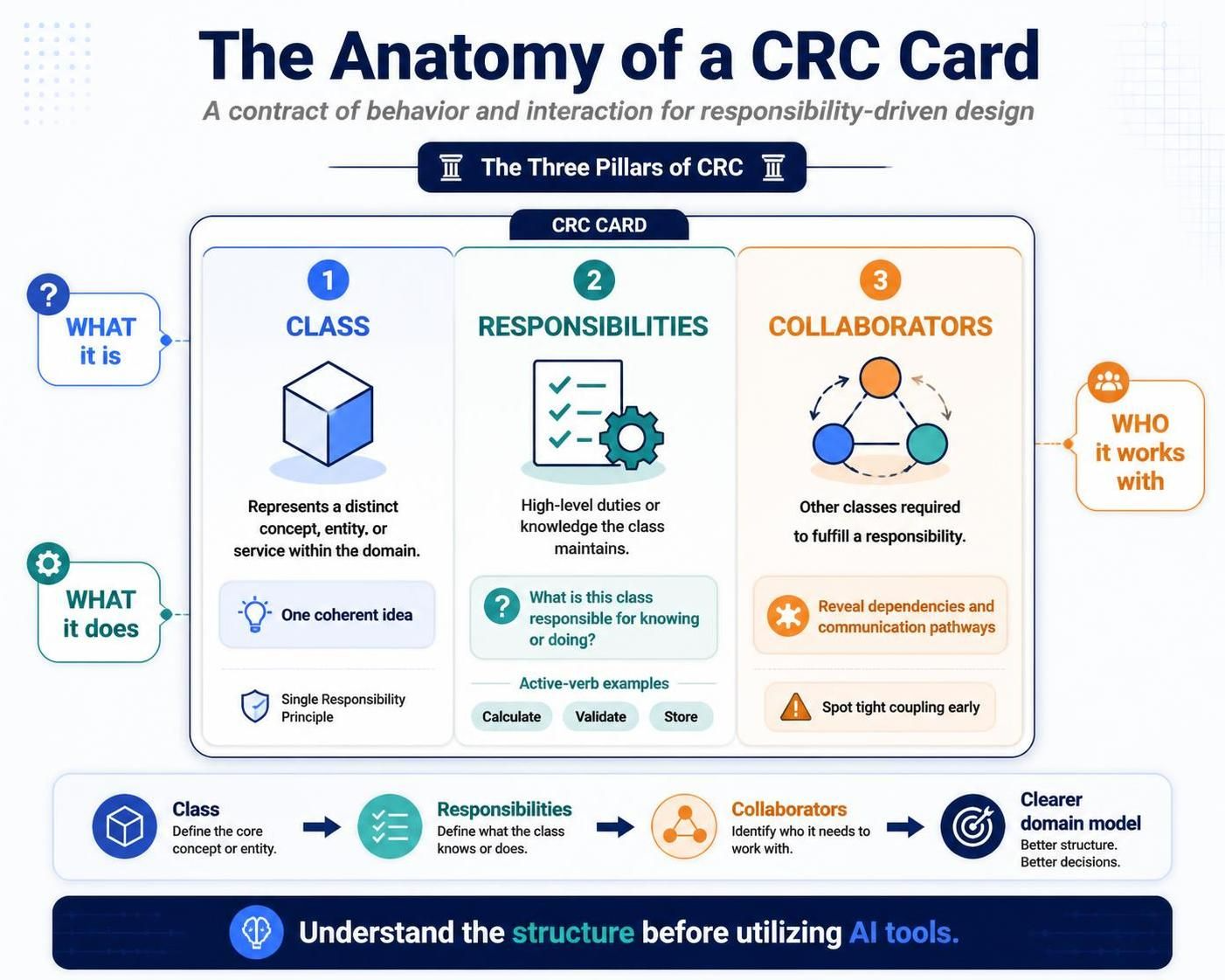
Before utilizing AI tools, it is vital to understand the structural elements that make CRC cards effective for responsibility-driven design. A CRC card is not just a list; it is a contract of behavior and interaction.
The Three Pillars of CRC
-
Class: Represents a distinct concept, entity, or service within the domain. In a robust design, each class should adhere to the Single Responsibility Principle, representing one coherent idea.
-
Responsibilities: These are the high-level duties or knowledge the class maintains. They answer the question: “What is this class responsible for knowing or doing?” Responsibilities should be expressed in active verbs (e.g., “Calculate,” “Validate,” “Store”).
-
Collaborators: These are the other classes required to fulfill a responsibility. Identifying collaborators early reveals the dependency graph and communication pathways of the system, helping to identify tight coupling before code is written.
Why “Diagrams as Code” Matters
Moving CRC cards into a code-based format like PlantUML offers several advantages over physical or static digital drawings:
-
Version Control: Changes to responsibilities or collaborators can be tracked via Git, providing an audit trail of architectural decisions.
-
Refactorability: Splitting a complex class or reassigning duties is as simple as editing text, rather than redrawing boxes and arrows.
-
Automation: Code-based diagrams can be automatically embedded into documentation pipelines, ensuring that architectural models never drift from the project’s technical records.
How the AI CRC Card Tool Works
Visual Paradigm’s AI Diagramming Chatbot utilizes natural language processing to interpret domain descriptions and output structured PlantUML code. This allows users to iterate on designs conversationally, refining the model until it accurately reflects the system requirements.
Step-by-Step Workflow
-
Define Your Domain: Provide a clear, concise prompt describing the system or module you wish to model.
-
Generate the Diagram: The AI analyzes the request and proposes a set of classes, assigning initial responsibilities and identifying necessary collaborators.
-
Review and Refine: Inspect the generated PlantUML code. If a class appears overloaded, instruct the AI to split it or redistribute duties.
-
Export and Integrate: Save the code for version control, embed it in documentation, or export it as a visual asset for stakeholder reviews.
Example: Hospital Patient Tracking System
Consider a scenario where you need to model the core interactions of a hospital’s patient management workflow. By submitting the prompt:
“Generate a CRC Card Diagram for a hospital patient tracking system.”
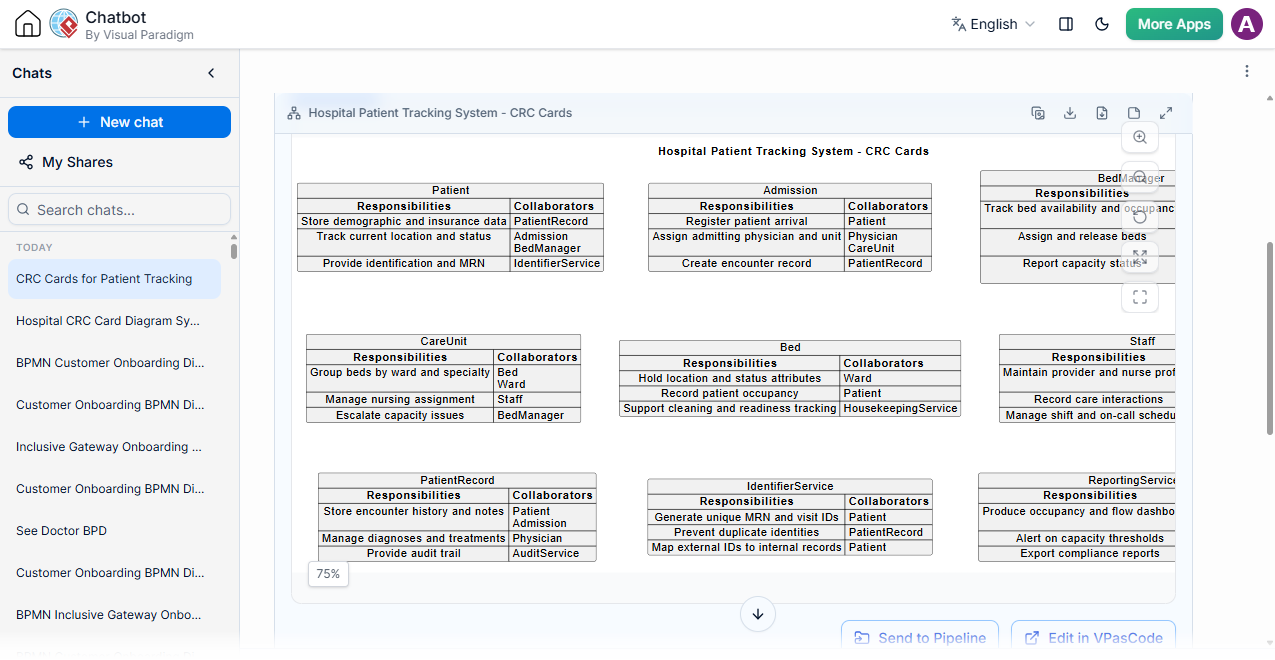
The chatbot produces a comprehensive model that maps out the interactions between patients, admissions, bed management, and staff. Below is the resulting visualization:
The Generated PlantUML Code
Note on Syntax: Standard PlantUML does not natively support CRC cards. Visual Paradigm has developed a specialized syntax extension (vpDiagramType CRCCardDiagram) that renders these cards as structured maps. This allows for seamless editing and visualization within the VPasCode ecosystem.
@startuml
skinparam {
  vpDiagramType CRCCardDiagram
}
title Hospital Patient Tracking System - CRC Cards

map "Patient" as Patient {
  <b>Responsibilities</b> => <b>Collaborators</b>
  Store demographic and insurance data => PatientRecord
  Track current location and status => Admission\nBedManager
  Provide identification and MRN => IdentifierService
}

map "Admission" as Admission {
  <b>Responsibilities</b> => <b>Collaborators</b>
  Register patient arrival => Patient
  Assign admitting physician and unit => Physician\nCareUnit
  Create encounter record => PatientRecord
}

map "BedManager" as BedManager {
  <b>Responsibilities</b> => <b>Collaborators</b>
  Track bed availability and occupancy => Bed\nWard
  Assign and release beds => Admission\nBed
  Report capacity status => Ward\nReportingService
}

map "CareUnit" as CareUnit {
  <b>Responsibilities</b> => <b>Collaborators</b>
  Group beds by ward and specialty => Bed\nWard
  Manage nursing assignment => Staff
  Escalate capacity issues => BedManager
}

map "Bed" as Bed {
  <b>Responsibilities</b> => <b>Collaborators</b>
  Hold location and status attributes => Ward
  Record patient occupancy => Patient
  Support cleaning and readiness tracking => HousekeepingService
}

map "Staff" as Staff {
  <b>Responsibilities</b> => <b>Collaborators</b>
  Maintain provider and nurse profiles => Role\nDepartment
  Record care interactions => PatientRecord
  Manage shift and on-call schedules => ShiftService
}

map "PatientRecord" as PatientRecord {
  <b>Responsibilities</b> => <b>Collaborators</b>
  Store encounter history and notes => Patient\nAdmission
  Manage diagnoses and treatments => Physician
  Provide audit trail => AuditService
}

map "IdentifierService" as IdentifierService {
  <b>Responsibilities</b> => <b>Collaborators</b>
  Generate unique MRN and visit IDs => Patient
  Prevent duplicate identities => PatientRecord
  Map external IDs to internal records => Patient
}

map "ReportingService" as ReportingService {
  <b>Responsibilities</b> => <b>Collaborators</b>
  Produce occupancy and flow dashboards => BedManager\nAdmission
  Alert on capacity thresholds => CareUnit
  Export compliance reports => AuditService
}

Patient -[hidden]right-> Admission
Admission -[hidden]right-> BedManager
Patient -[hidden]down-> CareUnit
Admission -[hidden]down-> Bed
BedManager -[hidden]down-> Staff
CareUnit -[hidden]right-> Bed
Bed -[hidden]right-> Staff
CareUnit -[hidden]down-> PatientRecord
Bed -[hidden]down-> IdentifierService
Staff -[hidden]down-> ReportingService
PatientRecord -[hidden]right-> IdentifierService
IdentifierService -[hidden]right-> ReportingService

@enduml
Explore the interactive CRC Card Diagram live chat session here.
Seamless Integration with the Visual Paradigm Ecosystem
Generating a diagram is only the beginning. The true power of Visual Paradigm’s AI CRC tool lies in its deep integration with the broader development and documentation ecosystem, ensuring that your architectural models remain living artifacts throughout the project lifecycle.
1. VPasCode Fine-Tuning
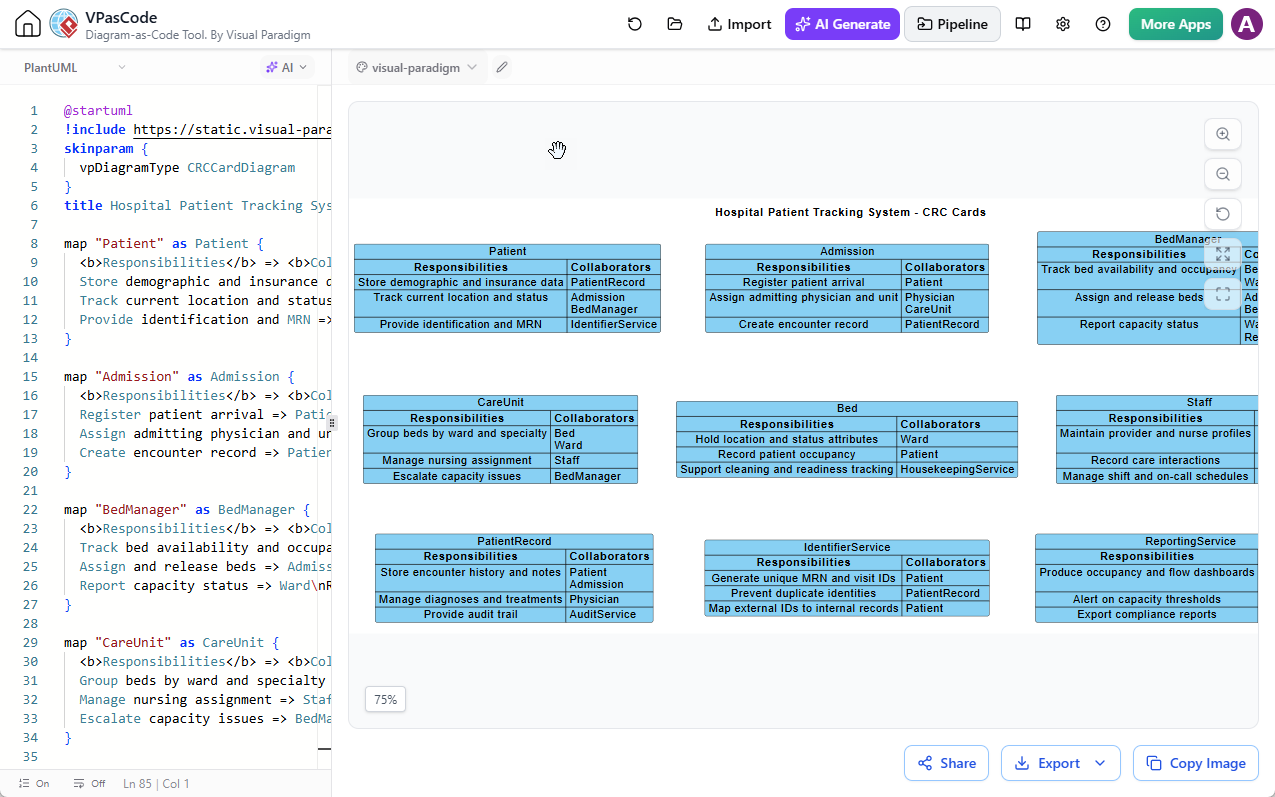
For developers who prefer a code-first approach, the generated PlantUML can be edited directly in Visual Paradigm VPasCode. This environment provides syntax highlighting and real-time preview, allowing for precise adjustments to class names, responsibilities, and collaborator relationships without leaving the code editor.
2. OpenDocs Integration
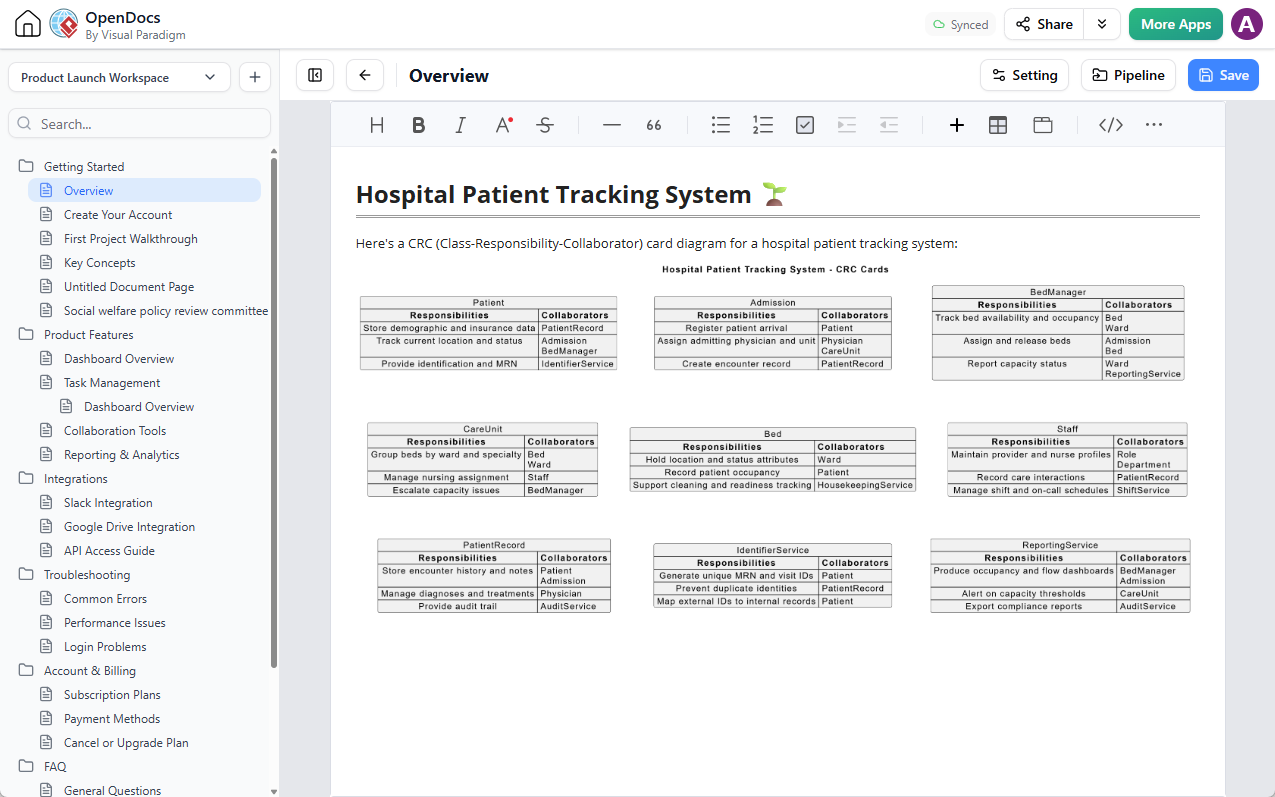
Maintaining up-to-date documentation is a common challenge. With Visual Paradigm OpenDocs, you can push your CRC diagrams directly into project documentation pipelines. This ensures that architectural models are always synchronized with technical specs, reducing the risk of outdated diagrams.
3. NotesKeep Knowledge Capture
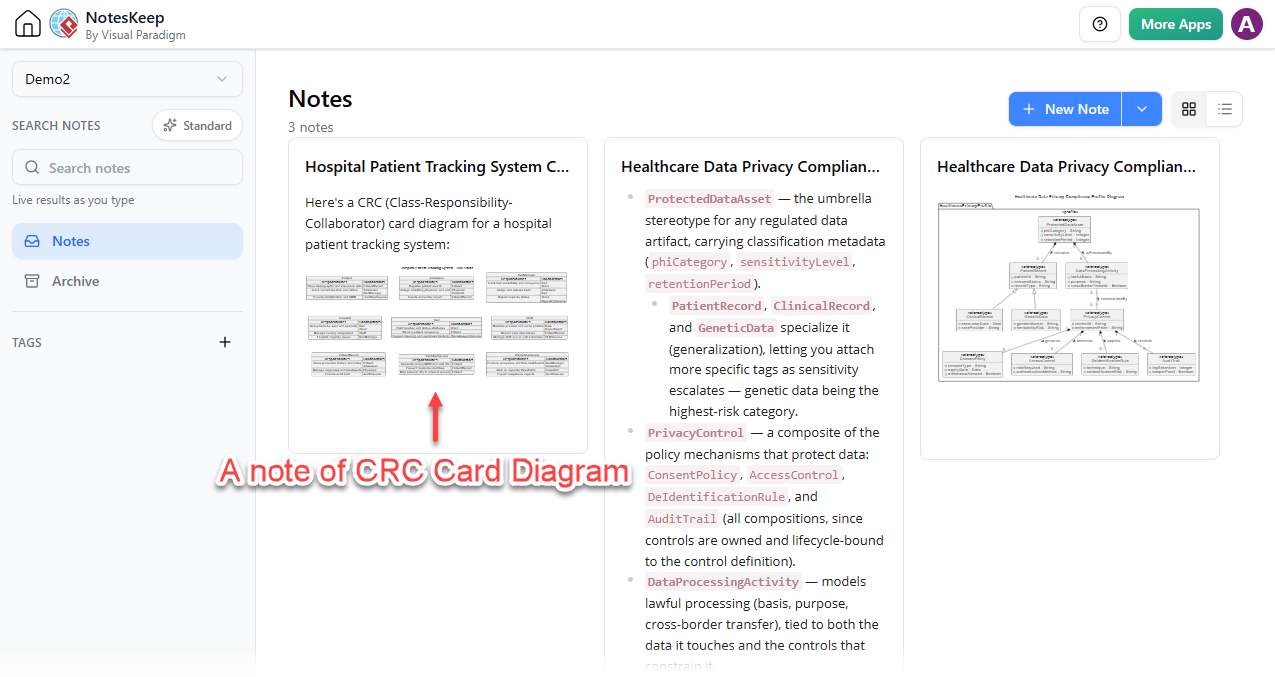
Architectural decisions often require context that isn’t captured in the diagram itself. Visual Paradigm NotesKeep allows teams to save key explanations, code blocks, or specific chat segments alongside their diagrams. This creates a ground truth for future reference, preserving the rationale behind design choices.
4. Multi-Format Export
For stakeholder presentations or design reviews, diagrams can be exported as high-resolution PNGs or SVG vector graphics. This ensures that your CRC models look professional and remain legible in any medium, from slide decks to printed reports.
Conclusion
The evolution of CRC cards from physical index cards to AI-generated, code-based diagrams represents a significant leap forward in object-oriented analysis. By leveraging Visual Paradigm’s PlantUML extension, teams can eliminate the friction of manual modeling while retaining the collaborative benefits of responsibility-driven design. Whether you are architecting a new microservice or documenting a legacy system, the ability to transform natural language prompts into structured, version-controlled domain models empowers developers to build more robust and maintainable software. As software complexity grows, tools that bridge the gap between human intent and machine-readable structure will become indispensable—and AI-driven CRC diagrams are leading the way.
Recommended Reading: Visual Paradigm Resources
- A Comprehensive Guide to the CRC Card Approach in Software Development: Detailed overview of CRC methodology, covering brainstorming techniques, role-playing scenarios, and practical tips for identifying classes and collaborators.
- Visual Paradigm CRC Cards: Digital Modeling Made Simple: Step-by-step tutorial for creating CRC cards in Visual Paradigm, including linking them to UML class diagrams and generating code skeletons.
- CRC Meets Agile: Lightweight Modeling for Iterative Design: Explores integration of CRC cards into agile sprints, with workflows for user story refinement and iterative design.
- A Comprehensive Guide to CRC (Class Responsibility Collaborator) Modeling: Official guide covering CRC card anatomy, team roles, and the complete six-step modeling process.
- AI CRC Card Diagram Generator | Visual Paradigm AI: Demonstrates using Visual Paradigm Desktop’s AI features to generate and refine CRC card structures from natural language prompts.
- Shared CRC Models in Visual Paradigm: Covers cloud-based CRC workshops for real-time collaboration, version control, and linking cards to use cases.
- Mastering CRC Card Diagrams: A Hands-On Guide to Object-Oriented Design with Visual Paradigm: Practical review of creating CRC diagrams in Visual Paradigm, with tips on inline editing and transitioning to UML.
- Class Responsibility Collaborator (CRC) Cards: An Agile Intro: Foundational introduction to CRC cards from Agile Modeling, covering the iterative process of conceptual modeling.
- CRC Card Tutorial: Learn Object-Oriented Design Basics: Beginner-friendly tutorial with hands-on exercises for modeling a banking system, covering responsibility-driven design.
- Integrating CRC Design into Agile Sprints: Case-study approach showing how to run CRC design sprints during backlog refinement, with examples for retail and fintech domains.
Related posts:
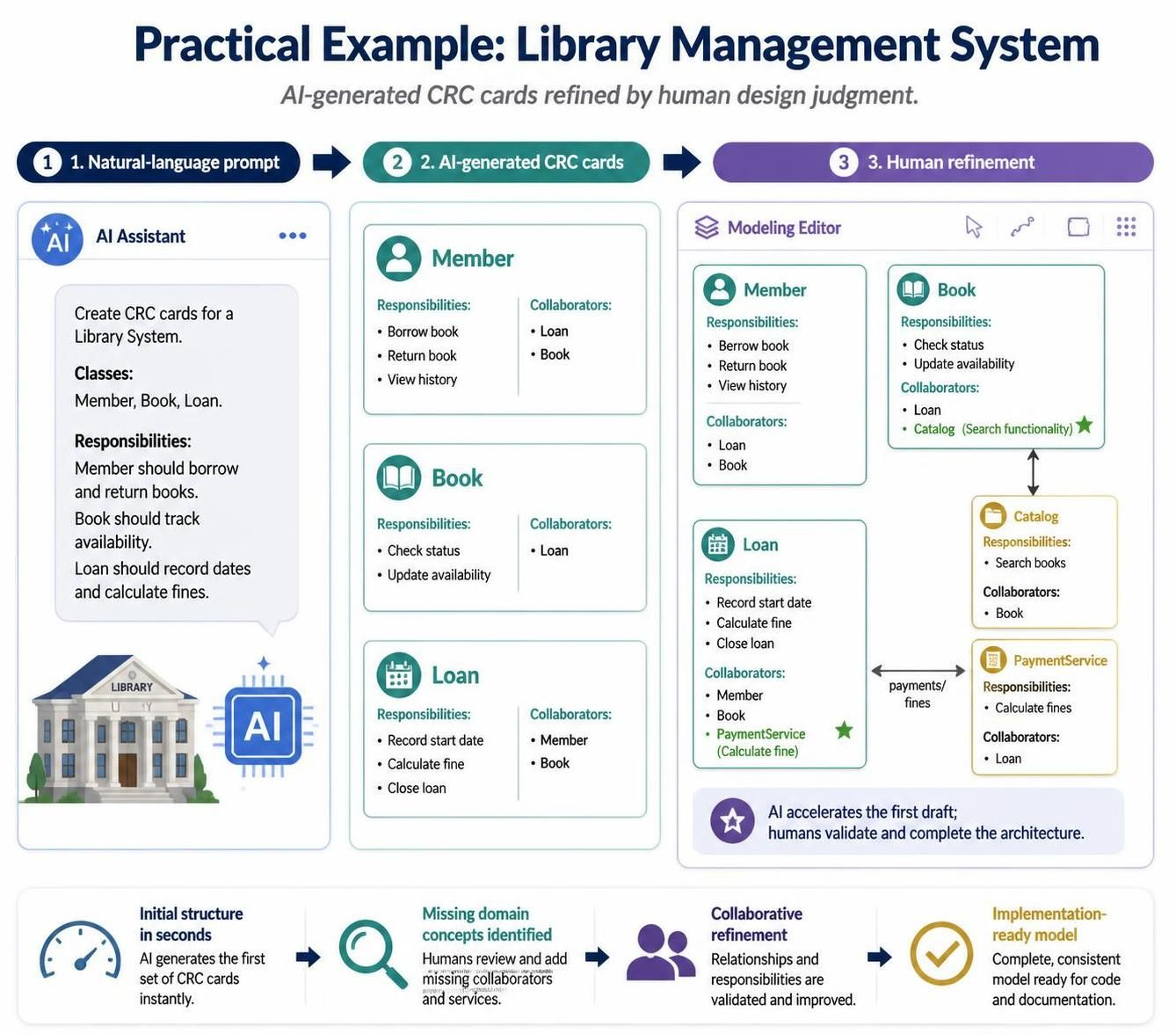 The Ultimate Guide to AI-Powered CRC Card Modeling
 From Concept to Code: Mastering CRC Card Diagrams with Visual Paradigm’s AI
Comprehensive Guide to Use Case Modeling with Visual Paradigm’s AI Ecosystem
From Concept to Code: Mastering CRC Card Diagrams with Visual Paradigm’s AI
Comprehensive Guide to Use Case Modeling with Visual Paradigm’s AI Ecosystem
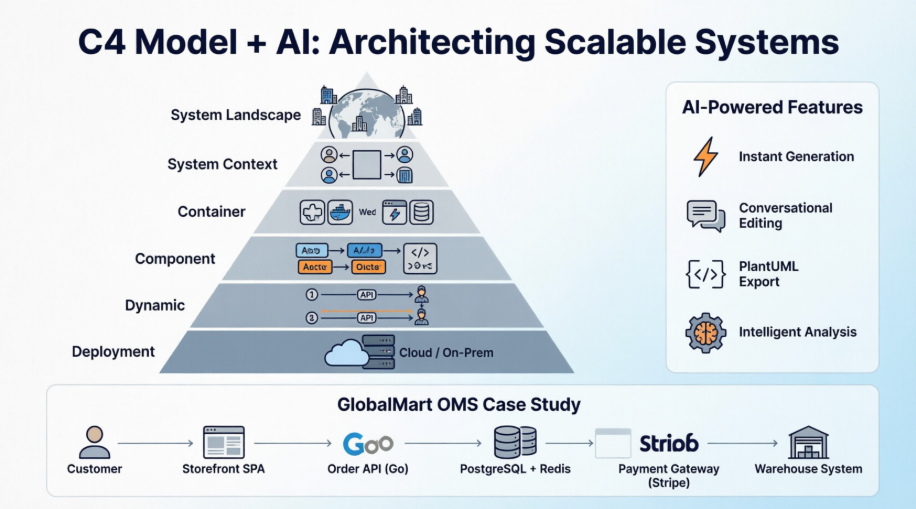 A Practical Guide to C4 Modeling with AI-Powered Visual Paradigm Tools: Architecting Scalable E-Commerce Systems

 English
 Arabic
 Chinese (Simplified)
 Dutch
Dutch French
 German
 Italian
 Japanese
 Korean
 Portuguese
 Russian
 Spanish